


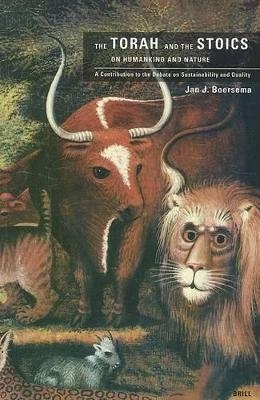
The Torah and the Stoics on humankind and nature
A Contribution to the Debate on Sustainability and Quality
Seiten
2001
Brill (Verlag)
9789004118867 (ISBN)
Brill (Verlag)
9789004118867 (ISBN)
In this work, the author re-examines the relevance of seminal texts, arguing that what we today know as "Christian cosmology" is in fact a grafting of classical Greek philosophy onto ancient Israelite thought, with certain valuable traditions being all but lost in the process.
The environmental problematique is intimately bound up with deep-seated human attitudes regarding our relationship with nature. Here in the west those attitudes have been shaped to no small degree by the canonical texts of the Bible and the classical philosophers. In this book the author re-examines some of these seminal texts, arguing that what we today know as 'Christian cosmology' is in fact a grafting of classical Greek philosophy onto ancient Israelite thought, with certain valuable traditions being all but lost in the process. The dietary laws of Leviticus and Deuteronomy, in particular, still prove surprisingly relevant today. Often misread on this point, the creation narratives of Genesis can likewise serve as a rich point of departure for examining our attitudes towards the natural world. A reappraisal of these sources is necessary and feasible. There is no need for an appeal to cosmologies alien to our own culture, nor for recourse to 'New Age' beliefs in all their variety.
The environmental problematique is intimately bound up with deep-seated human attitudes regarding our relationship with nature. Here in the west those attitudes have been shaped to no small degree by the canonical texts of the Bible and the classical philosophers. In this book the author re-examines some of these seminal texts, arguing that what we today know as 'Christian cosmology' is in fact a grafting of classical Greek philosophy onto ancient Israelite thought, with certain valuable traditions being all but lost in the process. The dietary laws of Leviticus and Deuteronomy, in particular, still prove surprisingly relevant today. Often misread on this point, the creation narratives of Genesis can likewise serve as a rich point of departure for examining our attitudes towards the natural world. A reappraisal of these sources is necessary and feasible. There is no need for an appeal to cosmologies alien to our own culture, nor for recourse to 'New Age' beliefs in all their variety.
Jan J. Boersema, Ph.D. in Theology at Groningen University, is Reader in environmental science and educated as a biologist. His publications cover a wide range of subjects focussing in recent years on the relation between sustainability and religion. He edited two environmental textbooks and is editor in chief of Milieu, a Dutch scientific journal.
| Erscheint lt. Verlag | 12.10.2001 |
|---|---|
| Verlagsort | Leiden |
| Sprache | englisch |
| Maße | 155 x 235 mm |
| Gewicht | 578 g |
| Themenwelt | Geisteswissenschaften ► Philosophie ► Philosophie Altertum / Antike |
| Religion / Theologie ► Christentum ► Kirchengeschichte | |
| Geisteswissenschaften ► Religion / Theologie ► Judentum | |
| ISBN-13 | 9789004118867 / 9789004118867 |
| Zustand | Neuware |
| Informationen gemäß Produktsicherheitsverordnung (GPSR) | |
| Haben Sie eine Frage zum Produkt? |
Mehr entdecken
aus dem Bereich

aus dem Bereich
eine andere Geschichte der Papststadt
Buch | Softcover (2024)
C.H.Beck (Verlag)
CHF 25,20
die Macht des Dunklen in unserer Zeit und wie wir ihr entgegentreten
Buch | Hardcover (2025)
Verlag Herder
CHF 27,90


