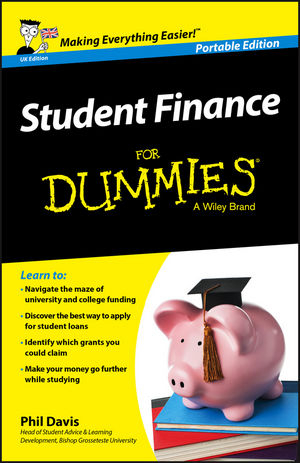
Student Finance For Dummies, UK Edition (eBook)
John Wiley & Sons (Verlag)
978-1-119-07586-8 (ISBN)
Navigating the intricacies of financing a UK education can make even the most composed parents and students lose their cool, Luckily, Student Financing For Dummies helps take some of the pain out of the struggle and offers everything you need-in one place-to put a money management plan in place and finance a university education, Packed with accessible guidance from authors throughout the UK who work with students and policy experts, it provides unique, sound and detailed financial advice to help students and their families manage money while at school,
Taking the guesswork out of the student-finance process and saving you countless hours of searching on the Internet, this friendly, plain-English guide helps you navigate applying for student finance, student loans and grants, makes sense of subject-specific income like the NHS, Teacher Training and Social Work and more, And after the money is in place, you'll discover how to establish a financial plan to make sure the money lasts-from term to term and through the entire time at uni,
- Covers student finance in England, Wales, Scotland and Northern Ireland
- Provides all the options for obtaining finance, loans and more
- Gives students and parents tips on which credit options to watch out for
- Offers expert advice on ongoing student finance support, managing income and expenditure and working during study
Take the worry out of financing your education and focus on your studies with the help of Student Finance For Dummies,
Phil Davis is Head of Student Advice & Learning Development at Bishop Grosseteste University and former Chairperson of the National Association of Student Money Advisers (NASMA), Has worked in Higher Education student services for 15 years,
Your guide to financing a university education Navigating the intricacies of financing a UK education can make even the most composed parents and students lose their cool. Luckily, Student Financing For Dummies helps take some of the pain out of the struggle and offers everything you need in one place to put a money management plan in place and finance a university education. Packed with accessible guidance from authors throughout the UK who work with students and policy experts, it provides unique, sound and detailed financial advice to help students and their families manage money while at school. Taking the guesswork out of the student-finance process and saving you countless hours of searching on the Internet, this friendly, plain-English guide helps you navigate applying for student finance, student loans and grants, makes sense of subject-specific income like the NHS, Teacher Training and Social Work and more. And after the money is in place, you'll discover how to establish a financial plan to make sure the money lasts from term to term and through the entire time at uni. Covers student finance in England, Wales, Scotland and Northern Ireland Provides all the options for obtaining finance, loans and more Gives students and parents tips on which credit options to watch out for Offers expert advice on ongoing student finance support, managing income and expenditure and working during study Take the worry out of financing your education and focus on your studies with the help of Student Finance For Dummies.
Phil Davis is Head of Student Advice & Learning Development at Bishop Grosseteste University and former Chairperson of the National Association of Student Money Advisers (NASMA). Has worked in Higher Education student services for 15 years.
Introduction 1
Part I: Wading into the Funding Pool 7
Chapter 1: Who Needs Student Finance? 9
Chapter 2: Putting the Pounds in Place: Planning 27
Part II: Applying for Government (Statutory) Funds 43
Chapter 3: Taking the First Steps 45
Chapter 4: Filling it in: The Application in Detail 73
Chapter 5: Exploring Student Loans 107
Chapter 6: Being Granted a Grant 125
Part III: Government Funds for Specific Students 141
Chapter 7: Turning to the NHS 143
Chapter 8: Teachers Needed, Funds Available! 157
Chapter 9: Finding Funds for Social Work 165
Chapter 10: Financing Studies After Your First Qualification 173
Part IV: Finding Financing from Other (Non-Statutory) Sources 187
Chapter 11: Finance From Universities 189
Chapter 12: Trying Out Educational Trusts and Charities 203
Chapter 13: Professional and Career Development Loans 215
Chapter 14: Students and the Welfare System 221
Part V: Managing Money and Maximising Income?@at University 243
Chapter 15: Getting to Know Your Money 245
Chapter 16: Making the Most of Your Money 261
Chapter 17: Maximising Your Income 283
Chapter 18: The Credit Chapter (You knew it was coming .?@.?@.) 295
Part VI: The Part of Tens 315
Chapter 19: Ten Do's and Don'ts when Applying for Student Finance 317
Chapter 20: Ten Tips to Make Your Money Last 327
Chapter 21: Ten Myths About Student Finance 337
Index 345
"The book answers both the myths you thought sounded pretty great, such as 'If you go abroad after graduation, you don't have to pay back the student loan', and the ones you were probably a bit worried about like a student loan making it harder to get a mortgage...I wouldn't be able to put all the details that bust those myths into better words than Davis, so you'll have to give the book a good read!" (Life and Times of a Student, February 2016)
Chapter 1
Who Needs Student Finance?
In This Chapter
Introducing student finance
Learning some useful jargon
Finding sources of student finance
‘Student finance’ is a term which covers a wide variety of funding schemes across the UK. Student finance differs across the four nations of the UK, and describes a number of different models of funding, including grants, loans, bursaries and scholarships. In addition to the various items of funding available, ‘student finance’ also covers the notion of financial capability – or how you can look after your money so that it can work for you (and not against your studies). This includes making strategies for budgeting and looking after the money that you have, as well as being careful to make informed choices about credit.
In this chapter, I provide an introduction to the various forms student finance can take, along with suggestions for the next chapters to read depending on your personal interest in finance.
Paying for Your Education and Making It Pay
Your higher education study is likely to give you a truly transformational experience, opening your horizons to opportunities for life-enriching experiences in terms of your academic, social and personal development. Higher education can also be an opportunity to develop your financial capability, and for many higher education students, time spent studying a degree is also time spent learning to manage personal finances for the very first time.
The time you begin to consider higher education study is also the ideal time for you to begin considering the practicalities of the financial side of studying, and to begin making preparations for it if at all possible.
You may not have had any previous contact with the world of student finance, particularly if you’re the first in your family to enter higher education, so finding out how you can manage your money is really important. You also need to understand how you can afford to pay for the experience of taking your education to the next level.
The UK government introduced the concept of students paying towards the cost of their tuition fees in 1998. Since then, government-subsidised loan schemes have been available to meet the cost of tuition fees. The loan scheme allows students to defer the cost of their education, not needing to repay until they have both finished their time in higher education and have entered into employment earning a sufficient level for the loan to be repaid.
These basic principles of the funding system remain in place today, and although some other aspects of the system have been ‘tweaked’, you can still enter your studies safe in the knowledge that you haven’t a thing to repay whilst you’re studying, and usually only need to make repayments once your personal taxable income has reached a required threshold.
Whilst tuition fee loans have been around since 2006 (prior to that tuition fee contribution grants had been in place since 1998), student loans for maintenance (living costs) were introduced back in 1990. Since then they have become an increasingly major part of the student finance package – and now you may even find a student loan is the sole source of student finance available to you (particularly if you’re ordinarily resident in England).
Being aware of the student finance available to you, understanding it and accessing it is only part of the story when it comes to making your finances work for you during your studies. You also need to develop your capability in terms of ensuring that you make the most of what money is available to you, avoiding unnecessary costs and realising as many economies as you can. Every little saving you can identify is the best means towards safeguarding your financial situation during your studies (read Chapters 15 and 16 for more tips on looking after your money once you have it). You should also seek to maximise the opportunities for securing funds to help make managing your situation far easier.
Building Your Funding Vocabulary
The UK student finance system has terminology you may not have encountered until you come to use it.
If you get a chance, start reading some online resources which describe the student finance system – particularly for courses that you’re interested in studying. The more you read, the sooner you become familiar with the various phrases and terms used. Check out the sidebar, ‘Speaking the lingo’, to get off to a flying start.
Speaking the lingo
Here’s a quick checklist of terms to get you started:
- Bursary: Usually this is an amount of money your course provider pays to you if you meet eligibility requirements. The amount you receive varies between course providers and often between types of course as well. You need to check your course provider’s access agreement (in England) or website for more details of what is available and how to apply. Some courses have statutory bursary schemes (which are usually non-repayable) available to them, such as NHS courses and courses for Initial Teacher Education.
- Grant: Grants may be available to you depending on your circumstances. They can assist with general living costs, costs associated with caring for a child (including childcare), costs associated with having someone else financially dependent upon you, and additional costs associated with study if you have a disability.
- Income-assessed: Several items of student finance depend upon your household income situation – generally speaking, you’re likely to be eligible to receive more student finance if your household income is lower. The lower income threshold for maximum financial support varies among the UK nations. An alternative phrase is ‘means-tested’, which is applied to NHS funding and sometimes to welfare benefits.
- Maintenance Loan: An amount available to you during your study in order to help your general costs whilst you study, such as course materials, accommodation, household and other living costs. You may be required to repay the loan in part or in full once you have finished your time in education and once you’re earning at a sufficient level from employment.
- Non income-assessed: This phrase is usually associated with tuition fee support and grants for students with a disability – both of which require basic criteria to be met in order for the financial support to be paid to you. The phrase also refers to the basic package of support available to students whose household income is too high to be considered for additional income-assessed financial support. ‘Non means-tested’ is an alternative phrase which is applied to NHS funding, and sometimes to welfare benefits.
- Scholarship: A scholarship may be very similar to a bursary – usually because it’s available from your course provider, but it’s more likely to have some more complex eligibility criteria, perhaps based on your academic achievements to date or your subject of study. Scholarships are usually non-repayable.
- Student Finance England (SFE): The agency responsible for processing student finance applications if you’re ordinarily resident in England.
- Student Finance Northern Ireland (SFNI): This actually is the name only of the website representing the Education Library Boards, which still process student finance applications at local level in Northern Ireland.
- Student Awards Agency for Scotland (SAAS): The agency responsible for processing student finance applications if you’re ordinarily resident in Scotland.
- Student Finance Wales (SFW): The agency responsible for processing student finance applications if you’re ordinarily resident in Wales.
- Student loan: This usually refers to a loan available from the UK government, paid to you by the Student Loans Company. There are four agencies which assess entitlement to loans in each of the four UK nations.
Loans versus grants
You probably require at least one student loan of some kind (maintenance and/or tuition fee) during your studies. You can usually expect to have to repay at least some of any loan you take out at some point during your career, but if you’re eligible to receive a grant, you must take every step to ensure you get it paid to you, as grants don’t have to be repaid and are effectively ‘free money’.
You can view a grant as being your ‘entitlement’ and as long as you meet the criteria for a grant to be payable, you should ensure that you apply for and obtain the money available to you.
In Scotland, you may only have access to a Maintenance Loan if you’re a Scottish student studying in Scotland, as the Scottish government covers the cost of your tuition fees – but you can get a Tuition Fee Loan if you choose to study elsewhere in the UK.
Whilst student loans are very much defined as being either for tuition fees or general living costs, grants can be available for wider, more specific purposes, for example:
- Students who are parents (Parent’s Learning Allowance; Lone Parent’s Grant; Childcare Grant)
- Disabled students (Disabled Students’ Allowances)
- Students studying abroad or on NHS dental/medical courses (Travel Grant)
If you’d like to find out more about specific...
| Erscheint lt. Verlag | 21.12.2015 |
|---|---|
| Sprache | englisch |
| Themenwelt | Geisteswissenschaften |
| Sozialwissenschaften ► Pädagogik ► Erwachsenenbildung | |
| Schlagworte | applying for grants • applying for student finance • applying for student loans • Bildungswesen • Education • Education Special Topics • finance a university education • financial advice to help students • financial advice to help students and their families • financing a UK education • financing your education • Grants • how to establish a financial plan • NHS • obtaining finance • obtaining loans • ongoing student finance • ongoing student finance support • phil davis • Social Work • Spezialthemen Bildungswesen • Student Finance • Student Finance For Dummies • Student Finance For Dummies UK Edition • student finance in England • student finance in Northern Ireland • student finance in Scotland • student finance in Wales • student-finance process • Student Loans • teacher training • UK Education • working during study |
| ISBN-10 | 1-119-07586-6 / 1119075866 |
| ISBN-13 | 978-1-119-07586-8 / 9781119075868 |
| Informationen gemäß Produktsicherheitsverordnung (GPSR) | |
| Haben Sie eine Frage zum Produkt? |
 EPUB (Adobe DRM)
Kopierschutz: Adobe-DRM
Adobe-DRM ist ein Kopierschutz, der das eBook vor Mißbrauch schützen soll. Dabei wird das eBook bereits beim Download auf Ihre persönliche Adobe-ID autorisiert. Lesen können Sie das eBook dann nur auf den Geräten, welche ebenfalls auf Ihre Adobe-ID registriert sind.
Details zum Adobe-DRM
Dateiformat: EPUB (Electronic Publication)
EPUB ist ein offener Standard für eBooks und eignet sich besonders zur Darstellung von Belletristik und Sachbüchern. Der Fließtext wird dynamisch an die Display- und Schriftgröße angepasst. Auch für mobile Lesegeräte ist EPUB daher gut geeignet.
Systemvoraussetzungen:
PC/Mac: Mit einem PC oder Mac können Sie dieses eBook lesen. Sie benötigen eine
eReader: Dieses eBook kann mit (fast) allen eBook-Readern gelesen werden. Mit dem amazon-Kindle ist es aber nicht kompatibel.
Smartphone/Tablet: Egal ob Apple oder Android, dieses eBook können Sie lesen. Sie benötigen eine
Geräteliste und zusätzliche Hinweise
Buying eBooks from abroad
For tax law reasons we can sell eBooks just within Germany and Switzerland. Regrettably we cannot fulfill eBook-orders from other countries.
aus dem Bereich