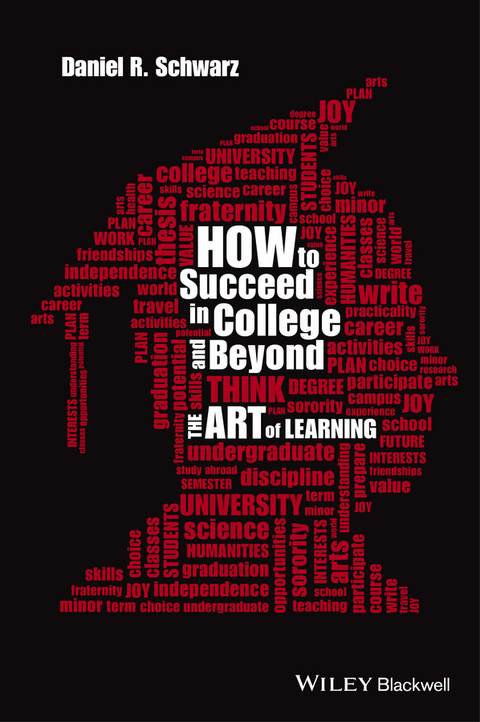
How to Succeed in College and Beyond (eBook)
John Wiley & Sons (Verlag)
978-1-118-97482-7 (ISBN)
How to Succeed in College and Beyond is an insightful, inspired guide to the undergraduate experience that helps students balance the joy of learning with the necessity of career preparation.
- Features a wealth of advice for getting the most from an undergraduate education, especially inthe areas of arts and humanities, written by an experienced educator and mentor
- Covers the entire undergraduate experience, from high school preparation, applications,financial aid, each undergraduate year from freshman to senior, junior year abroad course selection, and extra-curricular activities, to independent study, honors essays, graduate school, dissertations, and career searches
- Discusses the benefits of pursuing an arts and humanities degree including how to write effectively, speak articulately, and think critically and discusses how to balance the joy and practicality of education in terms of getting vocationally-focused qualifications.
- Packed with information that is as helpful to students as it is to their parents, teachers, and advisors, this guide is a indispensible resource for prospective and present undergraduates
Daniel R. Schwarz is Frederic J. Whiton Professor of English Literature and Stephen H. Weiss Presidential Fellow at Cornell University. He is a highly-regarded, author, a master teacher, an influential literary critic, and a regular contributor to the Huffington Post on Higher Education. His recent books include Reading the European Novel to 1900 (2014), Crises and Turmoil at the New York Times, 1999-2009 (2012, 2014), and In Defense of Reading: Teaching Literature in the Twenty-First Century (2008), both published by Wiley Blackwell.
How to Succeed in College and Beyond is an insightful, inspired guide to the undergraduate experience that helps students balance the joy of learning with the necessity of career preparation. Features a wealth of advice for getting the most from an undergraduate education, especially inthe areas of arts and humanities, written by an experienced educator and mentor Covers the entire undergraduate experience, from high school preparation, applications,financial aid, each undergraduate year from freshman to senior, junior year abroad course selection, and extra-curricular activities, to independent study, honors essays, graduate school, dissertations, and career searches Discusses the benefits of pursuing an arts and humanities degree including how to write effectively, speak articulately, and think critically and discusses how to balance the joy and practicality of education in terms of getting vocationally-focused qualifications. Packed with information that is as helpful to students as it is to their parents, teachers, and advisors, this guide is a indispensible resource for prospective and present undergraduates
Daniel R. Schwarz is Frederic J. Whiton Professor of English Literature and Stephen H. Weiss Presidential Fellow at Cornell University. He is a highly-regarded, author, a master teacher, an influential literary critic, and a regular contributor to the Huffington Post on Higher Education. His recent books include Reading the European Novel to 1900 (2014), Crises and Turmoil at the New York Times, 1999-2009 (2012, 2014), and In Defense of Reading: Teaching Literature in the Twenty-First Century (2008), both published by Wiley Blackwell.
Acknowledgments ix
1 Introduction: How to Succeed in College and Beyond: The Art of Learning 1
Part I Beginnings 13
2 How to Prepare for College 15
3 The College Olympics: How to Choose the Right College and How to Get the Right College to Choose You 24
Part II The College Experience 39
4 Twenty Suggestions for Incoming College Freshmen 41
5 Nineteen Suggestions for College Sophomores 52
6 Suggestions for College Juniors: Balancing the Joy and Practicality of Learning 57
7 Making the Most of Your Senior Year in College 66
8 Planning for the Future: Suggestions for Seniors Graduating from College 72
Part III Further Essentials 79
9 Seventeen Suggestions for How to Choose Classes in College 81
10 The Greek System: Should You Join a Fraternity or Sorority? 87
11 More Thoughts on the College Experience: Brief Observations and Suggestions 98
12 Growing Young Adults: What Parents Need to Know About Their Children in College 105
Part IV The Value of the Humanities 109
13 Why Study the Humanities? 111
14 Do the Humanities Help Us Understand the World in Which We Live? 117
15 What to Do with a Bachelor of Arts in English 124
16 Does It Make Sense to Pursue a Humanities Doctorate? The Pros and Cons of Graduate Education in the Humanities 131
Part V Perspectives of a Professor 141
17 Are Teaching and Research Mutually Exclusive? 143
18 The Classroom as Opportunity: Teaching Students How to Enjoy and Understand Literature, Read Closely, Write Lucidly, and Think Independently 148
19 Changing the World One Step at a Time: Comparing Contemporary Students with Those of the Explosive 1968-1970 Period 162
Works Cited and Select Bibliography 174
Index 181
"This should become required reading for current and prospective college students (and their parents) who want the inside scoop from a legendary professor on why college remains a wise investment, and a doorway to a fuller life. It offers practical, step-by-step advice on issues from finding a mentor, to student debt and rising tuition costs. Schwarz bolsters his wise commentary with testimonials from current and former students, as well
as other professors and administrators." Daniel Morris, Purdue University
"A feast of common sense at a time when common sense is not so common. The friendly conversational style of Schwarz's book will make it a valued companion as students and their parents navigate what looks from the outside like a mysterious terrain. He brings it down to earth." Stanley Fish, Florida International University
"There are many books on the college admissions process, but this invaluable book surpasses all of them, addressing not only the admissions process but also the entire college experience. Chapter by chapter, Professor Dan Schwarz takes the reader--whether a high school senior or a college undergraduate--from freshman through senior year as well as advising on how to prepare for graduate schools and post-college employment. He also offers parents wisdom on how to deal with their children's college experience. Informed by painstaking research and drawn from decades of personal experience teaching and advising college students, Schwarz, a much-honored and beloved Cornell University professor, understands the obstacles and opportunities young adults face and what they need in order to grow and flourish, not just in their college and professional careers, but in their lives." Lisa Esposito Kok, Independent College Consultant
1
Introduction: How to Succeed in College and Beyond: The Art of Learning
Purpose: Preparing Students for College
The purpose of this book is to help prepare students, parents, and high school advisors for the college experience and beyond. My goal is to help students balance the joy of learning with the practicality of finding a career path. This book is for all those contemplating a college education and for their families, as well as for those already admitted to college.
Important questions are being asked today about American higher education. Not only are the value of a college education and the economics of colleges and universities under scrutiny, but so too is the concept of the American dream whereby people use their ability and education to fulfill their potentials and move up the socio-economic ladder. On the one hand, colleges and universities do have more diverse student bodies than in the past. But on the other, evidence of severe economic inequality and social injustice dominates the news. Inequality and injustice are causes and effects of a crisis in America that extends to the role of higher education. I address those issues in the context of offering ideas for applying to and succeeding in college, including how to apply for financial aid and how to limit burdensome loans that hamper the future.
I suggest initiatives that might help middle- and working-class parents and their children who cannot afford to send their children to expensive private schools or to live in affluent communities with elite public schools. In these affluent communities, preparation for college dominates virtually every educational policy decision made by school administrators and Boards of Education. In such school districts, parents are in the foreground encouraging their children, playing roles in shaping school policy, and contributing to foundations that supplement the tax base for the purposes of supporting extra-curricular activities, including athletics. These parents also pay for their children’s private tutors and sports coaches. By contrast, in many rural and urban schools, graduation rates are low, school budgets are pinched, teachers are overworked and deal with serious discipline issues on a daily basis, guidance counselors are asked to serve far too many students, and parents struggling to make a living do not have time or funds to be advocates for their children.
In early fall 2014, in an op-ed piece for the US News as he began his ninth and last year as the President of Cornell, David Skorton asked vital questions:
For the first time in my 36 years in academia, the value of America’s colleges and universities is being questioned – and seriously. Is what we offer worth the money and time invested? Will a college degree really translate into a better job down the road or improve our quality of life? Couldn’t we rely more on technology and less on highly paid faculty members and expensive campuses and student amenities to deliver our “product” at lower cost?
In part, this book is a response to issues raised by these questions.
While my primary focus is on the US system of higher education, my suggestions are transferable to the educational systems of other countries. Young adults seeking higher education everywhere face similar challenges and pressures, although the US is unique in the financial issues students face. While career opportunities vary from country to country, balancing the joy of learning with the necessity and reality of career preparation is a pervasive issue.
I draw upon my 47 years as a Professor of English, but also the experience of colleagues and students at other universities in the US and other countries. My appointment has been at Cornell, but I have held visiting professorships at the main campus of the University of Hawaii, the University of Alabama at Huntsville (which is one of the Alabama state system’s four research universities along with Tuscaloosa, Auburn, and Birmingham), and at the University of Arkansas (Little Rock). As Director of five NEH (National Endowment for the Humanities) Summer Seminars for College Teachers, I have also worked with faculty from a wide variety of colleges. I have also directed four NEH Summer Programs for school teachers in which virtually all my participants were secondary school English teachers working with Advanced Placement classes and were knowledgeable about college preparation.
I have consulted hundreds of students and scores of colleagues for input on this book. This book is about the college experience and how to make the most of it, including not only the available resources for financial aid, but also ways for students to prepare for their economic futures.
Much has been written of late about the shortcomings of American colleges and universities, with a focus on the relatively little time students spend on their academic study, the excessive partying that turns campuses into permissive social circuses and sites of sexual abuse, and the burgeoning costs accompanied by excessive student loans. I will take up these legitimate concerns in the pages that follow. Although prior research about the economics of the university is not my primary focus, I will on occasion address how and why research universities balance their priorities in light of limited resources. While both acknowledging the shortcomings of American colleges and universities and praising their strengths, I will propose ways for students to get the most out of their higher education.
This finding fault with American higher education includes not only William Deresiewicz’s Excellent Sheep: The Miseducation of the American Elite and the Way to a Meaningful Life and the CNN documentary Ivory Tower but also Kevin Carey’s The End of College: Creating the Future of Learning and the University of Everywhere, and, to a lesser extent, Frank Bruni’s Where You Go Is Not Who You’ll Be: An Antidote to the College Admissions Mania.
Yes, I do believe that the most highly endowed universities and colleges could do better at controlling their rising tuition by drawing more on their endowments – that is, by increasing the payout rate of their endowments. Colleges and universities could also ask their most generous donors to contribute more to their year-to-year expenses rather than to endowments. In the case of the wealthiest schools like Harvard, Yale, Princeton, and Stanford, their endowments are so large that a case could be made for their not charging tuition to any students.
Owing to the rising prices of stocks and bonds, and taking into consideration major fluctuations in those assets, the ratio of payouts to total endowments has shrunk in the past two decades (see Ehrenberg, Tuition Rising, 35–49). At Cornell, a mere half percent increase in the payout would result in approximately $31 million, based on a $6.2 billion endowment. Indeed, to meet the competitive need to raise financial aid to at least approach its much wealthier peers, the payout was raised from 2010–11 to 2014–15, but there is no way that Cornell can keep up with the much larger endowments of Harvard, Yale, Princeton, and Stanford.
A significant issue is how to open the doors of higher education, including those of the most prestigious schools, to those in the lower economic and social strata. In a report by Barry Bergman for the Berkeley News, Goldie Blumenstyk, author of American Higher Education in Crisis? What Everyone Needs to Know, asserts:
[Y]ou’ll still find lower-income students and minority students far more concentrated in community colleges and for-profit colleges, and upper-income students and white students more concentrated at four-year private colleges and publics. …
[A]n adult from a wealthy family is nine times as likely to earn a bachelor’s degree by the age of 24 as one from a poor family – with all the implications for social and financial success that entails.
A narrative of higher education in America should highlight the role of public education, including that of the great state universities like California and Michigan and the role that CUNY (City University of New York) played and still plays for first-generation Americans. When admission was exceedingly competitive, CCNY (City College of New York) produced a significant number of Nobel Prize winners, and one could argue that the University of California at Berkeley has been the pre-eminent university of the country if not the world. Unfortunately, the days of free and almost free tuition have passed. Nonetheless, the public universities still offer a lower-cost alternative to elite schools, particularly for residents of the state or city in which they are located.
The Economic Value of Higher Education
While I will be realistic about problems, I will be telling another, more optimistic story than many critics of American Higher Education. As Barry Glassner and Morton Schapiro wrote in the October 6, 2014 Chronicle of Higher Education:
The vast majority of students graduate with relatively modest loans – under $30,000, on average – and almost one-third leave college with no debt at all. Meanwhile the college premium – the ratio of earnings by college graduates to those by high-school graduates – is at or near a record level.
MIT economist David Autor writes: “The economic payoff to college education rose...
| Erscheint lt. Verlag | 21.12.2015 |
|---|---|
| Sprache | englisch |
| Themenwelt | Kinder- / Jugendbuch ► Sachbücher |
| Geisteswissenschaften | |
| Sozialwissenschaften ► Pädagogik ► Bildungstheorie | |
| Sozialwissenschaften ► Pädagogik ► Erwachsenenbildung | |
| Schlagworte | arts and humanities college degree • Bildungswesen • Career Preparation • choosing a college major • College • college application preparation • college career advice • college career track • college interviews • college prep • college preparation • college prep for high school students • Education • financial aid • Hochschulen / Lehren u. Lernen • how to succeed with a humanities degree • Humanities education • Lernen • liberal arts college degrees • liberal arts college education • liberal arts in college • life after college • Literature • Literaturwissenschaft • majoring in English • majoring in liberal arts • obtaining a humanities degree • obtaining financial aid • studying humanities • Teaching & Learning (Higher Education) |
| ISBN-10 | 1-118-97482-4 / 1118974824 |
| ISBN-13 | 978-1-118-97482-7 / 9781118974827 |
| Informationen gemäß Produktsicherheitsverordnung (GPSR) | |
| Haben Sie eine Frage zum Produkt? |
 PDF (Adobe DRM)
Kopierschutz: Adobe-DRM
Adobe-DRM ist ein Kopierschutz, der das eBook vor Mißbrauch schützen soll. Dabei wird das eBook bereits beim Download auf Ihre persönliche Adobe-ID autorisiert. Lesen können Sie das eBook dann nur auf den Geräten, welche ebenfalls auf Ihre Adobe-ID registriert sind.
Details zum Adobe-DRM
Dateiformat: PDF (Portable Document Format)
Mit einem festen Seitenlayout eignet sich die PDF besonders für Fachbücher mit Spalten, Tabellen und Abbildungen. Eine PDF kann auf fast allen Geräten angezeigt werden, ist aber für kleine Displays (Smartphone, eReader) nur eingeschränkt geeignet.
Systemvoraussetzungen:
PC/Mac: Mit einem PC oder Mac können Sie dieses eBook lesen. Sie benötigen eine
eReader: Dieses eBook kann mit (fast) allen eBook-Readern gelesen werden. Mit dem amazon-Kindle ist es aber nicht kompatibel.
Smartphone/Tablet: Egal ob Apple oder Android, dieses eBook können Sie lesen. Sie benötigen eine
Geräteliste und zusätzliche Hinweise
Buying eBooks from abroad
For tax law reasons we can sell eBooks just within Germany and Switzerland. Regrettably we cannot fulfill eBook-orders from other countries.
aus dem Bereich