In Search of a Simple Introduction to Communication (eBook)
216 Seiten
Springer International Publishing (Verlag)
978-3-319-25625-2 (ISBN)
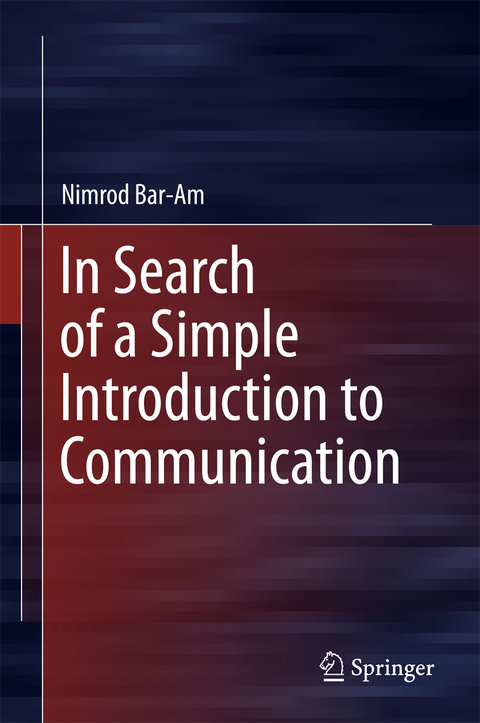
This book is a philosophical introduction to the field of communication and media studies. In search of the philosophical backgrounds of that relatively young field, the book explores why this overwhelmingly popular discipline is in crisis. The book discusses classic introductions on communication, provides an update on lessons learned, and re-evaluates the work of pioneers in the light of up-to-date philosophical standards. It summarizes various debates surrounding the foundations of system theory and especially its applicability to the Social Sciences in general and to Communication Studies in particular.
Communication schools promise their students an understanding of the source of a principal and dynamical power in their lives, a power shaping societies and identities, molding aspirations, and deciding their fates. They also promise students a practical benefit, a chance to learn the secret of controlling that dynamical power, improving a set of skills that would ensure them a critical edge in the future job market: become better media experts for all media. Yet no one seems to know how such promises are met. Can there be a general theory of communication? If not, what can (should) communication students learn? This book looks at the problem from a philosophical perspective and proposes a framework wherein critical cases can be tested.Nimrod Bar-Am is a philosopher of Science, Methodology and Communication. He is a Senior lecturer and head of the Rhetoric and Philosophy of Communication unit at the Communication Department of Sapir College, Israel.
He is the author of Extensionalism the Revolution in Logic (Springer 2008) and of various articles and peer-reviewed publications, most recent of which is 'Systems Heuristics and Digital Culture' with Raphael Sassower, in: Traditions of Systems Theory: Major Figures and Developments (Routledge 2013). His research focuses on Philosophy of Communication and on Scientific Methodology.
Nimrod Bar-Am is a philosopher of Science, Methodology and Communication. He is a Senior lecturer and head of the Rhetoric and Philosophy of Communication unit at the Communication Department of Sapir College, Israel. He is the author of Extensionalism the Revolution in Logic (Springer 2008) and of various articles and peer-reviewed publications, most recent of which is “Systems Heuristics and Digital Culture” with Raphael Sassower, in: Traditions of Systems Theory: Major Figures and Developments (Routledge 2013). His research focuses on Philosophy of Communication and on Scientific Methodology.
PART I: GETTING ACQUAINTED.- Chapter 1: Who am I? Where do I come from? Where am I going to?.- Chapter 2: Who are you? What are you here for? And can I help you achieve your goals?.- Chapter 3: Appendix from the classroom: towards a useful introduction to communication.- Chapter 4: ‘What is’ questions in general, and ‘What is communication?’ in particular.- PART II: TOWARDS A PHILOSOPHY OF COMMUNICATION.- Chapter 5: Emergence and reduction.- Chapter 6: The central problem of communication studies.- Chapter 7: Can there be a consistent reductive account of communication?.- Chapter 8: Descartes’ slip: a short appendix on the infinite theoretical complexity of simple objects.- Chapter 9: Meaning, context, and the limits of the reductive theory of meaning (extensionalism).- Chapter 10: Meaning and context again: on what students of communication can learn from Claude Shannon’s mathematical theory of communication.- Chapter 11: On the study of goals: Cybernetics vs. Reductionism.- PART III: HOW TO STUDY COMMUNICATION.- Chapter 12: The central problem of Communication again: why a complete theory of communication is impossible, and what can we do instead.- Chapter 13: Communication and Biology.- Chapter 14: Communication and Linguistics.- Chapter 15: Communication and the Social Sciences.- Chapter 16: Communication and Technology.- Chapter 17: Questions regarding our future.
| Erscheint lt. Verlag | 9.2.2016 |
|---|---|
| Zusatzinfo | X, 216 p. |
| Verlagsort | Cham |
| Sprache | englisch |
| Themenwelt | Geisteswissenschaften ► Philosophie ► Allgemeines / Lexika |
| Schlagworte | Cybernetics • Extensionalism and Intensionalism • General Systems Theory, Criticism of • Information and Content, Theories of • Philosophy of communication • Reductionism and Emergence • Second Level-Cybernetics • Social Cybernetics |
| ISBN-10 | 3-319-25625-4 / 3319256254 |
| ISBN-13 | 978-3-319-25625-2 / 9783319256252 |
| Informationen gemäß Produktsicherheitsverordnung (GPSR) | |
| Haben Sie eine Frage zum Produkt? |
 PDF (Wasserzeichen)
DRM: Digitales Wasserzeichen
Dieses eBook enthält ein digitales Wasserzeichen und ist damit für Sie personalisiert. Bei einer missbräuchlichen Weitergabe des eBooks an Dritte ist eine Rückverfolgung an die Quelle möglich.
Dateiformat: PDF (Portable Document Format)
Mit einem festen Seitenlayout eignet sich die PDF besonders für Fachbücher mit Spalten, Tabellen und Abbildungen. Eine PDF kann auf fast allen Geräten angezeigt werden, ist aber für kleine Displays (Smartphone, eReader) nur eingeschränkt geeignet.
Systemvoraussetzungen:
PC/Mac: Mit einem PC oder Mac können Sie dieses eBook lesen. Sie benötigen dafür einen PDF-Viewer - z.B. den Adobe Reader oder Adobe Digital Editions.
eReader: Dieses eBook kann mit (fast) allen eBook-Readern gelesen werden. Mit dem amazon-Kindle ist es aber nicht kompatibel.
Smartphone/Tablet: Egal ob Apple oder Android, dieses eBook können Sie lesen. Sie benötigen dafür einen PDF-Viewer - z.B. die kostenlose Adobe Digital Editions-App.
Buying eBooks from abroad
For tax law reasons we can sell eBooks just within Germany and Switzerland. Regrettably we cannot fulfill eBook-orders from other countries.
aus dem Bereich