


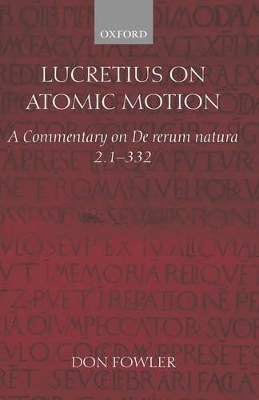
Lucretius on Atomic Motion
A Commentary on De rerum natura 2. 1-332
Seiten
2002
Oxford University Press (Verlag)
978-0-19-924358-7 (ISBN)
Oxford University Press (Verlag)
978-0-19-924358-7 (ISBN)
This is the first commentary on Lucretius' theory of atomic motion, one of the most difficult and technical parts of De rerum natura. The late Don Fowler sets new standards for Lucretian studies in his awesome command both of the ancient literary, philological, and philosophical background to this Latin Epicurean poem, and of the relevant modern scholarship.
Lucretius' theory of atomic motion is one of the most difficult and technical parts of De rerum natura, and, for that reason, has hitherto been neglected by commentators. This is the first commentary to take account of the remarkable discoveries and re-evaluations in the field of Hellenistic philosophy over the past fifty-five years, which have been stimulated by the publication of many more Epicurean fragments from Herculaneum. The philosophical aspects of the poem cannot, however, be separated from the literary features.. The late Don Fowler possessed rare and unrivalled expertise in both the workings of Latin poetry and the intricacies of Epicurean philosophy. His commentary, therefore, sets new standards for Lucretian studies in its awesome command both of the literary, philological, and philosophical background to the poem, and of the relevant modern scholarship. The detailed notation, the clear interpretations of Greek philosophical terminology, and the systematic contextualization of Lucretius within the entire Graeco-Roman cultural tradition enable the reader to achieve a profound understanding of the great complexity of this text. Lucretius on Atomic Motion makes an exceptional contribution to the history of the Latin poetic language (for which Lucretius is of fundamental and innovative importance), yet, at the same time, manages to be a tool of interpretation of the Graeco-Latin philosophical debate which infuses Lucretius' verse. Don Fowler's commentary will be invaluable not only to Lucretian specialists but also to the whole world of classical scholarship.
Lucretius' theory of atomic motion is one of the most difficult and technical parts of De rerum natura, and, for that reason, has hitherto been neglected by commentators. This is the first commentary to take account of the remarkable discoveries and re-evaluations in the field of Hellenistic philosophy over the past fifty-five years, which have been stimulated by the publication of many more Epicurean fragments from Herculaneum. The philosophical aspects of the poem cannot, however, be separated from the literary features.. The late Don Fowler possessed rare and unrivalled expertise in both the workings of Latin poetry and the intricacies of Epicurean philosophy. His commentary, therefore, sets new standards for Lucretian studies in its awesome command both of the literary, philological, and philosophical background to the poem, and of the relevant modern scholarship. The detailed notation, the clear interpretations of Greek philosophical terminology, and the systematic contextualization of Lucretius within the entire Graeco-Roman cultural tradition enable the reader to achieve a profound understanding of the great complexity of this text. Lucretius on Atomic Motion makes an exceptional contribution to the history of the Latin poetic language (for which Lucretius is of fundamental and innovative importance), yet, at the same time, manages to be a tool of interpretation of the Graeco-Latin philosophical debate which infuses Lucretius' verse. Don Fowler's commentary will be invaluable not only to Lucretian specialists but also to the whole world of classical scholarship.
Don Fowler was Fellow and Tutor in Classics at Jesus College, Oxford, from 1980 until his death on 15 October 1999
Text ; Commentary ; Appendix A: Lucretius on the Clinamen and 'Free Will' ; Appendix B: What sort of a Reductionist was Epicurus? The Case of the Swerve ; Appendix C: The Feminine Principle: Gender in the De rerum natura
| Erscheint lt. Verlag | 1.4.2002 |
|---|---|
| Verlagsort | Oxford |
| Sprache | englisch |
| Maße | 147 x 223 mm |
| Gewicht | 797 g |
| Themenwelt | Geisteswissenschaften ► Philosophie ► Philosophie Altertum / Antike |
| Geisteswissenschaften ► Sprach- / Literaturwissenschaft ► Anglistik / Amerikanistik | |
| Geisteswissenschaften ► Sprach- / Literaturwissenschaft ► Literaturwissenschaft | |
| ISBN-10 | 0-19-924358-1 / 0199243581 |
| ISBN-13 | 978-0-19-924358-7 / 9780199243587 |
| Zustand | Neuware |
| Informationen gemäß Produktsicherheitsverordnung (GPSR) | |
| Haben Sie eine Frage zum Produkt? |
Mehr entdecken
aus dem Bereich


aus dem Bereich
Anleitung zu einer Lektüre Mark Aurels
Buch | Hardcover (2025)
FinanzBuch Verlag
CHF 27,95
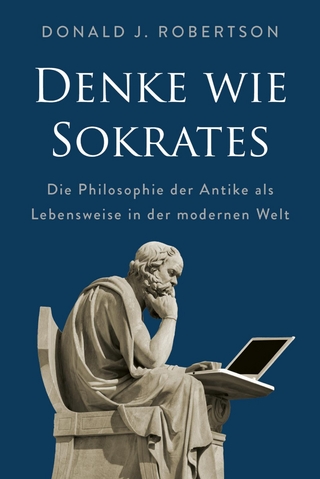
Die Philosophie der Antike als Lebensweise in der modernen Welt
Buch | Hardcover (2025)
FinanzBuch Verlag
CHF 25,20


