


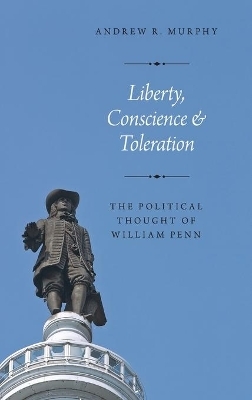
Liberty, Conscience, and Toleration
The Political Thought of William Penn
Seiten
2016
Oxford University Press Inc (Verlag)
9780190271190 (ISBN)
Oxford University Press Inc (Verlag)
9780190271190 (ISBN)
In Liberty, Conscience, and Toleration, Andrew Murphy shows that, despite widespread scholarly neglected, William Penn was a sophisticated political thinker who played a crucial role in the emergence of religious liberty and remains a singular, if often overlooked, figure in the history of liberty of conscience.
In a seventeenth-century English landscape populated with towering political and philosophical figures like Hobbes, Harrington, Cromwell, Milton, and Locke, William Penn remains in many ways a man apart. Yet despite being widely neglected by scholars, he was a sophisticated political thinker who contributed mightily to the theory and practice of religious liberty in the early modern Atlantic world. In this long-awaited intellectual biography of William Penn, Andrew R. Murphy presents a nuanced portrait of this remarkable entrepreneur, philosopher, Quaker, and politician.
Liberty, Conscience, and Toleration focuses on the major political episodes that attracted William Penn's sustained attention as a political thinker and actor: the controversy over the Second Conventicle Act, the Popish Plot and Exclusion Crisis, the founding and settlement of Pennsylvania, and the contentious reign of James II. Through a careful examination of writings published in the midst of the religious and political conflicts of Restoration and Revolutionary England, Murphy contextualizes the development of Penn's thought in England and America, illuminating the mutual interconnections between Penn's political thought and his colonizing venture in America.
An early advocate of representative institutions and religious freedom, William Penn remains a singular figure in the history of liberty of conscience. His political theorizing provides a window into the increasingly vocal, organized, and philosophically sophisticated tolerationist movement that gained strength over the second half of the seventeenth century. Not only did Penn attempt to articulate principles of religious liberty as a Quaker in England, but he actually governed an American polity and experienced firsthand the complex relationship between political theory and political practice. Murphy's insightful analysis shows Penn's ongoing significance to the broader study of Anglo-American political theory and practice, ultimately pointing scholars toward a new way of understanding the enterprise of political theory itself.
In a seventeenth-century English landscape populated with towering political and philosophical figures like Hobbes, Harrington, Cromwell, Milton, and Locke, William Penn remains in many ways a man apart. Yet despite being widely neglected by scholars, he was a sophisticated political thinker who contributed mightily to the theory and practice of religious liberty in the early modern Atlantic world. In this long-awaited intellectual biography of William Penn, Andrew R. Murphy presents a nuanced portrait of this remarkable entrepreneur, philosopher, Quaker, and politician.
Liberty, Conscience, and Toleration focuses on the major political episodes that attracted William Penn's sustained attention as a political thinker and actor: the controversy over the Second Conventicle Act, the Popish Plot and Exclusion Crisis, the founding and settlement of Pennsylvania, and the contentious reign of James II. Through a careful examination of writings published in the midst of the religious and political conflicts of Restoration and Revolutionary England, Murphy contextualizes the development of Penn's thought in England and America, illuminating the mutual interconnections between Penn's political thought and his colonizing venture in America.
An early advocate of representative institutions and religious freedom, William Penn remains a singular figure in the history of liberty of conscience. His political theorizing provides a window into the increasingly vocal, organized, and philosophically sophisticated tolerationist movement that gained strength over the second half of the seventeenth century. Not only did Penn attempt to articulate principles of religious liberty as a Quaker in England, but he actually governed an American polity and experienced firsthand the complex relationship between political theory and political practice. Murphy's insightful analysis shows Penn's ongoing significance to the broader study of Anglo-American political theory and practice, ultimately pointing scholars toward a new way of understanding the enterprise of political theory itself.
Andrew R. Murphy is Associate Professor of Political Science at Rutgers University. His previous books include Prodigal Nation: Moral Decline and Divine Punishment from New England to 9/11 and Conscience and Community: Revisiting Toleration and Religious Dissent in Early Modern England and America.
Preface
Acknowledgments
1. William Penn in England and America: An Approach to Political Thought in Context
2. Emergence: 1668-1671
3. Debut: The Peoples Ancient and Just Liberties
4. Plot: Parliament, Popery, and Liberty, 1678-1681
5. Founding: Theory Meets Practice?
6. Revolution: Penn, 1685-88
7. Return: The 1690s
8. Legacy?
Bibliography
Index
| Erscheinungsdatum | 27.06.2016 |
|---|---|
| Verlagsort | New York |
| Sprache | englisch |
| Maße | 236 x 160 mm |
| Gewicht | 598 g |
| Themenwelt | Geisteswissenschaften ► Philosophie |
| Sozialwissenschaften ► Politik / Verwaltung ► Politische Theorie | |
| ISBN-13 | 9780190271190 / 9780190271190 |
| Zustand | Neuware |
| Informationen gemäß Produktsicherheitsverordnung (GPSR) | |
| Haben Sie eine Frage zum Produkt? |
Mehr entdecken
aus dem Bereich


aus dem Bereich
Weltherrschaft und Menschheitsethos
Buch | Hardcover (2025)
Suhrkamp (Verlag)
CHF 67,20
Buch | Softcover (2025)
Matthes & Seitz Berlin (Verlag)
CHF 16,80
oder: das Ende der Politik
Buch | Softcover (2025)
Dietz Vlg Bln (Verlag)
CHF 22,40


