


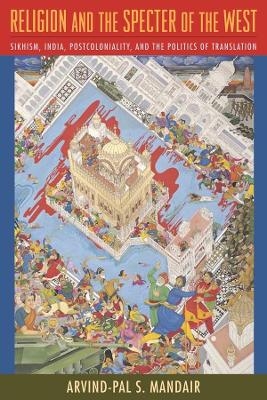
Religion and the Specter of the West
Sikhism, India, Postcoloniality, and the Politics of Translation
Seiten
2016
Columbia University Press (Verlag)
9780231147255 (ISBN)
Columbia University Press (Verlag)
9780231147255 (ISBN)
Arguing that intellectual movements, such as deconstruction, postsecular theory, and political theology, have different implications for cultures and societies that live with the debilitating effects of past imperialisms, Arvind Mandair unsettles the politics of knowledge construction in which the category of "religion" continues to be central. Through a case study of Sikhism, he launches an extended critique of religion as a cultural universal. At the same time, he presents a portrait of how certain aspects of Sikh tradition were reinvented as "religion" during the late nineteenth and early twentieth centuries. India's imperial elite subtly recast Sikh tradition as a sui generis religion, which robbed its teachings of their political force. In turn, Sikhs began to define themselves as a "nation" and a "world religion" that was separate from, but parallel to, the rise of the Indian state and global Hinduism. Rather than investigate these processes in isolation from Europe, Mandair shifts the focus closer to the political history of ideas, thereby recovering part of Europe's repressed colonial memory.
Mandair rethinks the intersection of religion and the secular in discourses such as history of religions, postcolonial theory, and recent continental philosophy. Though seemingly unconnected, these discourses are shown to be linked to a philosophy of "generalized translation" that emerged as a key conceptual matrix in the colonial encounter between India and the West. In this riveting study, Mandair demonstrates how this philosophy of translation continues to influence the repetitions of religion and identity politics in the lives of South Asians, and the way the academy, state, and media have analyzed such phenomena.
Mandair rethinks the intersection of religion and the secular in discourses such as history of religions, postcolonial theory, and recent continental philosophy. Though seemingly unconnected, these discourses are shown to be linked to a philosophy of "generalized translation" that emerged as a key conceptual matrix in the colonial encounter between India and the West. In this riveting study, Mandair demonstrates how this philosophy of translation continues to influence the repetitions of religion and identity politics in the lives of South Asians, and the way the academy, state, and media have analyzed such phenomena.
Arvind-Pal S. Mandair is associate professor of Asian languages and cultures and S.C.S.B. Endowed Professor of Sikh Studies at the University of Michigan. He is a founding coeditor of the journal Sikh Formations: Religion, Culture, Theory.
Preface Acknowledgments Introduction Part I. "Indian Religions" and Western Thought 1. Mono-theo-lingualism: Religion, Language, and Subjectivity in Colonial North India 2. Hegel and the Comparative Imaginary of the West Part II. Theology as Cultural Translation 3. Sikhism and the Politics of Religion-Making 4. Violence, Mysticism, and the Capture of Subjectivity Part III. Postcolonial Exits 5. Ideologies of Sacred Sound 6. Decolonizing Postsecular Theory Epilogue Glossary of Indic Terms Notes Index
| Erscheinungsdatum | 07.05.2016 |
|---|---|
| Reihe/Serie | Insurrections: Critical Studies in Religion, Politics, and Culture |
| Verlagsort | New York |
| Sprache | englisch |
| Maße | 152 x 229 mm |
| Themenwelt | Geisteswissenschaften ► Geschichte ► Regional- / Ländergeschichte |
| Geisteswissenschaften ► Religion / Theologie ► Weitere Religionen | |
| ISBN-13 | 9780231147255 / 9780231147255 |
| Zustand | Neuware |
| Informationen gemäß Produktsicherheitsverordnung (GPSR) | |
| Haben Sie eine Frage zum Produkt? |
Mehr entdecken
aus dem Bereich


aus dem Bereich
die Geschichte meiner Urgroßmutter
Buch | Hardcover (2025)
C.H.Beck (Verlag)
CHF 32,15
Träume und Macht : eine Biografie
Buch | Hardcover (2025)
C.H.Beck (Verlag)
CHF 61,60


