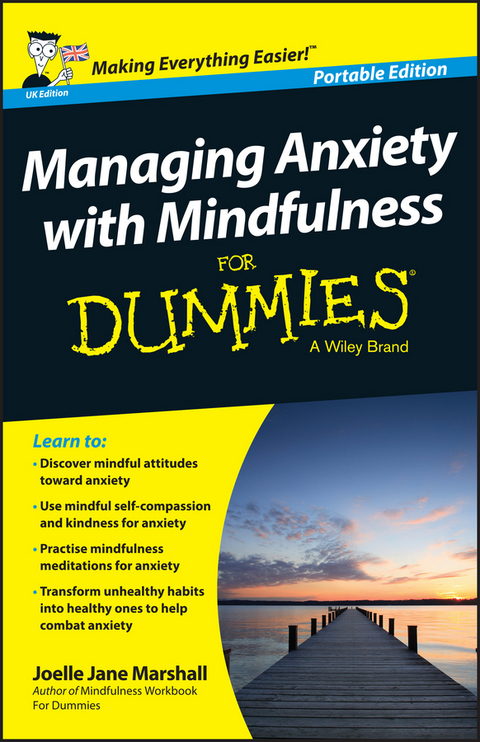
Managing Anxiety with Mindfulness For Dummies is a practical guide to overcoming your worries and minimising anxiety using mindfulness techniques. The National Health Service and the National Institute for Care and Excellence recommend mindfulness as a legitimate treatment for anxiety, and its also been proven to alleviate stress, depression, low self-esteem, and insomnia. This book explains the benefits of mindfulness, and how it can help you face your fears and defeat persistent, irrational worries. Learn how to break the anxiety cycle with an optimistic approach, live in the present moment, and manage your thoughts using the fundamental techniques of mindfulness therapy. This friendly guide will accompany you every step of the way as you understand your anxiety, identify solutions to your problem, maintain your gains, and avoid relapse.
Over three million people in the UK suffer from Generalised Anxiety Disorder, with millions more experiencing phobias, OCD, and panic disorders. Anxiety is potentially debilitating, but many people are daunted by navigating the health system and thus fail to seek treatment. This book provides a way for you to begin managing your symptoms at home, using simple techniques that can help change the way you think, feel, and act.
- Understand what anxiety is, and the common causes
- Employ mindful self-compassion to alleviate symptoms
- Discover mindful attitudes and practise mindful mediation
- Transform unhealthy habits into anxiety-busting self-care
Mindfulness can help you break free of the downward spiral of negative thought and action, and make positive choices that support your wellbeing. If you're tired of being anxious and long for a brighter outlook, Managing Anxiety with Mindfulness For Dummies provides a wide range of effective techniques to help you enjoy a calmer and happier life.
Joelle Jane Marshall is a freelance speaker and mindfulness coach who works closely with fellow Mindfulness For Dummies coauthor Shamash Alidina on workshops for 'Mindfulness and Overcoming Fear'. She trained in mindfulness with Shamash and meditates and practices yoga regularly.
Don't panic! Managing Anxiety with Mindfulness For Dummies is a practical guide to overcoming your worries and minimising anxiety using mindfulness techniques. The National Health Service and the National Institute for Care and Excellence recommend mindfulness as a legitimate treatment for anxiety, and its also been proven to alleviate stress, depression, low self-esteem, and insomnia. This book explains the benefits of mindfulness, and how it can help you face your fears and defeat persistent, irrational worries. Learn how to break the anxiety cycle with an optimistic approach, live in the present moment, and manage your thoughts using the fundamental techniques of mindfulness therapy. This friendly guide will accompany you every step of the way as you understand your anxiety, identify solutions to your problem, maintain your gains, and avoid relapse. Over three million people in the UK suffer from Generalised Anxiety Disorder, with millions more experiencing phobias, OCD, and panic disorders. Anxiety is potentially debilitating, but many people are daunted by navigating the health system and thus fail to seek treatment. This book provides a way for you to begin managing your symptoms at home, using simple techniques that can help change the way you think, feel, and act. Understand what anxiety is, and the common causes Employ mindful self-compassion to alleviate symptoms Discover mindful attitudes and practise mindful mediation Transform unhealthy habits into anxiety-busting self-care Mindfulness can help you break free of the downward spiral of negative thought and action, and make positive choices that support your wellbeing. If you're tired of being anxious and long for a brighter outlook, Managing Anxiety with Mindfulness For Dummies provides a wide range of effective techniques to help you enjoy a calmer and happier life.
Joelle Jane Marshall is a freelance speaker and mindfulness coach who works closely with fellow Mindfulness For Dummies coauthor Shamash Alidina on workshops for 'Mindfulness and Overcoming Fear'. She trained in mindfulness with Shamash and meditates and practices yoga regularly.
Chapter 1
Peering into the World of Anxiety
In This Chapter
Finding out what anxiety is
Exploring the effects of anxiety
Using mindfulness to tackle anxiety
Anxiety is very common. Everyone experiences some form of anxiety on a day-to-day basis. It can be a helpful emotion, making you focused, alert and productive, but it can also be incredibly upsetting, uncomfortable and hard to live with.
In this chapter, I describe the nature, experience and symptoms of anxiety, show how it can affect your body and mind and help you discern whether your levels of anxiety are severe or normal. I also introduce you to mindfulness – what it involves and how it can help when battling anxiety – including a short mindfulness exercise for you to try.
Comparing Fear, Excitement and Anxiety
Fear, excitement and anxiety are all common emotions. All three can conjure the same feelings, but crucial differences exist between them. Fear and excitement can be helpful emotions, whereas anxiety can sometimes result in a lot of discomfort. In this section, I explain the differences between these three feelings.
Investigating fear
Fear is a natural emotion, as is anxiety. In fact, fear raises the same feelings that anxiety can, such as alarm or apprehension. The difference is that with fear, these feelings have a reason behind them.
Fear is a feeling of terror, distress or alarm caused by a danger or a threat. For example, you may feel fear when you see a car racing toward you at great speed, when you’re in a situation where you may slip and fall or when you see a snake.
Clarifying the difference between anxiety and excitement
Feeling emotions such as agitation and distress without a just reason is one of the main factors of anxiety.
Anxiety is similar to fear, but without any obvious danger. It’s a thought focused on something going wrong in the future and is often a notion that things are worse than they really are. Sometimes a traumatic event or lots of stress-causing factors trigger anxiety, but other times it doesn’t have an identifiable reason. For more on the causes of anxiety, check out Chapter 2.
Anxiety is in the present moment, but the reason for it isn’t always clear – unlike with fear.
Everyone on the planet experiences some level of anxiety at some point – it’s a natural part of the human experience! But if you’re finding your anxiety difficult to deal with, don’t worry: Anxiety can be a very treatable condition.
In the physical sense, excitement is very similar to anxiety. If you’re excited about something, you may recognise the same physical sensations, such as a fast heartbeat and sweating.
Although excitement can arouse the same physical reactions as anxiety, the difference is internal. Feeling excited creates positive thoughts of future or past experiences, conjuring up positive outcomes, such as feelings of happiness connected to your social life.
If you’re anxious, however, you may be waking up every day with the same sense of dread but no real reason for it. Perhaps you’re avoiding certain social situations or activities, even though you know that doing so is silly. Check out Table 1-1 for a comparison of fear, anxiety and excitement.
Table 1-1 Differences between Fear, Excitement and Anxiety
| Emotional State | Physical Sensations | Reasons |
| Fear | Fast heartbeat, sweating, high energy | An immediate threat of danger |
| Excitement | Fast heartbeat, sweating, high energy | Can originate from or lead to positive memories |
| Anxiety | Fast heartbeat, sweating, high energy | Something that may happen in the future, which is causing worry and stress; or for no clear reason at all |
Discovering the Effect of Anxiety on the Mind
The mind expresses anxiety through worry, which often conjures up a collection of images, thoughts and feelings. One of the main anxiety problems that people experience is uncontrollable, excessive worries about anything, from minor to major things, despite no real threat of danger.
Your worries can take the form of several types of disturbing thoughts and feelings, such as the following:
- Thinking that you may lose control (go mad)
- Feeling detached from the world around you
- Thinking that everyone is everyone is watching you and knows that you’re anxious
- Wanting to run away to avoid the situation
- Visiting the doctor often with irrational worries about your health (for example, thinking that you have cancer or a brain tumour)
- Feeling hypersensitive and hyper alert to everything around you
As well as the worrying, anxiety can also affect your mind in other ways:
- Feeling irritable
- Feeling fearful
- Lacking the ability to concentrate
- Needing reassurance desperately
- Feeling dependent
- Feeling depressed
- Losing confidence
Anxiety is provoked by thoughts about fear rather than an immediate danger, and so the meaning that the brain gives the thought is all about perception. For example, you may have stumbled in a job interview just once, but the brain remembers this event as an unpleasant experience, which then creates anxiety. Other people may have also stumbled at previous job interviews but did well at the next ones; their brains didn’t let the unpleasant experience take over.
Read Chapter 4 for more on how thoughts affect your mind and body.
Finding out the Physical Effects of Anxiety on Bodily Functions
As I describe in the earlier section ‘Clarifying the Difference between anxiety’ and excitement, the physical effects on the body from anxiety are similar to the effects evoked from fear or excitement:
- Heart pounding
- Rapid breathing
- Urgency to use the toilet more often
- Pins and needles
- Dizziness
- Sweating
- Feeling sick
- Tense muscles (especially in the chest area)
- Dry mouth
- Headaches
Chapters 3 and 5 describe how mindfulness meditations can ease your physical health.
Understanding the Fight-or-Flight Response
The fight-or-flight response goes back to the days of cave dwellers and is the body’s natural reaction to danger. A researcher called Walter B Cannon discovered in 1915 that animals experience physical changes when confronted with danger. He found that the increases in blood pressure, secretion of powerful hormones and other physical and psychological changes prepare the animal to fight or flight.
Humans experience this same response to danger. Fight-or-flight is useful when people need to defend their families against wild animals, save them from burning buildings or run from a danger they can’t fight off, such as a natural disaster. But when you’re just doing day-to-day things, such as going to the shops, commuting to work or looking after children, this sudden release of hormones and physical changes can be difficult to deal with.
The excess chemicals that your body releases aren’t needed. As a result, the decreased carbon dioxide level in your lungs and blood can make you feel dizzy or faint, causing you to hyperventilate, which is when a panic attack can occur.
Exploring Why Thinking Negatively Is a Natural Human Trait
Your brain is more likely to think negatively rather than positively for one simple reason: survival.
If people thought positively all the time, they wouldn’t have a natural awareness to danger, and the human race wouldn’t have survived! If cave dwellers had just chilled out all the time, enjoying their cave paintings without a care in the world, the chances are that they’d have been killed and eaten by wild animals pretty quickly.
As a result, the brain is naturally wired to think more negatively than positively, and people are more likely to remember negative events than positive ones. The brain is also very quick at trying to create patterns, even if it has little evidence. It’s your brain’s way of protecting you from danger. The human nervous system is nervous.
Imagine that you stumbled during a work presentation a couple of times in the past – mixing up your notes, spilling your coffee and generally coming across like Mr Bean. The brain remembers these embarrassing events and creates a pattern for you, telling you that every time you have a work presentation, you’ll mess up again. Or say that you’ve had two bad relationship experiences: Your brain can now tell you that all members of the opposite sex are useless.
But you’re no longer a cave dweller. You don’t need this pattern of negative thinking because danger is no longer as imminent as it was thousands of years ago. With no real threat of present danger, these patterns can result in anxiety.
What used to be a saber tooth tiger is now more likely to be a paper-tiger.
It’s noteworthy to learn that humans can turn on the stress response by their thoughts alone, which can have the same measurable effects as any threatening stressor in the...
| Erscheint lt. Verlag | 20.11.2015 |
|---|---|
| Sprache | englisch |
| Themenwelt | Sachbuch/Ratgeber ► Gesundheit / Leben / Psychologie ► Lebenshilfe / Lebensführung |
| Sachbuch/Ratgeber ► Gesundheit / Leben / Psychologie ► Psychologie | |
| Geisteswissenschaften ► Psychologie ► Angst / Depression / Zwang | |
| Schlagworte | alleviating anxiety • Angst • anxiety causes • anxiety cycle • Anxiety Disorders • anxiety home care • anxiety-proof • anxiety self care • anxiety self-help • anxiety therapy • anxiety treatment • Aufmerksamkeit • GAD • generalised anxiety disorder • Jo Marshall • living with anxiety • managing anxiety • Managing Anxiety with Mindfulness For Dummies • mindfulness and stress • mindfulness and worry • mindfulness approach • mindfulness for anxiety • mindfulness habits • mindfulness meditation • mindfulness practice • mindfulness techniques • mindfulness therapy • mindfulness training • mindful outlook • Ratgeber • Self-Help |
| ISBN-13 | 9781118972571 / 9781118972571 |
| Informationen gemäß Produktsicherheitsverordnung (GPSR) | |
| Haben Sie eine Frage zum Produkt? |
 EPUB (Adobe DRM)
Kopierschutz: Adobe-DRM
Adobe-DRM ist ein Kopierschutz, der das eBook vor Mißbrauch schützen soll. Dabei wird das eBook bereits beim Download auf Ihre persönliche Adobe-ID autorisiert. Lesen können Sie das eBook dann nur auf den Geräten, welche ebenfalls auf Ihre Adobe-ID registriert sind.
Details zum Adobe-DRM
Dateiformat: EPUB (Electronic Publication)
EPUB ist ein offener Standard für eBooks und eignet sich besonders zur Darstellung von Belletristik und Sachbüchern. Der Fließtext wird dynamisch an die Display- und Schriftgröße angepasst. Auch für mobile Lesegeräte ist EPUB daher gut geeignet.
Systemvoraussetzungen:
PC/Mac: Mit einem PC oder Mac können Sie dieses eBook lesen. Sie benötigen eine
eReader: Dieses eBook kann mit (fast) allen eBook-Readern gelesen werden. Mit dem amazon-Kindle ist es aber nicht kompatibel.
Smartphone/Tablet: Egal ob Apple oder Android, dieses eBook können Sie lesen. Sie benötigen eine
Geräteliste und zusätzliche Hinweise
Buying eBooks from abroad
For tax law reasons we can sell eBooks just within Germany and Switzerland. Regrettably we cannot fulfill eBook-orders from other countries.
aus dem Bereich