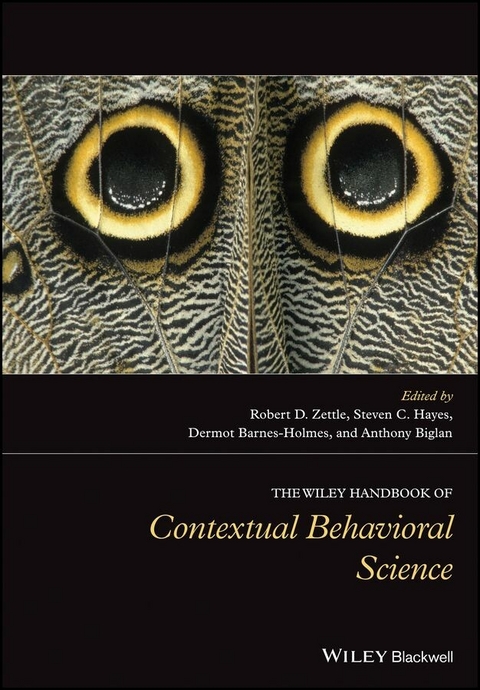
The Wiley Handbook of Contextual Behavioral Science (eBook)
John Wiley & Sons (Verlag)
978-1-118-48988-8 (ISBN)
- This is the first thorough examination of the philosophy, basic science, applied science, and applications of Contextual Behavioral Science
- Brings together the philosophical and empirical contributions that CBS is making to practical efforts to improve human wellbeing
- Organized and written in such a way that it can be read in its entirety or on a section-by-section basis, allowing readers to choose how deeply they delve into CBS
- Extensive coverage of this wide ranging and complex area that encompasses both a rich basic experimental tradition and in-depth clinical application of that experimental knowledge
- Looks at the development of RFT, and its implications for alleviating human suffering
Robert D. Zettle is Professor of Psychology at Wichita State University, USA. He serves on the editorial board of several journals including Behavior Modification, International Journal of Behavioral Consultation & Therapy and The Psychological Record. Professor Zettle has contributed many chapters to various books, and is the author of ACT for Depression (2007).
Steven C. Hayes is Nevada Foundation Professor at the Department of Psychology at the University of Nevada, USA. An author of 36 books including the best selling Get Out of Your Mind and Into Your Life (2005), his research demonstrates how language and thought leads to human suffering. He developed Acceptance and Commitment Therapy, and Relational Frame Theory, a contextual approach to language and cognition. Dr. Hayes has received the Lifetime Achievement Award from the Association for Behavioral and Cognitive Therapy.
Dermot Barnes-Holmes is foundation Professor of Psychology at the National University of Ireland Maynooth, and is known for the analysis of human language and cognition through the development of Relational Frame Theory with Steven C. Hayes, and its application in various psychological settings. Professor Barnes-Holmes has published over 250 scientific articles, chapters and books.
Tony Biglan is Professor of Psychology andDirector at the Center for Prevention of Problems in Early Adolescence at Oregon Research Institute, USA. His research over the past 30 years has helped to identify effective family, school, and community interventions to prevent the most common and costly problems of childhood and adolescence.
The Wiley Handbook of Contextual Behavioral Science describes the philosophical and empirical foundation of the contextual behavioral science movement; it explores the history and goals of CBS, explains its core analytic assumptions, and describes Relational Frame Theory as a research and practice program. This is the first thorough examination of the philosophy, basic science, applied science, and applications of Contextual Behavioral Science Brings together the philosophical and empirical contributions that CBS is making to practical efforts to improve human wellbeing Organized and written in such a way that it can be read in its entirety or on a section-by-section basis, allowing readers to choose how deeply they delve into CBS Extensive coverage of this wide ranging and complex area that encompasses both a rich basic experimental tradition and in-depth clinical application of that experimental knowledge Looks at the development of RFT, and its implications for alleviating human suffering
Robert D. Zettle is Professor of Psychology at Wichita State University, USA. He serves on the editorial board of several journals including Behavior Modification, International Journal of Behavioral Consultation & Therapy and The Psychological Record. Professor Zettle has contributed many chapters to various books, and is the author of ACT for Depression (2007). Steven C. Hayes is Nevada Foundation Professor at the Department of Psychology at the University of Nevada, USA. An author of 36 books including the best selling Get Out of Your Mind and Into Your Life (2005), his research demonstrates how language and thought leads to human suffering. He developed Acceptance and Commitment Therapy, and Relational Frame Theory, a contextual approach to language and cognition. Dr. Hayes has received the Lifetime Achievement Award from the Association for Behavioral and Cognitive Therapy. Dermot Barnes-Holmes is foundation Professor of Psychology at the National University of Ireland Maynooth, and is known for the analysis of human language and cognition through the development of Relational Frame Theory with Steven C. Hayes, and its application in various psychological settings. Professor Barnes-Holmes has published over 250 scientific articles, chapters and books. Tony Biglan is Professor of Psychology andDirector at the Center for Prevention of Problems in Early Adolescence at Oregon Research Institute, USA. His research over the past 30 years has helped to identify effective family, school, and community interventions to prevent the most common and costly problems of childhood and adolescence.
1
Examining the Partially Completed Crossword Puzzle: The Nature and Status of Contextual Behavioral Science
Steven C. Hayes, Robert D. Zettle, Dermot Barnes-Holmes, and Anthony Biglan
The purpose of this volume is to describe contextual behavioral science (CBS) – its nature, origins, status, and future. The parts of the handbook deal in succession with its foundational assumptions and strategies, basic work in language and cognition, contextual approaches to clinical interventions and assessment, and extensions of CBS across settings and populations. Although presented sequentially, the chapters are deliberately interwoven: Philosophical issues arise in the basic science chapters, basic science issues appear in the intervention chapters, and so on. They form a kind of intellectual and practical web or network (thus the term “reticulated” for the overall strategy) that taken as a whole describes CBS and its current status, as well as providing some good hints about where this tradition may be going.
It is in the nature of books that topics need to be presented in a linear fashion. CBS did not develop that way in a historical sense, however. For example, the work on functional contextualism did not precede the work on relational frame theory (RFT), which then preceded the development of acceptance and commitment therapy (ACT). CBS rather developed more the way one might attack a complex crossword puzzle – sometimes successfully pursuing clues in one part of the puzzle led to hints for how to move forward in other parts; sometimes advancements were made in a corner of the puzzle that would be disconnected from anything else for a long time. Sometimes these leaps and jumps were strategic; sometimes they were more like a random walk, driven by whim and circumstance. But always the goal was the overall puzzle: How to create a behavioral science more worthy of the challenge of the human condition.
A puzzle of that kind is one that in all likelihood will challenge behavioral science for some time, so although progress has clearly been made over the last few decades, what CBS is deliberately focused on is how to create a knowledge development strategy that is sustainable and progressive over the long haul. What CBS brings to the table is a principle-focused, communitarian strategy of reticulated scientific and practical development, grounded in functional contextualistic philosophical assumptions, and applied at all levels of analysis in behavioral science. This vision builds on the historical fact that CBS gradually gathered together different kinds of professionals who were pursuing clues in one part of the puzzle with an eye toward what it suggested for how to advance in other parts. What once was an implicit strategy driven merely by breadth of interests has blossomed into a more conscious strategy of constructing a coherent intellectual and practical web of knowledge by proceeding in an interrelated and communitarian way all at once. Having a web of knowledge as a scientific product is what all forms of behavioral science aspire to, but CBS has adopted that end point as an analytic approach at the operational level, challenging all of the professionals involved to be always responsible for the whole of it when approached within common functional contextualistic assumptions. That is the deeper sense in which CBS is a communitarian and contextualistic strategy of reticulated scientific and practical development.
The CBS approach is quite different than a bottom-up strategy, in which basic scientists alone are given all of the duties of constructing principles of high precision and scope that can be applied by practitioners to complex human behavior. It is also different than technological applied work that leaps into the evaluation of applied ideas without a concern for basic principles or the scope of theories. That is one of the major differences between CBS and purely technologically oriented approaches. In a CBS approach, clinicians sometimes need to be responsible themselves for developing psychological principles, and “bench” scientists sometimes need to be responsible for learning how to apply the principles they have derived. This occurs both in the laboratories and the clinics of those who straddle that applied/basic divide, and across the crossword puzzle of content domains. Clinicians are working on social stigma or the empowerment of indigenous peoples; educators are working on relational fluency and the development of intellect; therapists are working on prevention or extending the flexibility of organizations; basic scientists are writing about evolutionary epistemology or are extending implicit measures to clinics. Over time that approach seems to be expanding the CBS community itself, not just in terms of size, where its growth has been rapid, but also in terms of its focus and professional interconnections. Cognitive scientists and evolutionary biologists are part of the CBS community, for example, and their students and colleagues are being drawn into the same communitarian approach. The list of professions, disciplines, and groups heavily involved in CBS is already long and continues to grow: social workers, psychiatrists, occupational therapists, nurses, prevention scientists, coaches, behavior analysts, educators. Development is broad at the level of language communities and nations as well, bringing new sensitivities and a diversity of topics driven by culture, intellectual traditions, and social needs. About half of the current members of the Association for Contextual Behavioral Science are outside of North America, 20 chapters exist for countries outside of the United States, and 26 special interest groups pursue issues across the full range of behavioral science topics.
Now that a substantial body of interrelated work exists, it may seem to have emerged, in retrospect, from a coherent and predictable process. Students especially should not be deceived. Science is not only nonlinear, it is not predictable. Science is the behavior of scientists and as such it is sometimes systematic and is at other times an unsystematic social enterprise. It is ultimately self-organizing based on its purpose and knowledge criteria, but it is also constantly devolving and beginning anew. There is no reason to think that this naturally unsystematic or, at times, even chaotic quality will, or should, change. Simply because a body of work exists does not mean that it is finished, or that it could have only have turned out that way, or that developers had this end in mind all along.
Advancing an existing body of work requires the same kinds of risks and leaps that were required in its creation. Students may imagine or even be told that their scientific forbears knew what they were doing, saw a future, and then pursued it systematically. This can be a very inspiring story when it is applied to scientific heroes, but it is a secretly discouraging narrative because students in general do not see into the future and they often wait in vain for the touch of the muses they have been told visited their mentors. There is no such division between academic and practitioner generations – the apparent difference is an illusion imposed by the asymmetry of the impact of the known past versus unknown future on verbal processes. The purposive tales that surround established bodies of work are mostly reconstructions and reinterpretations, integrated into a coherent account that downplays or even hides from view the social, emotional, or accidental sources of progress that characterized the development of the tradition in real time.
CBS has moved forward fed not just by scientific studies and findings, and logical extensions of theories and principles, but also by personal commitments, leaps of intuition, friendships and alliances, the yearning to be of use, and by the “egos” of individual scientists, who, like most humans, seek to be heard and proven right in some way. While a mere verbal warning is unlikely to stem the tendency for scientific and clinical traditions to devolve into the safety of social agreement, we do not want this moment to pass without pleading with young scientists especially to accept nothing on faith. We would also urge them to politely refuse the appeals of the establishment to take anything as a given or as obvious, and thus as something that needs to be agreed to without further consideration. It does not matter if the establishment making this appeal is cognitively oriented or behaviorally oriented; psychological or biological in its approach; contextualistic or mechanistic in its assumptions. It does not matter if the establishment includes the very authors of this book. Doubt everything and hold it lightly – even doubt itself. Let CBS grow and change based on its successes, but be careful of adaptive peaks that could prevent this field from continuing to push toward its ultimate goals. The young, and others willing to take risks, will push this field forward, but not if they are turned into applauders or passive recipients of knowledge.
This book has a clear organization – which we will describe while that warning is fresh in our minds. In Part I of the book, edited primarily by Steven C. Hayes, we explore the idea that CBS is a strategy of scientific development, that is based on a core set of philosophical assumptions, and that is nested within multidimensional, multilevel evolution science as a contextual view of life. Chapter 3 (Levin, Twohig, & Smith), provides an overview of CBS; chapter 4 (Biglan & Hayes) provides a similarly broad summary for functional...
| Erscheint lt. Verlag | 13.11.2015 |
|---|---|
| Reihe/Serie | Wiley Clinical Psychology Handbooks |
| Wiley Clinical Psychology Handbooks | Wiley Clinical Psychology Handbooks |
| Sprache | englisch |
| Themenwelt | Geisteswissenschaften ► Psychologie ► Klinische Psychologie |
| Geisteswissenschaften ► Psychologie ► Verhaltenstherapie | |
| Schlagworte | Acceptance and Commitment Therapy • Clinical psychology • cognitive tradition • complex human behavior • contextual behavioral science • contextual CBT • Cultural Evolution • evolution science • experimental psychopathology research • Functional Contextualism • Klinische Psychologie • natural science perspectives • psychological flexibility • Psychologie • Psychology • psychopathology • Relational Frame Theory |
| ISBN-10 | 1-118-48988-8 / 1118489888 |
| ISBN-13 | 978-1-118-48988-8 / 9781118489888 |
| Informationen gemäß Produktsicherheitsverordnung (GPSR) | |
| Haben Sie eine Frage zum Produkt? |
 EPUB (Adobe DRM)
Kopierschutz: Adobe-DRM
Adobe-DRM ist ein Kopierschutz, der das eBook vor Mißbrauch schützen soll. Dabei wird das eBook bereits beim Download auf Ihre persönliche Adobe-ID autorisiert. Lesen können Sie das eBook dann nur auf den Geräten, welche ebenfalls auf Ihre Adobe-ID registriert sind.
Details zum Adobe-DRM
Dateiformat: EPUB (Electronic Publication)
EPUB ist ein offener Standard für eBooks und eignet sich besonders zur Darstellung von Belletristik und Sachbüchern. Der Fließtext wird dynamisch an die Display- und Schriftgröße angepasst. Auch für mobile Lesegeräte ist EPUB daher gut geeignet.
Systemvoraussetzungen:
PC/Mac: Mit einem PC oder Mac können Sie dieses eBook lesen. Sie benötigen eine
eReader: Dieses eBook kann mit (fast) allen eBook-Readern gelesen werden. Mit dem amazon-Kindle ist es aber nicht kompatibel.
Smartphone/Tablet: Egal ob Apple oder Android, dieses eBook können Sie lesen. Sie benötigen eine
Geräteliste und zusätzliche Hinweise
Buying eBooks from abroad
For tax law reasons we can sell eBooks just within Germany and Switzerland. Regrettably we cannot fulfill eBook-orders from other countries.
aus dem Bereich