


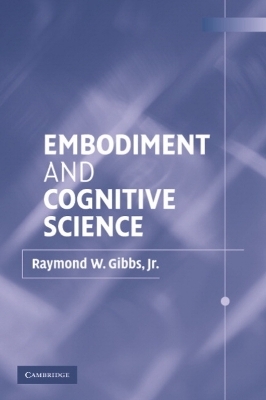
Embodiment and Cognitive Science
Seiten
2005
Cambridge University Press (Verlag)
9780521010498 (ISBN)
Cambridge University Press (Verlag)
9780521010498 (ISBN)
This 2006 book describes the many ways that the mind and body are closely interrelated, and how human thought and language are fundamentally linked to bodily action. The embodied nature of mind is explored through many topics, such as perception, thinking, language use, development, emotions, and consciousness.
This 2006 book explores how people's subjective, felt experiences of their bodies in action provide part of the fundamental grounding for human cognition and language. Cognition is what occurs when the body engages the physical and cultural world and must be studied in terms of the dynamical interactions between people and the environment. Human language and thought emerge from recurring patterns of embodied activity that constrain ongoing intelligent behavior. We must not assume cognition to be purely internal, symbolic, computational, and disembodied, but seek out the gross and detailed ways that language and thought are inextricably shaped by embodied action. Embodiment and Cognitive Science describes the abundance of empirical evidence from many disciplines, including work on perception, concepts, imagery and reasoning, language and communication, cognitive development, and emotions and consciousness, that support the idea that the mind is embodied.
This 2006 book explores how people's subjective, felt experiences of their bodies in action provide part of the fundamental grounding for human cognition and language. Cognition is what occurs when the body engages the physical and cultural world and must be studied in terms of the dynamical interactions between people and the environment. Human language and thought emerge from recurring patterns of embodied activity that constrain ongoing intelligent behavior. We must not assume cognition to be purely internal, symbolic, computational, and disembodied, but seek out the gross and detailed ways that language and thought are inextricably shaped by embodied action. Embodiment and Cognitive Science describes the abundance of empirical evidence from many disciplines, including work on perception, concepts, imagery and reasoning, language and communication, cognitive development, and emotions and consciousness, that support the idea that the mind is embodied.
Raymond W. Gibbs, Jr. is Professor of Psychology at the University of California, Santa Cruz. He is previously the author of The Poetics of Mind and Understanding and Intentions in the Experience of Meaning. He is co-editor (with G. Steen) of Metaphor in Cognitive Linguistics” and editor of the Interdisciplinary Journal, Metaphor and Symbol.
Acknowledgements; 1. Introduction; 2. Bodies and persons; 3. Perception and action; 4. Concepts; 5. Imagery, memory, and reasoning; 6. Language and communication; 7. Cognitive development; 8. Emotion and consciousness; 9. Conclusion.
| Erscheint lt. Verlag | 5.12.2005 |
|---|---|
| Zusatzinfo | 2 Line drawings, unspecified |
| Verlagsort | Cambridge |
| Sprache | englisch |
| Maße | 153 x 228 mm |
| Gewicht | 470 g |
| Themenwelt | Geisteswissenschaften ► Psychologie |
| ISBN-13 | 9780521010498 / 9780521010498 |
| Zustand | Neuware |
| Informationen gemäß Produktsicherheitsverordnung (GPSR) | |
| Haben Sie eine Frage zum Produkt? |
Mehr entdecken
aus dem Bereich



aus dem Bereich
Der Weltbestseller
Buch | Softcover (2025)
Klett-Cotta (Verlag)
CHF 28,90
welche Berufsfelder es zu entdecken gibt und was für eine erfüllte …
Buch | Softcover (2024)
Springer (Verlag)
CHF 34,95
warum wir endlich unbequem werden müssen
Buch | Softcover (2025)
Klett-Cotta (Verlag)
CHF 25,20


