


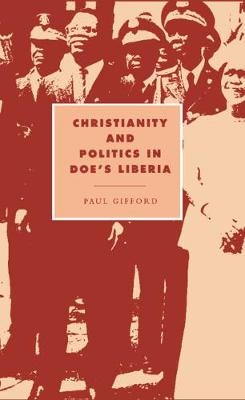
Christianity and Politics in Doe's Liberia
Seiten
1993
Cambridge University Press (Verlag)
978-0-521-42029-7 (ISBN)
Cambridge University Press (Verlag)
978-0-521-42029-7 (ISBN)
This study examines the role of Christianity in Liberia under the corrupt rule of Samuel K. Doe (1980–90). Paul Gifford argues that the Church encouraged obedience and acceptance of the status quo and thus served to entrench Doe's power and promote US objectives in the region.
This study examines the role of Christianity in Liberia under the corrupt rule of Samuel K. Doe (1980–90). Paul Gifford illustrates the relationship between mainline, evangelical, new Pentecostal and independent churches, and notes the strengths and weaknesses of each. He shows that, in general, Liberian Christianity - far from being a force for justice and human advancement - diverted attention from the causes of Liberia's ills, left change to God's miraculous intervention, encouraged obedience and acceptance of the status quo, and thus served to entrench Doe's power. In so doing, this Christianity, devised in the USA and promoted largely by American missionaries, helped to further the regional economic and political objectives of the US government which was committed to supporting Doe. The Lberian example is used to illustrate the difference between the kinds of Christianity to be found in Africa and in Latin America.
This study examines the role of Christianity in Liberia under the corrupt rule of Samuel K. Doe (1980–90). Paul Gifford illustrates the relationship between mainline, evangelical, new Pentecostal and independent churches, and notes the strengths and weaknesses of each. He shows that, in general, Liberian Christianity - far from being a force for justice and human advancement - diverted attention from the causes of Liberia's ills, left change to God's miraculous intervention, encouraged obedience and acceptance of the status quo, and thus served to entrench Doe's power. In so doing, this Christianity, devised in the USA and promoted largely by American missionaries, helped to further the regional economic and political objectives of the US government which was committed to supporting Doe. The Lberian example is used to illustrate the difference between the kinds of Christianity to be found in Africa and in Latin America.
Introduction; 1. The historical context; 2. The mainline churches; 3. The evangelical churches; 4. The faith gospel of health and wealth; 5. The independent churches; 6. The geopolitical context; 7. Conclusion.
| Erscheint lt. Verlag | 8.4.1993 |
|---|---|
| Reihe/Serie | Cambridge Studies in Ideology and Religion |
| Zusatzinfo | 1 Line drawings, unspecified |
| Verlagsort | Cambridge |
| Sprache | englisch |
| Maße | 143 x 222 mm |
| Gewicht | 559 g |
| Themenwelt | Religion / Theologie ► Christentum ► Kirchengeschichte |
| ISBN-10 | 0-521-42029-6 / 0521420296 |
| ISBN-13 | 978-0-521-42029-7 / 9780521420297 |
| Zustand | Neuware |
| Informationen gemäß Produktsicherheitsverordnung (GPSR) | |
| Haben Sie eine Frage zum Produkt? |
Mehr entdecken
aus dem Bereich


aus dem Bereich
eine andere Geschichte der Papststadt
Buch | Softcover (2024)
C.H.Beck (Verlag)
CHF 25,20
die Macht des Dunklen in unserer Zeit und wie wir ihr entgegentreten
Buch | Hardcover (2025)
Verlag Herder
CHF 27,90


