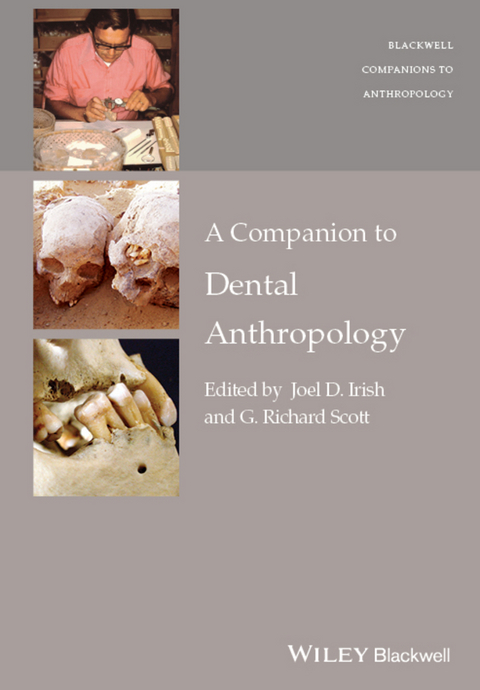
A Companion to Dental Anthropology (eBook)
John Wiley & Sons (Verlag)
978-1-118-84537-0 (ISBN)
- Represents the most comprehensive coverage of all sub-disciplines of dental anthropology available today
- Features individual chapters written by experts in their specific area of dental research
- Includes authors who also present results from their research through case studies or voiced opinions about their work
- Offers extensive coverage of topics relating to dental evolution, morphometric variation, and pathology
Joel D. Irish is Professor of Bioarchaeology in the Research Centre in Evolutionary Anthropology and Palaeoecology, School of Biological and Environmental Sciences, at Liverpool John Moores University, UK, and Professor Emeritus in the Anthropology Department at the University of Alaska Fairbanks. His research focuses on dental nonmetric and odontometric variation to estimate biological affinity in recent humans and fossil hominins.
G. Richard Scott is Foundation Professor of Anthropology at the University of Nevada Reno, and Professor Emeritus at the University of Alaska Fairbanks, where he taught for 24 years. He has published widely on issues relating to tooth crown and root morphology and biological affinity.
Companion to Dental Anthropology presents a collection of original readings addressing all aspects and sub-disciplines of the field of dental anthropology from its origins and evolution through to the latest scientific research. Represents the most comprehensive coverage of all sub-disciplines of dental anthropology available today Features individual chapters written by experts in their specific area of dental research Includes authors who also present results from their research through case studies or voiced opinions about their work Offers extensive coverage of topics relating to dental evolution, morphometric variation, and pathology
Joel D. Irish is Professor of Bioarchaeology in the Research Centre in Evolutionary Anthropology and Palaeoecology, School of Biological and Environmental Sciences, at Liverpool John Moores University, UK, and Professor Emeritus in the Anthropology Department at the University of Alaska Fairbanks. His research focuses on dental nonmetric and odontometric variation to estimate biological affinity in recent humans and fossil hominins. G. Richard Scott is Foundation Professor of Anthropology at the University of Nevada Reno, and Professor Emeritus at the University of Alaska Fairbanks, where he taught for 24 years. He has published widely on issues relating to tooth crown and root morphology and biological affinity.
Notes on Contributors viii
Foreword xv
Acknowledgments xviii
Part I Context 1
1 Introduction to Dental Anthropology 3
Joel D. Irish and G. Richard Scott
2 A Brief History of Dental Anthropology 7
G. Richard Scott
Part II Dental Evolution 19
3 Origins and Functions of Teeth: From "Toothed" Worms to Mammals 21
Peter S. Ungar
4 The Teeth of Prosimians, Monkeys, and Apes 37
Frank P. Cuozzo
5 The Hominins 1: Australopithecines and Their Ancestors 52
Lucas K. Delezene
6 The Hominins 2: The Genus Homo 67
Maria Martinon-Torres and Jose Maria Bermudez de Castro
Part III The Human Dentition 85
7 Terms and Terminology Used in Dental Anthropology 87
Joel D. Irish
8 Anatomy of Individual Teeth and Tooth Classes 94
Loren R. Lease
9 The Masticatory System and Its Function 108
Peter W. Lucas
Part IV Dental Growth and Development 121
10 An Overview of Dental Genetics 123
Toby Hughes, Grant Townsend, and Michelle Bockmann
11 Odontogenesis 142
Edward F. Harris
12 Tooth Eruption and Timing 159
Helen M. Liversidge
13 Tooth Classes, Field Concepts, and Symmetry 172
Grant Townsend, Alan Brook, Robin Yong, and Toby Hughes
Part V Dental Histology from the Inside Out 189
14 The Pulp Cavity and Its Contents 191
Scott S. Legge and Anna M. Hardin
15 Dentine and Cementum Structure and Properties 204
Nancy Tang, Adeline Le Cabec, and Daniel Antoine
16 Enamel Structure and Properties 223
Daniel Antoine and Simon Hillson
Part VI Dental Morphometric Variation in Populations 245
17 Identifying and Recording Key Morphological (Nonmetric) Crown and Root Traits 247
G. Richard Scott, Christopher Maier and Kelly Heim
18 Assessing Dental Nonmetric Variation among Populations 265
Joel D. Irish
19 Measurement of Tooth Size (Odontometrics) 287
Brian E. Hemphill
20 Assessing Odontometric Variation among Populations 311
Brian E. Hemphill
Part VII Dental Morphometric Variation in Individuals 337
21 Forensic Odontology 339
Heather J.H. Edgar and Anna L.M. Rautman
22 Estimating Age, Sex, and Individual ID from Teeth 362
Christopher W. Schmidt
23 Indicators of Idiosyncratic Behavior in the Dentition 377
Christopher M. Stojanowski, Kent M. Johnson, Kathleen S. Paul, and Charisse L. Carver
24 Dentition, Behavior, and Diet Determination 396
Kristin L. Krueger
Part VIII Dental Health and Disease 413
25 Crown Wear: Identification and Categorization 415
Scott E. Burnett
26 Caries: The Ancient Scourge 433
Daniel H. Temple
27 Dental Stress Indicators from Micro- to Macroscopic 450
Debbie Guatelli-Steinberg
28 A Host of Other Dental Diseases and Disorders 465
Greg C. Nelson
Part IX The Future of Dental Anthropology 485
29 New Directions in Dental Development Research 487
John P. Hunter and Debbie Guatelli-Steinberg
30 Chemical and Isotopic Analyses of Dental Tissues 499
Louise T. Humphrey
31 Non-Invasive Imaging Techniques 514
Jose Braga
Index 528
Notes on Contributors
Daniel Antoine is the British Museum’s Curator of Physical Anthropology, with responsibility for the museum’s human remains. He completed his PhD at University College London in 2001 and has published widely on bioarchaeology and dental anthropology, including Ancient Lives, New Discoveries: Eight Mummies, Eight Stories (2014) with John Taylor, and Regarding the Dead: Human Remains in the British Museum (2014) with Alexandra Fletcher and J.D. Hill.
José-María Bermúdez de Castro, PhD in Biology and Research Professor of the Consejo Superior de Investigaciones Científicas (CSIC, Spain), is currently affiliated with the National Research Center on Human Evolution (Burgos, Spain). From 1991, he has been co-director of the Sierra de Atapuerca project. His main scientific contributions deal with the study of the hominin fossils recovered from the Sierra de Atapuerca sites, including the naming, in Science, of a new Homo species: Homo antecessor.
Michelle Bockmann is a member of the Craniofacial Biology Research Group in the School of Dentistry at the University of Adelaide, Australia. Her main research interests involve studies of the human dentition aimed at clarifying the roles of genetic, epigenetic, and environmental factors on dental development and morphology together with translation of research findings to the general community.
José Braga is Professor of Evolutionary Anthropology and Human Evolution in the Research Department of Biological Anthropology of the University of Toulouse, France. He conducts fieldwork in Kromdraai (South Africa), where he recovers fossil remains of human ancestors and their relatives. His research interests lie in sorting the neutral and adaptive processes that governed the diversification of populations and species during human evolution, and in seeking the morphological correlates of these evolutionary processes using non-invasive imaging techniques.
Alan Brook is a member of the Craniofacial Biology Research Group in the School of Dentistry at the University of Adelaide, Australia. He also has an affiliation with Queen Mary University of London, UK. His main research interests revolve around studies of the human dentition aimed at clarifying the roles of genetic, epigenetic, and environmental factors on dental development and morphology.
Scott E. Burnett is Associate Professor of Anthropology at Eckerd College (St. Petersburg, Florida). His research concerns skeletal biology, dental anthropology, and bioarchaeology, with emphasis on population variation. He has published in anthropological, anatomical, and clinical journals, and a recent chapter, “Wear’s the problem: Examining the effect of dental wear on studies of crown morphology” (with J.D. Irish and M.R. Fong) in Anthropological Perspectives on Tooth Morphology: Genetics, Evolution, Variation, Scott and Irish, eds. (2013).
Charisse L. Carver is a PhD candidate in the School of Human Evolution and Social Change at Arizona State University and a Fulbright Scholar. Her research focuses on ethnogenesis and biodistance in the Early Middle Ages of Western Europe, the bioarchaeology of prehistoric Africa, and dental morphology. Recent publications include “Incisor avulsion, social identity and Saharan population history: New data from the Early Holocene southern Sahara” in Journal of Anthropological Archaeology.
Frank P. Cuozzo is an Associate Professor of Biological Anthropology at the University of North Dakota. His research focuses on the variation and function of primate teeth, with an emphasis on prosimian primates. He has over a dozen years of field experience in Madagascar and South Africa, where he studies the interaction between primate tooth morphology, its use, and the environments in which lemurs and other prosimians live, thus studying their “dental ecology.”
Lucas K. Delezene’s research focuses on the evolution of hominin and primate teeth. His research has, to date, been primarily focused on canine and premolar evolution in early Australopithecus species. It has ranged from investigating temporal trends in premolar evolution, to reconstructing patterns of premolar and canine use using dental microwear analysis, and to using patterns of trait covariation (morphological integration) to reveal the signatures of natural selection that drove early hominin dental evolution.
Heather J.H. Edgar is Curator of Human Osteology, Maxwell Museum of Anthropology, and Assistant Professor of Anthropology, University of New Mexico. Her research focuses on how cultural and historical events and trends shape the biology of populations. She often uses dental morphological data in this work; these data can also be applied to race estimation. Recent research includes biohistorical analyses of pre-contact Mesoamerican groups and the development of theoretical and statistical approaches in forensic dental anthropology.
Debbie Guatelli-Steinberg is Professor of Anthropology and Courtesy Professor of Evolution, Ecology, and Organismal Biology at The Ohio State University. Her research interests include developmental defects of enamel as well as dental growth, development, and morphology in living and fossil human and non-human primates.
Anna M. Hardin is a PhD candidate in the Department of Anthropology at the University of Minnesota. She is researching the impacts of body size and genetic heritability on primate dental morphology using a quantitative genetic approach. Additional interests include fossil primate taxonomy and deciduous dental morphology.
Edward F. Harris is Professor Emeritus of Bioscience Research at the University of Tennessee Health Science Center. He has published extensively in the areas of dental anthropology as well as dental clinical research. He is also Editor Emeritus of the journal Dental Anthropology, the official publication of the Dental Anthropology Association.
Kelly Heim is currently working on her PhD in the Department of Anthropology at the University of Nevada, Reno. She received her MA from Louisiana State University, Baton Rouge in 2013, where she also worked in the Forensic Anthropology and Computer Enhancement Services (FACES) Laboratory. Her research interests include forensic anthropology, dental development, and dental morphology.
Brian E. Hemphill is an Associate Professor in the Department of Anthropology at the University of Alaska Fairbanks. He has been actively conducting research on dental variability among prehistoric and living members of the myriad castes and tribes of South Asia since 1987. His primary research interests include multivariate statistical analyses and reconstruction of population histories, especially with respect to patterns of gene flow, genetic drift, and marital distance.
Simon Hillson is Professor of Bioarchaeology at the Institute of Archaeology, University College London. He has been teaching and researching in bioarchaeology since the completion of his PhD in 1979. Among his books published with Cambridge University Press are Teeth (first published 1986, second edition 2006), Dental Anthropology (1996), and Dental Development in Human Evolution and Bioarchaeology (2014).
Toby Hughes is a member of the Craniofacial Biology Research Group in the School of Dentistry at the University of Adelaide, Australia. His main research interests revolve around studies of the human dentition aimed at clarifying the roles of genetic, epigenetic, and environmental factors on dental development and morphology.
Louise T. Humphrey is a Researcher in Human Origins in the Department of Earth Sciences at the Natural History Museum in London. Her research addresses human development and life history, with a focus on retrieving the retrospective evidence of environmental and physiological influences embedded in the structure and chemical composition of dental tissues forming before and after birth.
John P. Hunter is Associate Professor of Evolution, Ecology and Organismal Biology at The Ohio State University at Newark. A vertebrate paleontologist, he studies mammals of the late Mesozoic and early Cenozoic, their evolution and ecology, as revealed through their teeth, and their early biogeographic history. Recently, in collaboration with Debbie Guatelli-Steinberg and students, he has turned his attention to one extant species of large mammal with particularly dull teeth and its relatives.
Joel D. Irish is Professor of Bioarchaeology in the Research Centre in Evolutionary Anthropology and Palaeoecology, School of Biological and Environmental Sciences, at Liverpool John Moores University, UK, and Professor Emeritus in the Anthropology Department at the University of Alaska Fairbanks. His research focuses on dental nonmetric and odontometric variation to estimate biological affinity in recent humans and fossil hominins.
Kent M. Johnson is a PhD candidate in the School of Human Evolution and Social Change at Arizona State University. His research involves state collapse and social organization in the pre-Hispanic Andes, kinship, peopling of the Americas, and dental morphology. Recent publications include “Sinodonty and beyond” in Anthropological Perspectives on Tooth Morphology: Genetics, Evolution, Variation and “New evidence on the spatiotemporal distribution and evolution of the Uto-Aztecan premolar” in American...
| Erscheint lt. Verlag | 21.10.2015 |
|---|---|
| Reihe/Serie | Blackwell Companions to Anthropology |
| Blackwell Companions to Anthropology | Wiley Blackwell Companions to Anthropology |
| Sprache | englisch |
| Themenwelt | Geisteswissenschaften ► Archäologie |
| Geschichte ► Allgemeine Geschichte ► Vor- und Frühgeschichte | |
| Naturwissenschaften ► Biologie ► Humanbiologie | |
| Naturwissenschaften ► Geowissenschaften ► Geologie | |
| Sozialwissenschaften ► Ethnologie | |
| Sozialwissenschaften ► Soziologie ► Mikrosoziologie | |
| Technik | |
| Schlagworte | Anthropologie • Anthropology • Archäologie • Archaeological Methods & Theory • archaeology • Archäologie • Biological Anthropology • Biologische Anthropologie • Dental anthropology, fossil remains, fossil dentitions, dental fossils, teeth, biological anthropology, human osteology, human variation, forensic anthropology, paleopathology • earth sciences • Geowissenschaften • Methoden u. Theorie der Archäologie • Methoden u. Theorie der Archäologie • Paläontologie • Paläontologie, Paläobiologie u. Geobiologie • Paläontologie • Paläontologie, Paläobiologie u. Geobiologie • Paleontology, Paleobiology & Geobiology |
| ISBN-10 | 1-118-84537-4 / 1118845374 |
| ISBN-13 | 978-1-118-84537-0 / 9781118845370 |
| Informationen gemäß Produktsicherheitsverordnung (GPSR) | |
| Haben Sie eine Frage zum Produkt? |
 EPUB (Adobe DRM)
Kopierschutz: Adobe-DRM
Adobe-DRM ist ein Kopierschutz, der das eBook vor Mißbrauch schützen soll. Dabei wird das eBook bereits beim Download auf Ihre persönliche Adobe-ID autorisiert. Lesen können Sie das eBook dann nur auf den Geräten, welche ebenfalls auf Ihre Adobe-ID registriert sind.
Details zum Adobe-DRM
Dateiformat: EPUB (Electronic Publication)
EPUB ist ein offener Standard für eBooks und eignet sich besonders zur Darstellung von Belletristik und Sachbüchern. Der Fließtext wird dynamisch an die Display- und Schriftgröße angepasst. Auch für mobile Lesegeräte ist EPUB daher gut geeignet.
Systemvoraussetzungen:
PC/Mac: Mit einem PC oder Mac können Sie dieses eBook lesen. Sie benötigen eine
eReader: Dieses eBook kann mit (fast) allen eBook-Readern gelesen werden. Mit dem amazon-Kindle ist es aber nicht kompatibel.
Smartphone/Tablet: Egal ob Apple oder Android, dieses eBook können Sie lesen. Sie benötigen eine
Geräteliste und zusätzliche Hinweise
Buying eBooks from abroad
For tax law reasons we can sell eBooks just within Germany and Switzerland. Regrettably we cannot fulfill eBook-orders from other countries.
aus dem Bereich