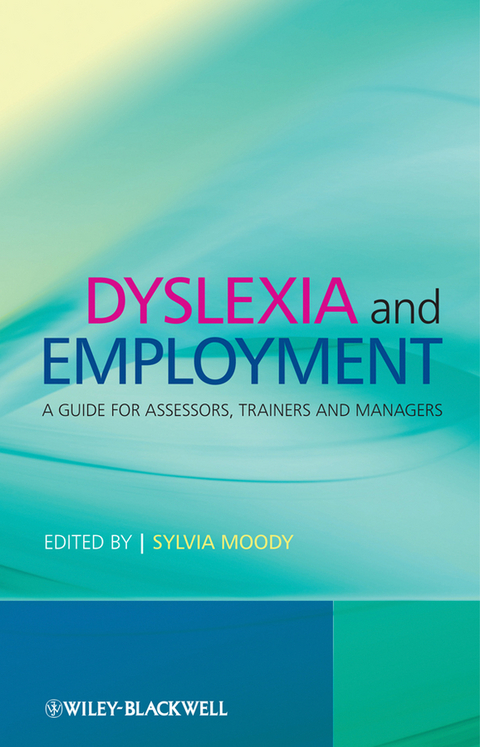
Dyslexia and Employment (eBook)
John Wiley & Sons (Verlag)
978-0-470-74919-7 (ISBN)
- Professional dilemma chapters discuss tricky issues which have arisen in practice.
- General perspective chapters take the viewpoint of professionals such as HR managers or trades-union representatives.
- How to do it right chapters offer advice on how to carry out diagnostic, workplace needs and legal assessments, and on devising training programmes.
- Information Point chapters provide brief information on general topics such as dyslexic difficulties in the workplace, emotional problems related to dyslexia, and the application of the Disability Discrimination Act.
With contributions from leading experts on workplace consultancy, this definitive guide will be of interest to dyslexia professionals, managers, legal professionals, trades unions, coaches, mentors and careers advisors - as well as dyslexic employees and job-seekers.
Dr Sylvia Moody has a PhD in Psychology, a diploma in Clinical Psychology and is a Fellow of the Royal Society of Arts. She runs the Dyslexia Assessment Service in London, is the author of Dyslexia: A Teenager's Guide (2004), Dyslexia: Surviving and Succeeding at College (2007), Dyslexia: How to Survive and Succeed at Work (2006), and has also written several children's books.
Edited by award-winning author Sylvia Moody, this jargon-free guide to good practice in dyslexia workplace consultancy, and related legal issues, provides comprehensive coverage in four clearly distinguished areas: Professional dilemma chapters discuss tricky issues which have arisen in practice. General perspective chapters take the viewpoint of professionals such as HR managers or trades-union representatives. How to do it right chapters offer advice on how to carry out diagnostic, workplace needs and legal assessments, and on devising training programmes. Information Point chapters provide brief information on general topics such as dyslexic difficulties in the workplace, emotional problems related to dyslexia, and the application of the Disability Discrimination Act. With contributions from leading experts on workplace consultancy, this definitive guide will be of interest to dyslexia professionals, managers, legal professionals, trades unions, coaches, mentors and careers advisors - as well as dyslexic employees and job-seekers.
Dr Sylvia Moody has a PhD in Psychology, a diploma in Clinical Psychology and is a Fellow of the Royal Society of Arts. She runs the Dyslexia Assessment Service in London, is the author of Dyslexia: A Teenager's Guide (2004), Dyslexia: Surviving and Succeeding at College (2007), Dyslexia: How to Survive and Succeed at Work (2006), and has also written several children's books.
Introduction (Sylvia Moody).
1. Dyslexia: A Case of Mistaken Identity (Sylvia
Moody)?
How dyslexia can be wrongly diagnosed or escape
recognition.
A. Dyslexia Difficulties in the Workplace (Diana
Bartlett).
2. A Human Resources Manager Speaks (Brian Hagan).
B. Reasonable Adjustments (Brian Hagan).
3. How to Do a Workplace Needs Assessment (Sylvia
Moody).
4. Dyslexia on the Front Line (Pauline Sumner).
A dyslexic person wishes to train as, say, a nurse, police
officer or firefighter and the question arises as to whether
his/her inefficiencies might put lives at risk.
C. Disclosure Guidelines (Pauline Sumner)
5. Dyspraxia: Problems and Solutions (Sarah Howard).
D. Neurodiversity (David Grant).
6. How To Do an Assistive Technology Assessment (Sylvia
Moody).
E. Visual Stress (Melanie Jameson).
7. Disputes around Dyslexia (Katherine Kindersley).
A change in job or manager can bring unexpected difficulties
for a dyslexic employee and relations between manager and employee
can become acrimonious. How can such situations be
resolved?
F. Access to Work Disability Support (Katherine
Kindersley).
8. A Dyslexic Employee Speaks (Jeffrey Till).
9. How to Set Up a Workplace Skills Training Programme
(Katherine Kindersley).
G. Careers for Dyslexic Adults (Brian Hagan).
10. Dyslexia: Attitudes and Emotions (Diana
Bartlett).
11. Dyslexia on Trial (Melanie Jameson).
At an employment tribunal a dyslexic person may be so
hampered by their communication difficulties that they give the
impression of being unco-operative and obstructing justice. How can
the legal profession be made aware of dyslexic problems?
H. Disability Discrimination Legislation (Brenda
Allan).
12. How to Write a Legal Report (Sylvia Moody).
I. Specific Learning Difficulties: Guidelines for Lawyers
(Melanie Jameson).
Conclusion (Sylvia Moody).
Appendix I: Checklists.
Appendix II: Assistive Technology.
Appendix III: Useful addresses.
Appendix IV: Further Reading.
Author Biographies.
Index.
| Erscheint lt. Verlag | 12.10.2015 |
|---|---|
| Sprache | englisch |
| Themenwelt | Geisteswissenschaften |
| Sozialwissenschaften ► Pädagogik ► Sonder-, Heil- und Förderpädagogik | |
| Wirtschaft ► Betriebswirtschaft / Management | |
| Schlagworte | Assessment • Bildungswesen • Business & Management • dyslexia • Education • Employment • Human Resource Management • Learning Disabilities • Lernstörungen, Lernschwächen • Lernstörungen, Lernschwächen • Management • Personalmanagement • Training • Training & Development • Training u. Personalentwicklung • Wirtschaft u. Management • workplace |
| ISBN-10 | 0-470-74919-9 / 0470749199 |
| ISBN-13 | 978-0-470-74919-7 / 9780470749197 |
| Informationen gemäß Produktsicherheitsverordnung (GPSR) | |
| Haben Sie eine Frage zum Produkt? |
 PDF (Adobe DRM)
Kopierschutz: Adobe-DRM
Adobe-DRM ist ein Kopierschutz, der das eBook vor Mißbrauch schützen soll. Dabei wird das eBook bereits beim Download auf Ihre persönliche Adobe-ID autorisiert. Lesen können Sie das eBook dann nur auf den Geräten, welche ebenfalls auf Ihre Adobe-ID registriert sind.
Details zum Adobe-DRM
Dateiformat: PDF (Portable Document Format)
Mit einem festen Seitenlayout eignet sich die PDF besonders für Fachbücher mit Spalten, Tabellen und Abbildungen. Eine PDF kann auf fast allen Geräten angezeigt werden, ist aber für kleine Displays (Smartphone, eReader) nur eingeschränkt geeignet.
Systemvoraussetzungen:
PC/Mac: Mit einem PC oder Mac können Sie dieses eBook lesen. Sie benötigen eine
eReader: Dieses eBook kann mit (fast) allen eBook-Readern gelesen werden. Mit dem amazon-Kindle ist es aber nicht kompatibel.
Smartphone/Tablet: Egal ob Apple oder Android, dieses eBook können Sie lesen. Sie benötigen eine
Geräteliste und zusätzliche Hinweise
Buying eBooks from abroad
For tax law reasons we can sell eBooks just within Germany and Switzerland. Regrettably we cannot fulfill eBook-orders from other countries.
aus dem Bereich