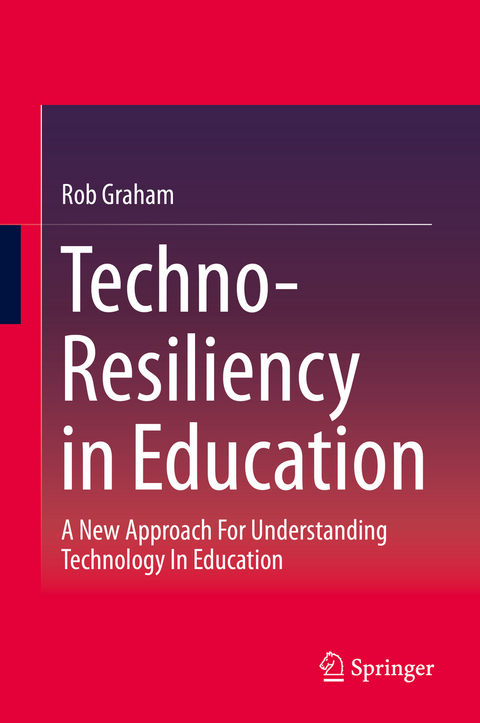
Techno-Resiliency in Education (eBook)
XXV, 114 Seiten
Springer International Publishing (Verlag)
978-3-319-22011-6 (ISBN)
This book formulates a greater understanding of how to enable a capacity for building social professional practice related to technology-enriched teaching and learning (TETL) specific, but not limited to, educational settings. This book comes at a time when many in education are struggling to provide a technology enriched learning experience for students who are entering classrooms with high expectations for such an experience. The focus on the protective factors and identified resilient professional practices, instead of on well documented and commonly cited risk factors and barriers that impede the effective integration of TETL, represents a distinguishing feature of this work. By attempting to better understand and document how two schools that were classified as resilient in their use of technology have been able to overcome risk factors (e.g., budgetary constraints, a lack of resources, a lack of training, technological support issues), this book will offer the unique concept of techno-resiliency and some of its deeper insights and strategies.
Dr. Graham has been an educator for 22 years. He has a diverse teaching portfolio that includes teaching appointments as far reaching as Japan and Hawaii, and as challenging as a penal institution. He also taught for 11 years in a public school, 12 years as an adult educator in a community college, and most recently, 9 years as an assistant professor at Nipissing University in the Schulich School of Education located in North Bay, Ontario, Canada. He was awarded the 2013 Nipissing University Distinguished Alumni Award. In 2015, the national organization, Canadian Association for Teacher Education (CATE), recognized his doctoral research that was conducted out of Lancaster University in the UK by awarding him the CATE Doctoral Research Award. Most recently, Dr. Graham served on the Prime Minister of Canada Teaching Excellence Committee. He looks forward to speaking with others about his book and the insights he provides about the challenges and rewards of technology integration. Please feel free to contact him at technoresiliency@gmail.com to schedule speaking engagements.
Dr. Graham has been an educator for 22 years. He has a diverse teaching portfolio that includes teaching appointments as far reaching as Japan and Hawaii, and as challenging as a penal institution. He also taught for 11 years in a public school, 12 years as an adult educator in a community college, and most recently, 9 years as an assistant professor at Nipissing University in the Schulich School of Education located in North Bay, Ontario, Canada. He was awarded the 2013 Nipissing University Distinguished Alumni Award. In 2015, the national organization, Canadian Association for Teacher Education (CATE), recognized his doctoral research that was conducted out of Lancaster University in the UK by awarding him the CATE Doctoral Research Award. Most recently, Dr. Graham served on the Prime Minister of Canada Teaching Excellence Committee. He looks forward to speaking with others about his book and the insights he provides about the challenges and rewards of technology integration. Please feel free to contact him at technoresiliency@gmail.com to schedule speaking engagements.
Dedication 6
Abstract 8
Foreword 10
What to Expect from and Imagined Uses for This Book 12
Book Outline 13
Acknowledgements 16
Abbreviations, Original Concepts,Original Terminology ContainedWithin the Book Abbreviations 18
Contents 20
List of Figures 24
List of Tables 26
Chapter 1: Have We Really Come That Far? 27
1.1 Establishing the Context 28
1.2 Techno-Resiliency: A Personal Narrative 28
1.3 Significance of the Book: Making IT Happen Then and Now 29
1.4 Resilience: Adoption, Adaptation, and Added Value 30
1.5 Summary 31
References 32
Chapter 2: Research Matters 33
2.1 A Basis for Review 33
2.2 A Curious Juxtaposition 34
2.2.1 Theoretical Threads 35
2.3 Looking Beyond the Barriers: Inequity 36
2.3.1 Theoretical Threads 40
2.4 Unmet Expectations 41
2.4.1 Theoretical Threads 41
2.5 Constructing the Conditions for Change: Resilience as a Theoretical Lens 42
2.5.1 Theoretical Threads 43
2.6 The Concept of Resiliency: An Adapted Approach 43
2.6.1 Theoretical Threads 46
2.7 Organizational Learning and the Metabolism Metaphor 47
2.7.1 Theoretical Threads 49
2.8 Practice Matters 49
2.8.1 Theoretical Threads 51
2.9 Summary 52
References 52
Chapter 3: A Unique Approach for Gaining Insight 56
3.1 Qualitative Research Approach: A Rationale 56
3.2 Personal Epistemology and Ontological Perspective 58
3.3 An Instrumental Approach 59
3.4 Checking My Conceptual Baggage 59
3.5 School Selection Process 60
3.6 The Need for Benchmarks: ISTE 62
3.7 Participant Levels and Sampling Strategy: Invited Convenience 63
3.7.1 Principal and Teacher-Level Participation 63
3.8 Member Checking 64
3.9 Student-Level Participation: A Higher Level of Authenticity 65
3.10 Tools of Inquiry 66
3.11 Semiformal Interviews: Guiding Process 67
3.12 Active-Immersive Participant Observation: A Reconceptualization 67
3.13 Experiential Knowledge 69
3.13.1 Stage Theory of the Taken-for-Granted: Preguiding Theoretical Propositions 70
3.14 Participant Metrics and Context Descriptors 70
3.15 Data Analysis: Procedures and Process 71
3.15.1 Methods and Technological Enhancements 71
3.15.2 Analogue Reorientation Analysis: A Unique Procedure 73
3.16 Qualitative Research Software: Technolust or Digital Enhancement? 74
3.17 Summary 75
References 75
Chapter 4: What They Showed Me and What They Told Me 77
4.1 Key Themes, Observations, Interview Data, and Experiential Knowledge 78
4.2 Theme 1: A Propensity for Engaged Technology Use: Practices That Matter 80
4.2.1 Active-Immersive Participant Observations: Beyond the Backstage Pass 80
4.2.2 Urban and Rural: Key Contextual Differences 83
4.2.3 A Notable Resilient Practice: BYOD 84
4.2.4 Points of Intersection and Distinction: Rural and Urban Settings 87
4.2.5 Semiformal Interview Data: Interpretations of What They Told Me 87
4.2.6 Transcript in Context 88
4.2.7 The Magical Elixir for a CoP? 90
4.2.8 The Psychologically Responsive Classroom: Student-Centric Practices 90
4.2.9 Combined Grades and Team Teaching: Resilient Practices and Vehicle for Transporting Tacit Knowledge? 92
4.2.10 Experiential Knowledge: Connections with My Professional Past and Present 94
4.3 Theme 2: A Notable Professional Imperative 95
4.3.1 Active-Immersive Participant Observation: Beyond the Backstage Pass 95
4.3.2 Semiformal Interview Data: Interpretations of What They Told Me 96
4.3.3 Who Is Driving Whom? 96
4.3.4 Principal as Extrinsic Driver 98
4.3.5 Experiential Knowledge: Connections with My Professional Past and Present 100
4.4 Theme 3: A Pocket of Resilience 101
4.4.1 Active-Immersive Participant Observation: Beyond the Backstage Pass 101
4.4.2 Semiformal Interview Data: Interpretations of What They Told Me 101
4.4.3 Experiential Knowledge: Connections with My Professional Past and Present and the Darker Side of Resilience 103
4.5 Theme 4: Significant Voices: A Level of Student Taken-for-Grantedness 104
4.5.1 Active-Immersive Participant Observation: Beyond the Backstage Pass 104
4.5.2 Semiformal Interview Data: Interpretations of What They Told Me 104
4.5.3 The Anticipated Sense of Engagement: Putting Myself into It! 105
4.5.4 Experiential Knowledge: Connections with My Professional Past and Present 107
4.6 Summary 108
References 108
Chapter 5: Establishing Connections 110
5.1 So, Where Are We Now and Where Am I Going? 110
5.2 Back to Where We Started 111
5.3 Resilience as a Theoretical Lens 112
5.4 Practice as Teacher and In-house PD: A Shift in Thinking 112
5.5 A Matter of Principles or Principal? 113
5.6 Who Impacts Whom? A Form of Backwards Design 114
5.7 Student-Taken-for-Grantedness or Routinization of Practice? 115
5.8 The Darker Side of Resilient Practice: Expansion, Responsibility, and Sustainability 117
5.9 Determining the Threshold of Sustainable Resilient Practices 118
5.10 A Not-So-Straight-Forward Solution 118
5.11 Moving From Barriers to Bridges: Magnifying Conditions for Change 119
5.12 Overcoming Inequity: Lessons Learned from Resilient Practices 120
5.13 Essential Conditions: ISTE 120
5.14 Summary 122
References 122
Chapter 6: Practically Speaking 124
6.1 Okay, So What Is Next? 124
6.2 For Those with an Appetite: Four Menus to Choose from! 125
6.3 Looking in the Mirror, What Do I See? Reflections on the Research Process and the Aims of This Book 127
6.4 Checking My Conceptual Baggage at the Door 131
6.5 Research Report Card: Room for Improvement! 131
6.6 Recommendation Briefs: Lessons Learned 132
6.7 Where Do We Go from Here? Implications for Further Research and Key Contributions 133
6.8 Concluding Comments: Ending with an Academic Starting Point! 134
References 135
Index 136
| Erscheint lt. Verlag | 16.10.2015 |
|---|---|
| Zusatzinfo | XXV, 114 p. 5 illus. |
| Verlagsort | Cham |
| Sprache | englisch |
| Themenwelt | Geisteswissenschaften |
| Sozialwissenschaften ► Pädagogik ► Schulpädagogik / Grundschule | |
| Schlagworte | Educational technology • Learning and Instruction • technology and learning • technology and pedagogy • technology and the classroom • technology-enriched learning • technology integration |
| ISBN-10 | 3-319-22011-X / 331922011X |
| ISBN-13 | 978-3-319-22011-6 / 9783319220116 |
| Informationen gemäß Produktsicherheitsverordnung (GPSR) | |
| Haben Sie eine Frage zum Produkt? |
 PDF (Wasserzeichen)
DRM: Digitales Wasserzeichen
Dieses eBook enthält ein digitales Wasserzeichen und ist damit für Sie personalisiert. Bei einer missbräuchlichen Weitergabe des eBooks an Dritte ist eine Rückverfolgung an die Quelle möglich.
Dateiformat: PDF (Portable Document Format)
Mit einem festen Seitenlayout eignet sich die PDF besonders für Fachbücher mit Spalten, Tabellen und Abbildungen. Eine PDF kann auf fast allen Geräten angezeigt werden, ist aber für kleine Displays (Smartphone, eReader) nur eingeschränkt geeignet.
Systemvoraussetzungen:
PC/Mac: Mit einem PC oder Mac können Sie dieses eBook lesen. Sie benötigen dafür einen PDF-Viewer - z.B. den Adobe Reader oder Adobe Digital Editions.
eReader: Dieses eBook kann mit (fast) allen eBook-Readern gelesen werden. Mit dem amazon-Kindle ist es aber nicht kompatibel.
Smartphone/Tablet: Egal ob Apple oder Android, dieses eBook können Sie lesen. Sie benötigen dafür einen PDF-Viewer - z.B. die kostenlose Adobe Digital Editions-App.
Buying eBooks from abroad
For tax law reasons we can sell eBooks just within Germany and Switzerland. Regrettably we cannot fulfill eBook-orders from other countries.
aus dem Bereich