


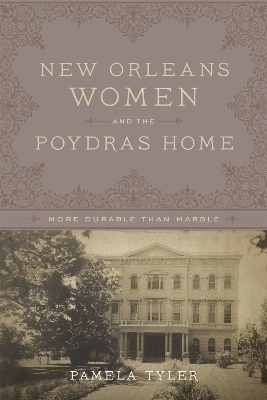
New Orleans Women and the Poydras Home
More Durable Than Marble
Seiten
2016
Louisiana State University Press (Verlag)
978-0-8071-6322-1 (ISBN)
Louisiana State University Press (Verlag)
978-0-8071-6322-1 (ISBN)
- Lieferbar (Termin unbekannt)
- Versandkostenfrei
- Auch auf Rechnung
- Artikel merken
A two-hundred-year-old institution, the Poydras Home stands as an exemplar of woman-led charitable organisations. In an engaging narrative, Pamela Tyler offers the first complete history of this New Orleans establishment from its founding as an orphanage to its present-day operation as a retirement community and assisted-living facility.
A two-hundred-year-old institution, the Poydras Home -- originally the Poydras Asylum -- stands as an exemplar of woman-led charitable organizations. In a thorough and engaging narrative, Pamela Tyler offers the first complete history of this remarkable New Orleans establishment from its founding as an orphanage for young girls to its present-day operation as a retirement community and assisted-living facility. Throughout, Tyler paints a vivid picture of the many women who faced down the challenges of war, disease, natural disaster, social unrest, and restrictive gender ideals to realize the mission of the Poydras Home.
Drawing on previously unreleased archival material, Tyler documents how the institution's benefactor, Julien Poydras, used his immense wealth to support a haven for impoverished girls, and how the dedicated women of the Poydras board pursued that ambition through more than just residential services. Tyler reveals that the majority of the Poydras ""orphans"" had one living parent, and it was dire poverty and a dearth of social services in New Orleans that drove single parents, usually mothers, to place their daughters in the asylum. Further research demonstrates that the Poydras went beyond simply providing a shelter for the children of distressed parents; volunteer managers worked to shape their charges' character through an emphasis on morals, education, and the fundamentals of housewifery.
Following the institution from its antebellum origins to Reconstruction, through the Progressive era, and into the obsolescence of children's homes in the mid-twentieth century, Tyler highlights the impacts of both national affairs and daily life on the charity. This rich history winds through the last fifty years as the Poydras Home boldly and successfully changed its mission to provide care for elderly men and women.
The result of years of research, New Orleans Women and the Poydras Home is a sweeping social history that recognizes the determination of women caregivers and the thousands of lives they benefited.
A two-hundred-year-old institution, the Poydras Home -- originally the Poydras Asylum -- stands as an exemplar of woman-led charitable organizations. In a thorough and engaging narrative, Pamela Tyler offers the first complete history of this remarkable New Orleans establishment from its founding as an orphanage for young girls to its present-day operation as a retirement community and assisted-living facility. Throughout, Tyler paints a vivid picture of the many women who faced down the challenges of war, disease, natural disaster, social unrest, and restrictive gender ideals to realize the mission of the Poydras Home.
Drawing on previously unreleased archival material, Tyler documents how the institution's benefactor, Julien Poydras, used his immense wealth to support a haven for impoverished girls, and how the dedicated women of the Poydras board pursued that ambition through more than just residential services. Tyler reveals that the majority of the Poydras ""orphans"" had one living parent, and it was dire poverty and a dearth of social services in New Orleans that drove single parents, usually mothers, to place their daughters in the asylum. Further research demonstrates that the Poydras went beyond simply providing a shelter for the children of distressed parents; volunteer managers worked to shape their charges' character through an emphasis on morals, education, and the fundamentals of housewifery.
Following the institution from its antebellum origins to Reconstruction, through the Progressive era, and into the obsolescence of children's homes in the mid-twentieth century, Tyler highlights the impacts of both national affairs and daily life on the charity. This rich history winds through the last fifty years as the Poydras Home boldly and successfully changed its mission to provide care for elderly men and women.
The result of years of research, New Orleans Women and the Poydras Home is a sweeping social history that recognizes the determination of women caregivers and the thousands of lives they benefited.
Pamela Tyler is associate professor of history at the University of Southern Mississippi and author of Silk Stockings and Ballot Boxes: Women and Politics in New Orleans, 1920- 1963.
| Erscheinungsdatum | 05.04.2016 |
|---|---|
| Verlagsort | Baton Rouge |
| Sprache | englisch |
| Maße | 155 x 237 mm |
| Gewicht | 494 g |
| Themenwelt | Geisteswissenschaften ► Geschichte ► Regional- / Ländergeschichte |
| Geschichte ► Teilgebiete der Geschichte ► Kulturgeschichte | |
| Studium ► Querschnittsbereiche ► Geschichte / Ethik der Medizin | |
| Sozialwissenschaften ► Politik / Verwaltung ► Staat / Verwaltung | |
| Sozialwissenschaften ► Soziologie ► Gender Studies | |
| ISBN-10 | 0-8071-6322-8 / 0807163228 |
| ISBN-13 | 978-0-8071-6322-1 / 9780807163221 |
| Zustand | Neuware |
| Informationen gemäß Produktsicherheitsverordnung (GPSR) | |
| Haben Sie eine Frage zum Produkt? |
Mehr entdecken
aus dem Bereich



aus dem Bereich
Die Revolution des Gemeinen Mannes
Buch | Softcover (2024)
C.H.Beck (Verlag)
CHF 16,80
Eine Geschichte des Geschmacks
Buch | Hardcover (2025)
C.H.Beck (Verlag)
CHF 49,95
vom Mittelalter bis zur Gegenwart
Buch | Softcover (2024)
C.H.Beck (Verlag)
CHF 16,80


