


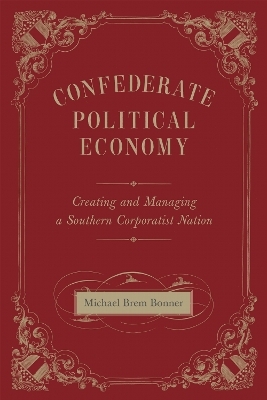
Confederate Political Economy
Creating and Managing a Southern Corporatist Nation
Seiten
2016
Louisiana State University Press (Verlag)
978-0-8071-6212-5 (ISBN)
Louisiana State University Press (Verlag)
978-0-8071-6212-5 (ISBN)
Argues that the Confederate nation was an expedient corporatist state - a society that required all sectors of the economy to work for the national interest, as defined by a partnership of industrial leaders and a dominant government.
In Confederate Political Economy, Michael Bonner suggests that the Confederate nation was an expedient corporatist state -- a society that required all sectors of the economy to work for the national interest, as defined by a partnership of industrial leaders and a dominant government. As Bonner shows, the characteristics of the Confederate States' political economy included modern organisational methods that mirrored the economic landscape of other late nineteenth-century and early-twentieth-century corporatist governments.
Southern leaders, Bonner argues, were slave-owning agricultural capitalists who sought a counterrevolution against northern liberal capitalism. During secession and as the war progressed, they built and reinforced Confederate nationalism through specific centralized government policies. Bolstered by the Confederate constitution, these policies evolved into a political culture that allowed for immense executive powers, facilitated an anti-party ideology, and subordinated individual rights. In addition, the South's lack of industrial capacity forced the Confederacy to pursue a curious manufacturing policy that used both private companies and national ownership to produce munitions. This symbiotic relationship was just one component of the Confederacy's expedient corporatist state: other wartime policies like conscription, the domestic passport system, and management of southern railroads also exhibited unmistakable corporatist characteristics. Bonner's probing research and new comparative analysis expand our understanding of the complex organisation and relationships in Confederate political and economic culture during the Civil War.
In Confederate Political Economy, Michael Bonner suggests that the Confederate nation was an expedient corporatist state -- a society that required all sectors of the economy to work for the national interest, as defined by a partnership of industrial leaders and a dominant government. As Bonner shows, the characteristics of the Confederate States' political economy included modern organisational methods that mirrored the economic landscape of other late nineteenth-century and early-twentieth-century corporatist governments.
Southern leaders, Bonner argues, were slave-owning agricultural capitalists who sought a counterrevolution against northern liberal capitalism. During secession and as the war progressed, they built and reinforced Confederate nationalism through specific centralized government policies. Bolstered by the Confederate constitution, these policies evolved into a political culture that allowed for immense executive powers, facilitated an anti-party ideology, and subordinated individual rights. In addition, the South's lack of industrial capacity forced the Confederacy to pursue a curious manufacturing policy that used both private companies and national ownership to produce munitions. This symbiotic relationship was just one component of the Confederacy's expedient corporatist state: other wartime policies like conscription, the domestic passport system, and management of southern railroads also exhibited unmistakable corporatist characteristics. Bonner's probing research and new comparative analysis expand our understanding of the complex organisation and relationships in Confederate political and economic culture during the Civil War.
Michael Brem Bonner is assistant professor of history at the University of South Carolina at Lancaster.
| Erscheinungsdatum | 30.04.2016 |
|---|---|
| Reihe/Serie | Conflicting Worlds: New Dimensions of the American Civil War |
| Verlagsort | Baton Rouge |
| Sprache | englisch |
| Maße | 141 x 223 mm |
| Gewicht | 333 g |
| Themenwelt | Geisteswissenschaften ► Geschichte ► Regional- / Ländergeschichte |
| Geschichte ► Teilgebiete der Geschichte ► Militärgeschichte | |
| Geschichte ► Teilgebiete der Geschichte ► Wirtschaftsgeschichte | |
| Wirtschaft ► Volkswirtschaftslehre ► Wirtschaftspolitik | |
| ISBN-10 | 0-8071-6212-4 / 0807162124 |
| ISBN-13 | 978-0-8071-6212-5 / 9780807162125 |
| Zustand | Neuware |
| Informationen gemäß Produktsicherheitsverordnung (GPSR) | |
| Haben Sie eine Frage zum Produkt? |
Mehr entdecken
aus dem Bereich



aus dem Bereich
von der Wiederbewaffnung bis zur Zeitenwende
Buch | Softcover (2025)
C.H.Beck (Verlag)
CHF 16,80
Deutschlands großer Volksaufstand
Buch | Softcover (2024)
Propyläen Verlag
CHF 30,80


