


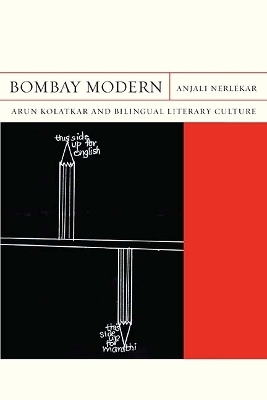
Bombay Modern
Arun Kolatkar and Bilingual Literary Culture
Seiten
2016
Northwestern University Press (Verlag)
978-0-8101-3274-0 (ISBN)
Northwestern University Press (Verlag)
978-0-8101-3274-0 (ISBN)
- Titel z.Zt. nicht lieferbar
- Versandkostenfrei
- Auch auf Rechnung
- Artikel merken
Offers a close reading of Arun Kolatkar's canonical poetic works that relocates the genre of poetry to the centre of both Indian literary modernist studies and postcolonial Indian studies. Nerlekar shows how a bilingual, materialist reading of Kolatkar's texts uncovers a uniquely resistant sense of the “local” that defies the monolinguistic cultural pressures of the post-1960 years.
Anjali Nerlekar's Bombay Modern is a close reading of Arun Kolatkar's canonical poetic works that relocates the genre of poetry to the center of both Indian literary modernist studies and postcolonial Indian studies. Nerlekar shows how a bilingual, materialist reading of Kolatkar's texts uncovers a uniquely resistant sense of the ""local"" that defies the monolinguistic cultural pressures of the post-1960 years and straddles the boundaries of English and Marathi writing.
Bombay Modern uncovers an alternative and provincial modernism through poetry, a genre that is marginal to postcolonial studies, and through bilingual scholarship across English and Marathi texts, a methodology that is currently peripheral at best to both modernist studies and postcolonial literary criticism in India. Eschewing any attempt to define an overarching or universal modernism, Bombay Modern delimits its sphere of study to ""Bombay"" and to the ""post-1960"" (the sathottari period) in an attempt to examine at close range the specific way in which this poetry redeployed the regional, the national, and the international to create a very tangible yet transient local.
Anjali Nerlekar's Bombay Modern is a close reading of Arun Kolatkar's canonical poetic works that relocates the genre of poetry to the center of both Indian literary modernist studies and postcolonial Indian studies. Nerlekar shows how a bilingual, materialist reading of Kolatkar's texts uncovers a uniquely resistant sense of the ""local"" that defies the monolinguistic cultural pressures of the post-1960 years and straddles the boundaries of English and Marathi writing.
Bombay Modern uncovers an alternative and provincial modernism through poetry, a genre that is marginal to postcolonial studies, and through bilingual scholarship across English and Marathi texts, a methodology that is currently peripheral at best to both modernist studies and postcolonial literary criticism in India. Eschewing any attempt to define an overarching or universal modernism, Bombay Modern delimits its sphere of study to ""Bombay"" and to the ""post-1960"" (the sathottari period) in an attempt to examine at close range the specific way in which this poetry redeployed the regional, the national, and the international to create a very tangible yet transient local.
Anjali Nerlekar is an assistant professor of South Asian literatures at Rutgers University, USA.
| Erscheinungsdatum | 03.06.2016 |
|---|---|
| Reihe/Serie | Flashpoints |
| Verlagsort | Evanston |
| Sprache | englisch |
| Maße | 154 x 231 mm |
| Gewicht | 582 g |
| Themenwelt | Geisteswissenschaften ► Sprach- / Literaturwissenschaft ► Anglistik / Amerikanistik |
| Geisteswissenschaften ► Sprach- / Literaturwissenschaft ► Literaturwissenschaft | |
| Geisteswissenschaften ► Sprach- / Literaturwissenschaft ► Sprachwissenschaft | |
| ISBN-10 | 0-8101-3274-5 / 0810132745 |
| ISBN-13 | 978-0-8101-3274-0 / 9780810132740 |
| Zustand | Neuware |
| Informationen gemäß Produktsicherheitsverordnung (GPSR) | |
| Haben Sie eine Frage zum Produkt? |
Mehr entdecken
aus dem Bereich



aus dem Bereich
Paul Celans Poetik der Mehrsprachigkeit
Buch | Hardcover (2025)
De Gruyter (Verlag)
CHF 153,90


