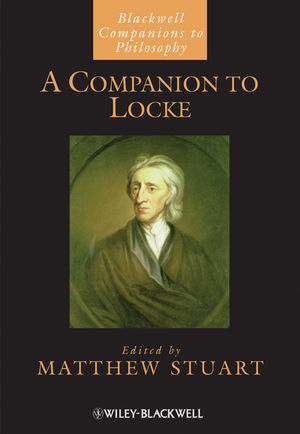
A Companion to Locke (eBook)
John Wiley & Sons (Verlag)
978-1-118-32879-8 (ISBN)
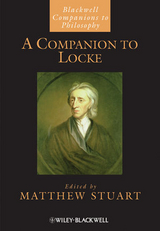
This collection of 28 original essays examines the diverse scope of John Locke's contributions as a celebrated philosopher, empiricist, and father of modern political theory.
- Explores the impact of Locke's thought and writing across a range of fields including epistemology, metaphysics, philosophy of science, political theory, education, religion, and economics
- Delves into the most important Lockean topics, such as innate ideas, perception, natural kinds, free will, natural rights, religious toleration, and political liberalism
- Identifies the political, philosophical, and religious contexts in which Locke's views developed, with perspectives from today's leading philosophers and scholars
- Offers an unprecedented reference of Locke's contributions and his continued influence
Matthew Stuart is Professor of Philosophy at Bowdoin College. He is the author of Locke's Metaphysics (2013), which examines Locke's views about ontology, primary and secondary qualities, essence and accident, substratum, mind and matter, constitution, personal identity, and agency. He has also written articles on Locke's philosophy of science and his theory of ideas.
This collection of 28 original essays examines the diverse scope of John Locke s contributions as a celebrated philosopher, empiricist, and father of modern political theory. Explores the impact of Locke s thought and writing across a range of fields including epistemology, metaphysics, philosophy of science, political theory, education, religion, and economics Delves into the most important Lockean topics, such as innate ideas, perception, natural kinds, free will, natural rights, religious toleration, and political liberalism Identifies the political, philosophical, and religious contexts in which Locke s views developed, with perspectives from today s leading philosophers and scholars Offers an unprecedented reference of Locke s contributions and his continued influence
Matthew Stuart is Professor of Philosophy at Bowdoin College. He is the author of Locke's Metaphysics (2013), which examines Locke's views about ontology, primary and secondary qualities, essence and accident, substratum, mind and matter, constitution, personal identity, and agency. He has also written articles on Locke's philosophy of science and his theory of ideas.
Notes on Contributors ix
References to Locke'sWorks xvi
Introduction 1
Matthew Stuart
Part I Life and Background 25
1 Locke's Life 27
Mark Goldie
2 The Contexts of Locke's Political Thought 45
Jacqueline Rose
3 Locke and Natural Philosophy 64
Peter R. Anstey
4 Locke and Scholasticism 82
E.J. Ashworth
5 Locke and Descartes 100
Lisa Downing
Part II Metaphysics and Epistemology 121
6 The Genesis and Composition of the Essay 123
J. R. Milton
7 The Theory of Ideas 140
David Soles
8 Locke's Critique of Innatism 157
Raffaella De Rosa
9 Locke on Perception 175
Michael Jacovides
10 Primary and Secondary Qualities 193
Robert A.Wilson
11 Locke on Essence and the Social Construction of Kinds 212
Kenneth P.Winkler
12 Locke's Theory of Identity 236
Dan Kaufman
13 Liberty and Suspension in Locke's Theory of theWill 260
Don Garrett
14 Language and Meaning 279
E.J. Lowe
15 Locke on Knowledge and Belief 296
Antonia LoLordo
16 Sensitive Knowledge: Locke on Skepticism and Sensation 313
Jennifer Nagel
17 Locke on Thinking Matter 334
Martha Brandt Bolton
18 The Correspondence with Stillingfleet 354
Matthew Stuart
Part III Government, Ethics, and Society 371
19 Locke on the Law of Nature and Natural Rights 373
S. Adam Seagrave
20 Locke on Property and Money 394
Richard Boyd
21 Locke on the Social Contract 413
A. John Simmons
22 Locke on Toleration 433
Alex Tuckness
23 Locke on Education 448
Ruth W. Grant and Benjamin R. Hertzberg
Part IV Religion 467
24 Locke's Philosophy of Religion 469
Marcy P. Lascano
25 The Reasonableness of Christianity and A Paraphrase and Notes on the Epistles of St Paul 486
Victor Nuovo
Part V Locke's Legacy 503
26 Locke and British Empiricism 505
Louis E. Loeb
27 Locke and the Liberal Tradition 528
Richard J. Arneson
28 Locke and America 546
Mark Goldie
Index 564
"A Companion to Locke is a splendid collection of essays by an international team of distinguished scholars. The breadth of its coverage will make it an invaluable resource for specialists and students alike."
Nicholas Jolley, University of California, Irvine
"This is an extremely valuable resource both for entry-level students and for experts. Stuart has put together a distinguished group of scholars writing on a wide range of topics; the resulting volume will prove a springboard for the next stage in the development of studies of Locke's philosophy."
Edwin McCann, University of Southern California
"The volume offers a very valuable commentary on most aspects of Locke's philosophy. Broadly conceived and written by leading and younger Locke scholars, it offers what is perhaps the best available commentary of its kind on the founder of both modern empiricism and liberal political philosophy."
John Rogers, Keele University
Notes on Contributors
Peter R. Anstey is an ARC Future Fellow and Professor of Philosophy in the School of Philosophical and Historical Inquiry at the University of Sydney. He specializes in early-modern philosophy with a special focus on the philosophy of leading English philosophers including John Locke, Robert Boyle, and Francis Bacon. He is the author of John Locke and Natural Philosophy (Oxford University Press, 2011) and editor (with Lawrence M. Principe) of the Clarendon edition of John Locke: Writings on Natural Philosophy and Medicine, forthcoming.
Richard J. Arneson is Professor of Philosophy, and occupies the Valtz Family Chair in Philosophy, at the University of California, San Diego. He also codirects the Institute for Law and Philosophy at UCSD's School of Law. He is the author of more than 100 articles on a wide range of topics in political philosophy. His recent current research is on distributive justice. Some of this work explores how one might best incorporate a reasonable account of personal responsibility into a broadly egalitarian theory of justice. He also considers how consequentialist morality might be developed in a version that is appealing and appropriately responsive to its critics. This latter project involves exploring the structure of moderate deontology to identify the best rival of consequentialism.
E. Jennifer Ashworth is Distinguished Professor Emerita of Philosophy at the University of Waterloo in Canada. She has published extensively on medieval and postmedieval logic and philosophy of language. Her first book, Language and Logic in the Post-Medieval Period, was published in 1974 and her most recent book, Les théories de l'analogie du XIIe au XVIe siècle, was published in 2008. She has contributed to the Cambridge History of Later Medieval Philosophy (1982), the Cambridge History of Renaissance Philosophy (1988) and the new Cambridge History of Medieval Philosophy (2010).
Martha Brandt Bolton is Professor of Philosophy at Rutgers University. She works on the history of seventeenth- and eighteenth-century philosophy and is currently interested in theories of cognition and substance metaphysics. Her articles on Locke include “The taxonomy of ideas in Locke's Essay” in Cambridge Companion to Locke's Essay concerning Human Understanding, ed. Lex Newman, and “Intellectual virtue and moral law in Locke's Ethics” in Contemporary Perspectives on Early Modern Philosophy, eds Paul Hoffman, David Owen, and Gideon Yaffe.
Richard Boyd is Associate Professor of Government at Georgetown University. He is the author of Uncivil Society: The Perils of Pluralism and the Making of Modern Liberalism (Rowman & Littlefield, 2004) and coeditor of Tocqueville and the Frontiers of Democracy (Cambridge University Press, 2013). His articles on early-modern political thought, liberalism, and civil society have appeared in Journal of Politics, Review of Politics, History of Political Thought, Political Theory, Social Philosophy & Policy, Political Studies, Perspectives on Politics, Polity, European Journal of Political Theory, and other journals. Before coming to Georgetown he taught at the University of Wisconsin-Madison, University of Pennsylvania, University of Chicago, and Deep Springs College.
Raffaella De Rosa is Associate Professor and Chair of the Philosophy Department at Rutgers-Newark. She is also a member of the Graduate Faculty in the Philosophy Department at Rutgers-New Brunswick and of the Graduate Faculty in the Psychology Department at Rutgers-Newark. Her research interests are in early modern theories of cognition, mental representation, and concept acquisition, as well as contemporary theories of mind and concepts. Some of her work can be described as being at the intersection between early-modern and contemporary theories of mind. After publishing several articles on Locke's and Descartes' theories of mind and ideas and a book on Descartes' account of sensory representation (Descartes and the Puzzle of Sensory Representation, Oxford University Press, 2010), she turned the focus of her research onto the philosophical and psychological question of the origin of concepts.
Lisa Downing is Professor of Philosophy at the Ohio State University. She has published essays on Locke in The Philosophical Review, The Journal of the History of Philosophy, The Cambridge Companion to Locke's Essay, and many other journals and volumes. She also works on Descartes, Malebranche, Boyle, Berkeley, and early Newtonianism, especially on issues at the intersection between philosophy and natural philosophy in the seventeenth and early eighteenth centuries, such as mechanist conceptions of body and their justification, the status of gravity/attraction, the structure of efficient causation, and changing views of scientific explanation.
Don Garrett is Silver Professor of Philosophy at New York University. He was previously Kenan Distinguished Professor for Teaching Excellence at the University of North Carolina at Chapel Hill. He has also taught at Harvard University and the University of Utah. His research interests include seventeenth- and eighteenth-century metaphysics, epistemology, philosophy of mind, ethics, and political philosophy. He is the author of Cognition and Commitment in Hume's Philosophy (Oxford University Press, 1997), Hume (Routledge, 2015), and Nature and Necessity in Spinoza's Philosophy (Oxford University Press, forthcoming). He is the editor of The Cambridge Companion to Spinoza (Cambridge University Press, 1996; second edition forthcoming), and has served as coeditor of Hume Studies and as North American editor of Archiv für Geschichte der Philosophie.
Mark Goldie is Professor of Intellectual History and Fellow of Churchill College, University of Cambridge. He has published extensively on the political, religious, and intellectual history of seventeenth- and eighteenth-century Britain. He is editor of John Locke: Political Essays (Cambridge University Press, 1997) and The Selected Correspondence of John Locke (Oxford University Press, 2002), and coeditor of The Cambridge History of Political Thought, 1450–1700 (1991) and The Cambridge History of Eighteenth-Century Political Thought (2006). An intellectual biography of Locke in the post-Revolution era is in preparation.
Ruth W. Grant is Professor of Political Science and Philosophy and a Senior Fellow at the Kenan Institute for Ethics at Duke University. She is the author of John Locke's Liberalism and of several articles on Locke's political thought. She is the editor, with Nathan Tarcov, of Locke's educational writings. She has published widely in early-modern thought and ethics and politics. Her most recent book is Strings Attached: Untangling the Ethics of Incentives (Princeton University Press, 2014).
Benjamin Hertzberg is Visiting Professor of Political Science at Brigham Young University in Provo, Utah, where he researches and teaches contemporary liberal and democratic theory, the history of political thought, and religion and politics. He is the author of “Chains of persuasion in the deliberative system: addressing the pragmatics of religious inclusion,” Journal of Politics 2015 (4). Hertzberg's current research analyzes the epistemic and deliberative costs and benefits of religious participation in democratic decision making. He completed an appointment as a Robert Wood Johnson Foundation Scholar in Health Policy Research at Harvard University in 2013.
Michael Jacovides is Associate Professor of Philosophy at Purdue University. He has published articles on a variety of topics, including nine on various aspects of Locke's philosophy. He is also at work on a book about Locke and the scientific revolution.
Dan Kaufman is Associate Professor of Philosophy at the University of Colorado, Boulder. He has published extensively on seventeenth-century philosophy, especially on metaphysical issues – modality, individuation, identity, and substance. He is the editor of the forthcoming Routledge Companion to Seventeenth Century Philosophy, as well as the volume Identity, for the Oxford Philosophical Concepts series.
Marcy P. Lascano is Associate Professor of Philosophy at California State University Long Beach. Her primary research is in early-modern philosophical theology and metaphysics. Her published work includes “Emilie du Châtelet on the existence and nature of god: an examination of her arguments in light of their sources,” in British Journal for the History of Philosophy, 19 (4) 2011: 739–756, “Mary Astell on the existence and nature of God,” in Feminist Interpretations of Mary Astell, edited by Penelope Weiss and Alice Sowaal (Pennsylvania State University Press, forthcoming), and “Arguments for the existence of God” in The Routledge Companion to Seventeenth Century Philosophy, edited by Daniel Kaufman (Routledge, 2015). She is the recipient of an NEH Fellowship for the 2015–2016 year to work on her book manuscript, Early...
| Erscheint lt. Verlag | 23.9.2015 |
|---|---|
| Reihe/Serie | Blackwell Companions to Philosophy |
| Blackwell Companions to Philosophy | Blackwell Companions to Philosophy |
| Sprache | englisch |
| Themenwelt | Geisteswissenschaften ► Philosophie ► Allgemeines / Lexika |
| Geisteswissenschaften ► Philosophie ► Geschichte der Philosophie | |
| Geisteswissenschaften ► Philosophie ► Philosophie der Neuzeit | |
| Schlagworte | 17th & 18th Century Philosophy • 20th Century Philosophy • Classic Liberalism • Empiricism • Epistemology • Erkenntnistheorie • Essay Concerning Human Understanding • Free Will • innate ideas • innatism • Laws of Nature • lockean • Locke, John • Metaphysics • Modern Political Theory • Natural Philosophy • Natural Rights • Natural science • perception • Philosophie • Philosophie des 17. u. 18. Jhd. • Philosophie des 20. Jhd. • Philosophy • Philosophy of Religion • philosophy of science • Political Liberalism • Political thought • primary and secondary qualities • Religious toleration • SCHOLASTICISM • The enlightenment |
| ISBN-10 | 1-118-32879-5 / 1118328795 |
| ISBN-13 | 978-1-118-32879-8 / 9781118328798 |
| Informationen gemäß Produktsicherheitsverordnung (GPSR) | |
| Haben Sie eine Frage zum Produkt? |
 EPUB (Adobe DRM)
Kopierschutz: Adobe-DRM
Adobe-DRM ist ein Kopierschutz, der das eBook vor Mißbrauch schützen soll. Dabei wird das eBook bereits beim Download auf Ihre persönliche Adobe-ID autorisiert. Lesen können Sie das eBook dann nur auf den Geräten, welche ebenfalls auf Ihre Adobe-ID registriert sind.
Details zum Adobe-DRM
Dateiformat: EPUB (Electronic Publication)
EPUB ist ein offener Standard für eBooks und eignet sich besonders zur Darstellung von Belletristik und Sachbüchern. Der Fließtext wird dynamisch an die Display- und Schriftgröße angepasst. Auch für mobile Lesegeräte ist EPUB daher gut geeignet.
Systemvoraussetzungen:
PC/Mac: Mit einem PC oder Mac können Sie dieses eBook lesen. Sie benötigen eine
eReader: Dieses eBook kann mit (fast) allen eBook-Readern gelesen werden. Mit dem amazon-Kindle ist es aber nicht kompatibel.
Smartphone/Tablet: Egal ob Apple oder Android, dieses eBook können Sie lesen. Sie benötigen eine
Geräteliste und zusätzliche Hinweise
Buying eBooks from abroad
For tax law reasons we can sell eBooks just within Germany and Switzerland. Regrettably we cannot fulfill eBook-orders from other countries.
aus dem Bereich