


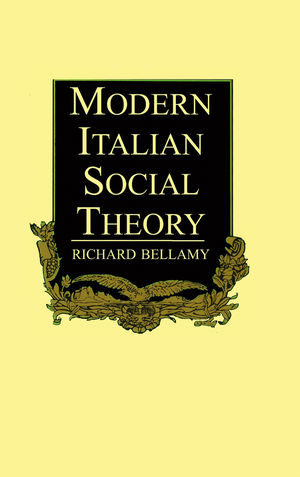
Modern Italian Social Theory (eBook)
Richard Bellamy is the author of Modern Italian Social Theory: Ideology and Politics from Pareto to the Present, published by Wiley.
2
VILFREDO PARETO
Pareto, when studied at all, is generally interpreted in two apparently mutually exclusive ways. Economists regard him as a classical liberal, who made important contributions to the theory of rational choice underlying the defence and analysis of market mechanisms. Sociologists and political theorists, by contrast, tend to dismiss his ideas as crude and illiberal – as attacking the role of reason and democracy in politics, and exalting the use of force by an elite to impose its will on the populace.1 The two images are said to correspond to different periods of his life. The first belongs to the early phase when, as an engineer and later a captain of industry, he threw himself into the movement for free trade. The second resulted from disillusionment at the frustration of his early hopes. An exile and recluse in Switzerland, he became the bitter and cynical commentator and dissector of contemporary events. The two divergent views are thereby reconciled by the thesis of an historical break between the early and the late Pareto.2
This chapter challenges this view by exploring the development of his sociology in the context of his political opinions and involvements.3 If disappointment with Italian politics is indeed the key to his sociological thought, then the ideals of the early period repay study by providing the background to his later criticisms. This constitutes the first section of this chapter. I then turn, in section two, to the examination of his system to show how the principles of his economic liberalism governed those of his sociology. Finally, in section three, I demonstrate the continuity between the supposed two Paretos, revealing how his use of the insights of the Trattato to describe political developments from the First World War to his death in 1923, echoes his analysis of events before the war.
I claim that the similarity between Pareto’s earlier and later views derives from the conceptual scheme he employed to interpret human behaviour. Pareto’s liberal principles led him to shrink the political spectrum drastically, reducing all human activity to certain sharply-defined and contestable types – essentially ‘rational’ or ‘irrational’. These categories were then enshrined within his sociology. This, in turn, had the effect of legitimizing a particular form of political practice – namely fascism. Pareto’s development thereby illustrates the central issue of this book – namely, the nature of the relationship between social theory and political action.
THE POLITICS OF PARETO’S SOCIOLOGY
Pareto was born in Paris in the year of liberal revolutions, 1848. His father, the Marquis Raffaello Pareto, had been exiled from Genoa to France in 1835 or 1836 for his Mazzinian opinions, and had taken a French wife. An amnesty enabled him to return in 1855. A civil engineer, he rose to high rank in the service of the Piedmontese (later Italian) government. Pareto followed his father’s career, graduating in engineering in 1869 with a thesis on ‘The fundamental principles of equilibrium in solid bodies’, which inspired a number of his later ideas on economics and sociology. He was appointed a director of the Florence branch of the Rome Railway Company in 1870 and held this post until 1874, when he became managing director of the Società Ferriere d’Italia.
During these years he increasingly took part in political debates as an ardent supporter of universal suffrage, republicanism, free trade and disarmament. Borkenau and H. Stuart Hughes regard his later debunking of humanitarian and democratic ideas as a reaction to his father’s Mazzinian beliefs. Yet, as Finer has pointed out, there is no evidence for this interpretation.4 On the contrary, he was plainly attracted by these ideas, regretting the ‘inauspicious circumstances’ that led to his being born in France rather than Italy, and regarding someone opposed to the goals of the Risorgimento as a ‘bad citizen’ and ‘a disgraceful being who lacks one of the prime qualities of man: patriotism and the love of liberty.5 Far from rejecting his paternal heritage, Pareto’s writings, in both economics and sociology, have their roots in his attempt to analyse the conditions governing the development of democracy in post-unification Italy, and to struggle for its realization in an uncorrupted form.
The difficulties confronting such schemes can be imagined by anyone with a cursory knowledge of Italian history. The moderate conservatives, the ‘Historical Right’, who ruled Italy from 1861 to 1876, were obsessed with reducing the debts incurred by the Risorgimento, the Italians becoming the most heavily taxed populace in Europe as a result. This was combined with a centralized and heavily bureaucratic administration, distant and remote from the people, only 2 per cent of whom had the franchise in any case. As attention was focused increasingly on internal problems, the Right’s inability to stimulate the economy or ameliorate the social conditions of the masses drew increased criticism. Popular unrest manifested itself in violent mass movements – Bakunin’s anarchism enjoying a spectacular new lease of life – and culminating in an attempted insurrectional putsch in 1874. Unfortunately the parliamentary opposition did little to solve these problems either. The ‘Young Left’ dropped the Mazzinian programme for the privileges of office, seeking little more than a reduction of taxation and a small increase of the electorate (to 7 per cent of the population) to ensure their continued stay in office. Under their leader Depretis, Italian politics became a matter of bargaining and the exploitation of government patronage to obtain the necessary balance between northern and southern interests by the various party or faction leaders to maintain their administration in power. This policy of trasformismo characterized public life for the next fifty years, and effectively blocked any radical change in government.
Pareto’s first political writings were primarily directed against the abuses of the Italian parliamentary system and the ruling classes’ lack of concern for the plight of the people. An admirer of Mill and Spencer and the British political system generally, he argued from the principle of individual liberty for a policy of universal suffrage and free trade. Pareto contended that the opposition of the bourgeoisie to both of these policies was motivated by the desire to protect their privileges, rather than a principled defence of freedom, as they maintained. They argued that the franchise must remain limited, because only those who paid taxes had a stake in the nation, adding that the illiterate masses were unable to make a reasoned decision in any case. Pareto retorted that responsible government would only result when all, through elections, were involved in it. The vote was not, he wrote, a right, but ‘the exercise of a necessary function for the good working of civil society.’ The voter required, as ‘a first and indispensable quality’, the possession of ‘the culture and the necessary knowledge to fulfil adequately his task.’ Compulsory education was therefore a prerequisite in a country where 78 per cent of the people were illiterate, if universal suffrage was to become not just ‘an empty word, but a beneficial reality.’
Following Mill, he defined liberty as ‘the faculty of doing everything which in a direct and immediate way does not harm others.’ Like Mill, however, some of the conclusions he drew from this principle which have more in common with T. H. Green’s ‘new liberalism’ than ‘classical liberalism’. For example, he argued that compulsory education, far from confliciting with liberty, was essential for its exercise:
Now it is manifestly clear that compulsory education should rather be called freedom of education, since the parent who does not educate his son harms him greatly and in a direct way … The new born son is a citizen to whom the law owes guardianship and protection, and in fact this principle prevails in the modern legislation of civilised peoples … even taking away the father’s right to dispose of his entire estate in his will. In virtue of what principle, I ask, must this guardianship, which is exercised over material goods, be diminished when treating that other patrimony, education, which is indispensable to all but above all to those, and they are the majority, who have no other?6
Pareto defended the workers’ right to combine and strike on analogous grounds. The innovative studies of Franchetti, Sonnino, Fortunato and Villari, from 1874 onwards, had already revealed the abject poverty oppressing the southern peasantry.7 Pareto’s own experience made him aware of the similar conditions prevailing amongst factory workers in the north.8 Commenting on a proposal to set a minimum wage and a maximum margin of profit, he sarcastically speculated on where the ‘lovers of liberty’, who opposed it, had been hiding
when the tide of government interference was growing, instituting monopolies of every sort. It must be because of my weak mental faculties that I can’t understand such a subtle distinction, but I fail to understand … how the principles of economics are unhurt when one punishes a citizen who does not want, either in agreement with others or alone, to sell his labour for a supposedly fair price and are mortally wounded when one...
| Erscheint lt. Verlag | 16.9.2015 |
|---|---|
| Sprache | englisch |
| Themenwelt | Geisteswissenschaften ► Sprach- / Literaturwissenschaft ► Sprachwissenschaft |
| Sozialwissenschaften ► Politik / Verwaltung ► Politische Theorie | |
| Sozialwissenschaften ► Soziologie ► Allgemeine Soziologie | |
| Schlagworte | amazon • author • bellamy • bellamyformat paperbackmodern • Development • Gesellschaftstheorie • Introduction • Italian • Italy • Modern • modern italian • Pareto • Political • Politics • present • Richard • sciencesmodern • Social • Social Theory • Sociology • Soziologie • Systematic • theory |
| ISBN-13 | 9780745689029 / 9780745689029 |
| Informationen gemäß Produktsicherheitsverordnung (GPSR) | |
| Haben Sie eine Frage zum Produkt? |
 EPUB (Adobe DRM)
Kopierschutz: Adobe-DRM
Adobe-DRM ist ein Kopierschutz, der das eBook vor Mißbrauch schützen soll. Dabei wird das eBook bereits beim Download auf Ihre persönliche Adobe-ID autorisiert. Lesen können Sie das eBook dann nur auf den Geräten, welche ebenfalls auf Ihre Adobe-ID registriert sind.
Details zum Adobe-DRM
Dateiformat: EPUB (Electronic Publication)
EPUB ist ein offener Standard für eBooks und eignet sich besonders zur Darstellung von Belletristik und Sachbüchern. Der Fließtext wird dynamisch an die Display- und Schriftgröße angepasst. Auch für mobile Lesegeräte ist EPUB daher gut geeignet.
Systemvoraussetzungen:
PC/Mac: Mit einem PC oder Mac können Sie dieses eBook lesen. Sie benötigen eine
eReader: Dieses eBook kann mit (fast) allen eBook-Readern gelesen werden. Mit dem amazon-Kindle ist es aber nicht kompatibel.
Smartphone/Tablet: Egal ob Apple oder Android, dieses eBook können Sie lesen. Sie benötigen eine
Geräteliste und zusätzliche Hinweise
Buying eBooks from abroad
For tax law reasons we can sell eBooks just within Germany and Switzerland. Regrettably we cannot fulfill eBook-orders from other countries.
aus dem Bereich


