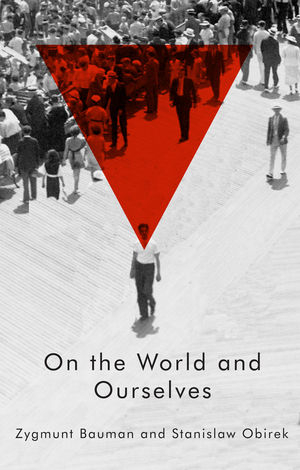
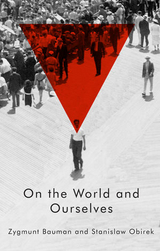
In the second series of their conversations Zygmunt Bauman and Stanislaw Obirek reflect on the life challenges confronted by the denizens of the fragmented, individualized society of consumers and the form taken in such a society by the fundamental aspects of the human condition - such as human responsibility for the choice between good and evil, self-formation and self-assertion, the need for recognition or the call to empathy, mutual respect, human dignity and tolerance.
Zygmunt Bauman is Professor Emeritus of Sociology at the University of Leeds, UK. His books have become international bestsellers and have been translated into more than thirty languages.
Stanislaw Obirek is a former Jesuit and priest, and is now Professor of Theology and Religious Studies at the University of Warsaw.
Unde malum from where does evil come? That is the question that has plagued humankind ever since Eve, seduced by the serpent, tempted Adam to taste the forbidden fruit of the tree of knowledge of good and evil. Throughout history the awareness of good and evil has always been linked to the awareness of choice and to the freedom and responsibility to choose this is what makes us human. But the responsibility to choose is a burden that weighs heavily on our shoulders, and the temptation to hand this over to someone else be they a demagogue or a scientist who claims to trace everything back to our genes is a tempting illusion, like the paradise in which humans have at last been relieved of the moral responsibility for their actions. In the second series of their conversations Zygmunt Bauman and Stanislaw Obirek reflect on the life challenges confronted by the denizens of the fragmented, individualized society of consumers and the form taken in such a society by the fundamental aspects of the human condition - such as human responsibility for the choice between good and evil, self-formation and self-assertion, the need for recognition or the call to empathy, mutual respect, human dignity and tolerance.
Zygmunt Bauman (1925-2017) was Professor Emeritus of Sociology at the University of Leeds, UK. His books have become international bestsellers and have been translated into more than thirty languages. Stanislaw Obirek is a former Jesuit and priest, and is now Professor of Theology and Religious Studies at the University of Warsaw.
Preface
I Reveries of Solitary Walkers
II Tangled Identities
III Hic et Nunc
2
Tangled Identities
Stanisław Obirek Leaving for a moment our discussion about good and evil, responsibility and love, I would like to provoke you into a discussion about who we are. Or, perhaps more accurately, about who we think we are hic et nunc. This ‘here and now’ is important I think, because ‘there and then’, we would, I suspect, have answered the question differently. The immediate impetus for my train of thought on identity were the last days spent in Białowieẓa Forest – literally in the heart of this virgin forest, closer to trees and animals than to people. But rather than extolling the beauty of this region of Poland, I would like to write about the people there, inscribed as it were into the trees, at one with nature. It was my first visit to Białowieza. Historically, I learned (priceless internet) that the town was the favourite of both King Władysław IV and Augustus III, and that it was possibly the hunting ground of Sigismund II Augustus and of Stefan Batory, while buildings were erected there by Tsar Alexander III. There is a Russian church, there is a chapel, there is an excellent restaurant which remembers its once-Jewish owner and serves delicacies of Jewish cuisine.
And we see a multiculturalism typical of this region, where Poles and Belorussians and Jews had lived in harmony for centuries, adding local Tatars into the mix, and, like other nations, managed to maintain their individuality while counting themselves in with the locals. In short, discussions on ethnicity and nationality were for years regarded here as tactless. It was mostly left for others, usually outsiders, to bring those discussions with them, complicating life for the locals.
Or maybe this is the case everywhere, not just in the province of Podlasie? This brief experience provokes me to question the justification of existing borders, or even their legitimacy. After all there is little advantage to them; they are nothing but a great deal of trouble. Similar vagaries of history have divided whole families, who after 1945 were forced to ‘feel’ Polish, Belorussian, Ukrainian, Lithuanian etc. How do you deal with this heritage – do you accept it, debate with it, or perhaps reject it out of hand? So where are my roots? The past and the present of Białowieza residents can be seen as metaphors for our here and now.
Zygmunt Bauman The shape in which you've brought up the question of ‘identity’ has been inspired, it seems, by the remnant of the times before the ‘nation-building’ frenzy (an era which lasted for 99 per cent of the history of mankind): no wonder, as it was composed in Białowieza – still redolent of the aromas of Jewish kitchens, the sounds of the muezzin calling and echoes of the hunt of the Lithuanians, Swedes, Saxons, Hungarians – all kings of the res publica, retrospectively described by historians as of ‘Both Nations’ (meaning Lithuanian and Polish). Miłosz wrote beautifully about the region, while you revive the tradition, lately less and less mentioned and heard of. It was there, in that region, where resided the vast majority of the 707,088 citizens of the Second Polish Republic listed in the Second Census of December 1931 as ‘locals’ because they could not understand the question about their ‘nationality’. The great central-European novelist Joseph Roth who lived some 200 kilometres south of Białowieża, though under the Habsburgs' rule, wrote in his short story The Bust of the Emperor about a certain Count Morstin, settled there in his ancestral estate, whom ‘no one ever saw drunk or gambling, or womanising’ because his sole passion was opposition to the ‘national question’. As Roth noted, the national question was at the time coming into focus throughout the Empire: ‘Everyone – whether willingly or just pretending – joined one of the many ethnic groups living in the old monarchy.’ And he explains: ‘It was discovered in the 19th century that he who wants to be a fully-fledged citizen, must first be a member of a particular race or nation.’ Franz Grillparzer, the highly popular Austrian poet and playwright, intuited the conclusion of that story in the imminent internecine slaughter – on battlefields randomly scattered all over the world's continents – of the Europeans moving ‘from humanity, through nationality, to bestiality’. And, as Roth himself commented in 1935, after that fact (and before the next one, yet more gruesome): ‘Nationalism, the omen of prelude to barbarity’.
Indeed, in our modern times, the division into nations replaced division into religions as the paramount motive and pretext for mass murder – at the same time taking over the baton in the centuries-old relay race of genocides. Its entry into the race was in a sense preordained at the 1555 Augsburg meeting of the envoys of the most powerful dynastic rulers of Europe who desperately sought a way of bringing to a halt the endless religious wars which had been devastating their estates and decimating their subjects. The negotiators reached a formula of cuius regio eius religio (in a loose but essence-grasping translation: ‘whoever rules decides which God his subjects should believe in’) – but it took another hundred years of bloody conflict, until 1648, for the dynastic power-houses of Europe, having sent their delegates this time to Münster and Osnabrück, to accept the Augsburg formula in deed and not just in word, and to set it into operation. The Agreement recorded in historiography as the ‘Treaty of Westphalia’, defined the concept of ‘territorial sovereignty’ still formally in operation today: as a complete, inalienable and indivisible power of the ruler, hereditary or elected, king or people, deemed to be anointed by God or representing (increasingly after the 1848 ‘Spring of the Nations’) the national body, the true owner of the state, over the population within its territorial boundaries. According to the Stanford Encyclopaedia of Philosophy, ‘sovereign power is practiced within territorial boundaries, but also, by definition, in relation to others who are forbidden to interfere in the sphere of sovereign authority.’ Here ‘others’ are equally territorially defined powers, except that their territory starts on the other side of the border. Any attempt to interfere with the status quo established by a sovereign was regarded as a-priori illegal, contemptuous – and represented a casus belli.
This historically framed pattern, chosen from amongst many other imaginable, workable and credible patterns for establishing order, became gradually, yet apparently irrevocably, ‘naturalized’ in the course of the following centuries. It was given a cast-iron, no longer questionable status in most of Europe; gradually but consistently it was also imposed on the rest of the planet under the decisive influence of Europe-centred world empires and in the course of a long succession of wars waged against local, all too often doggedly resistant, realities (think of the blatantly contrived, artificial ‘national boundaries’ of post-colonial countries, hardly if at all mitigating inter-tribal warfare – if anything, bringing inter-tribal antagonisms to a boiling point; or about the gory fate of the multi-ethnic populations of the former republic of Yugoslavia).
When, after the nightmare of the twentieth century's thirty-year-long world war, an attempt was made to establish a feasible consensual order of peaceful global cohabitation, it was this Westphalian model of sovereignty which formed the basis of the United Nations Charter – a conglomeration of leaders of sovereign countries called upon to jointly monitor, invigilate and defend by tooth and claw the principles of territorial sovereignty. Article 2(4) of the Charter forbids attacks on ‘political independence and territorial integrity’, while Article 2(7) clearly limits the possibility of intervention from outside in the internal affairs of a sovereign country, however worrying they might be. But let me return for a moment to the beginning…the greatly simplified definition of sovereign power given earlier, and the strategies of sovereign rule suggested by it, inspired the epoch of nation-building which began shortly after the Westphalian meeting, gaining speed and intensity in the course of the next two centuries – together with a shift in the concept of sovereignty away from the initial focus on its subject – the person of the ruler at the discretion of God or nation – to the newly formed or rather newly postulated object, known as ‘the people’ (‘Le peuple’, ‘das Volk’) which in the course (or as a result) of the process of nation-building was renamed ‘nation’. The point is that nation-building was taking place in parallel to the construction of the modern state; both processes and the close mutual relationship between them were the outcome of an acceptance of the Westphalian formula of territorial sovereignty as the leading principle of international relations. To make use of the formula, it was sufficient to substitute the prefix ‘natio’ for ‘religio’. ‘Nation’, as defined by Wikipedia after Anthony Smith, today one of the foremost...
| Erscheint lt. Verlag | 14.9.2015 |
|---|---|
| Sprache | englisch |
| Themenwelt | Geisteswissenschaften ► Philosophie ► Allgemeines / Lexika |
| Geisteswissenschaften ► Philosophie ► Ethik | |
| Sozialwissenschaften ► Politik / Verwaltung | |
| Sozialwissenschaften ► Soziologie ► Allgemeine Soziologie | |
| Schlagworte | Gesellschaftstheorie • Religion • Religion & Culture • Religion & Theology • religion, sociology, selfhood, the self. society • Religionswissenschaft • Religion u. Kultur • Religion u. Theologie • Religious Studies • Social Theory • Sociology • Soziologie |
| ISBN-13 | 9780745687155 / 9780745687155 |
| Informationen gemäß Produktsicherheitsverordnung (GPSR) | |
| Haben Sie eine Frage zum Produkt? |
 EPUB (Adobe DRM)
Kopierschutz: Adobe-DRM
Adobe-DRM ist ein Kopierschutz, der das eBook vor Mißbrauch schützen soll. Dabei wird das eBook bereits beim Download auf Ihre persönliche Adobe-ID autorisiert. Lesen können Sie das eBook dann nur auf den Geräten, welche ebenfalls auf Ihre Adobe-ID registriert sind.
Details zum Adobe-DRM
Dateiformat: EPUB (Electronic Publication)
EPUB ist ein offener Standard für eBooks und eignet sich besonders zur Darstellung von Belletristik und Sachbüchern. Der Fließtext wird dynamisch an die Display- und Schriftgröße angepasst. Auch für mobile Lesegeräte ist EPUB daher gut geeignet.
Systemvoraussetzungen:
PC/Mac: Mit einem PC oder Mac können Sie dieses eBook lesen. Sie benötigen eine
eReader: Dieses eBook kann mit (fast) allen eBook-Readern gelesen werden. Mit dem amazon-Kindle ist es aber nicht kompatibel.
Smartphone/Tablet: Egal ob Apple oder Android, dieses eBook können Sie lesen. Sie benötigen eine
Geräteliste und zusätzliche Hinweise
Buying eBooks from abroad
For tax law reasons we can sell eBooks just within Germany and Switzerland. Regrettably we cannot fulfill eBook-orders from other countries.
aus dem Bereich