


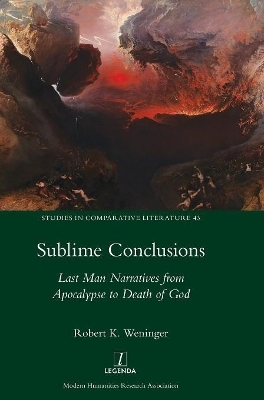
Sublime Conclusions
Last Man Narratives from Apocalypse to Death of God
Seiten
2026
Legenda (Verlag)
978-1-910887-21-9 (ISBN)
Legenda (Verlag)
978-1-910887-21-9 (ISBN)
- Noch nicht erschienen (ca. Januar 2026)
- Versandkostenfrei
- Auch auf Rechnung
- Artikel merken
One writer, Mary Shelley, inaugurated two of the three paradigms through which human beings imagine, with panic or pleasure, the end of their species. This book deals with her work.
One writer, Mary Shelley, inaugurated two of the three paradigms through which human beings imagine, with panic or pleasure, the end of their species. Complementing her visions of a world-encompassing natural plague (The Last Man, 1826) and man-made technological self-eradication (Frankenstein, 1818), the third - and oldest - paradigm of how to depict humankind's demise is the religious notion of Apocalypse, God's Day of Reckoning. Through in-depth philosophical and theological contextualization of the German, French and British literary settings of the apocalyptic tradition around 1800, Sublime Conclusions chronicles the transition from theism and deism to atheism and the 'Death of God' on which, Weninger contends, Shelley's novels - and hence modern science fiction in general - are premised. A tour de force of comparative methodology, Weninger's transdisciplinary approach is as wide-ranging as it is meticulous, interweaving the manifold discourses of catastrophe in literary history, art and film history, philosophy and theology, as well as the history of science and science fiction, across more than two centuries of European intellectual history from Voltaire's mid-eighteenth-century response to the earthquake of Lisbon to Gunther Anders's presaging, in the wake of Hiroshima, humankind's extinction through nuclear Armageddon.
One writer, Mary Shelley, inaugurated two of the three paradigms through which human beings imagine, with panic or pleasure, the end of their species. Complementing her visions of a world-encompassing natural plague (The Last Man, 1826) and man-made technological self-eradication (Frankenstein, 1818), the third - and oldest - paradigm of how to depict humankind's demise is the religious notion of Apocalypse, God's Day of Reckoning. Through in-depth philosophical and theological contextualization of the German, French and British literary settings of the apocalyptic tradition around 1800, Sublime Conclusions chronicles the transition from theism and deism to atheism and the 'Death of God' on which, Weninger contends, Shelley's novels - and hence modern science fiction in general - are premised. A tour de force of comparative methodology, Weninger's transdisciplinary approach is as wide-ranging as it is meticulous, interweaving the manifold discourses of catastrophe in literary history, art and film history, philosophy and theology, as well as the history of science and science fiction, across more than two centuries of European intellectual history from Voltaire's mid-eighteenth-century response to the earthquake of Lisbon to Gunther Anders's presaging, in the wake of Hiroshima, humankind's extinction through nuclear Armageddon.
Selected Table of Contents to come.
| Erscheinungsdatum | 26.07.2017 |
|---|---|
| Verlagsort | Leeds |
| Sprache | englisch |
| Themenwelt | Religion / Theologie ► Christentum ► Kirchengeschichte |
| Geisteswissenschaften ► Sprach- / Literaturwissenschaft ► Anglistik / Amerikanistik | |
| Geisteswissenschaften ► Sprach- / Literaturwissenschaft ► Literaturgeschichte | |
| ISBN-10 | 1-910887-21-8 / 1910887218 |
| ISBN-13 | 978-1-910887-21-9 / 9781910887219 |
| Zustand | Neuware |
| Informationen gemäß Produktsicherheitsverordnung (GPSR) | |
| Haben Sie eine Frage zum Produkt? |
Mehr entdecken
aus dem Bereich



aus dem Bereich
eine andere Geschichte der Papststadt
Buch | Softcover (2024)
C.H.Beck (Verlag)
CHF 25,20
die Macht des Dunklen in unserer Zeit und wie wir ihr entgegentreten
Buch | Hardcover (2025)
Verlag Herder
CHF 27,90


