


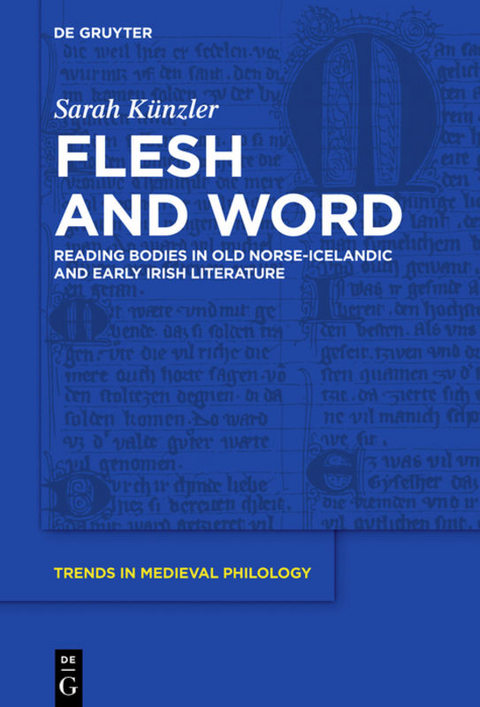
Flesh and Word
Reading Bodies in Old Norse-Icelandic and Early Irish Literature
Seiten
2016
De Gruyter (Verlag)
9783110455380 (ISBN)
De Gruyter (Verlag)
9783110455380 (ISBN)
The series in German medieval studies includes central topics of current research debates in medieval studies and provides a place for groundbreaking research in the subject literature. The series is intended to give international and young researchers/research teams the possibility to effectively present innovative surveys and discussions to the scientific community. The series sees itself as a ‘young’ research forum with a high standard of quality and is therefore also open to excellent degree theses, should they enhance the series.
Bodies and their role in cultural discourse have been a constant focus in the humanities and social sciences in recent years, but comparatively few studies exist about Old Norse-Icelandic or early Irish literature. This study aims to redress this imbalance and presents carefully contextualised close readings of medieval texts. The chapters focus on the role of bodies in mediality discourse in various contexts: that of identity in relation to ideas about self and other, of inscribed and marked skin and of natural bodily matters such as defecation, urination and menstruation. By carefully discussing the sources in their cultural contexts, it becomes apparent that medieval Scandinavian and early Irish texts present their very own ideas about bodies and their role in structuring the narrated worlds of the texts. The study presents one of the first systematic examinations of bodies in these two literary traditions in terms of body criticism and emphasises the ingenuity and complexity of medieval texts.
Bodies and their role in cultural discourse have been a constant focus in the humanities and social sciences in recent years, but comparatively few studies exist about Old Norse-Icelandic or early Irish literature. This study aims to redress this imbalance and presents carefully contextualised close readings of medieval texts. The chapters focus on the role of bodies in mediality discourse in various contexts: that of identity in relation to ideas about self and other, of inscribed and marked skin and of natural bodily matters such as defecation, urination and menstruation. By carefully discussing the sources in their cultural contexts, it becomes apparent that medieval Scandinavian and early Irish texts present their very own ideas about bodies and their role in structuring the narrated worlds of the texts. The study presents one of the first systematic examinations of bodies in these two literary traditions in terms of body criticism and emphasises the ingenuity and complexity of medieval texts.
Sarah Künzler, Universität Zürich, Schweiz.
Sarah Künzler, University of Zurich, Switzerland.
"Wie an dieser Stelle gelingen Künzler in ihrem Buch insgesamt vielfältige neue Einsichten und Analysen, indem sie einen methodisch anregenden und ungewohnten Blick auf bekannte und weniger bekannte Texte durch die Fokussierung auf ihre narrative Inszenierung von Körpern wagt."
Erich Poppe in: ZfdA 147, 2018/2, 257-259
| Erscheinungsdatum | 25.07.2016 |
|---|---|
| Reihe/Serie | Trends in Medieval Philology ; 31 |
| Zusatzinfo | 1 col. ill. |
| Verlagsort | Berlin/Boston |
| Sprache | englisch |
| Maße | 155 x 230 mm |
| Gewicht | 797 g |
| Themenwelt | Geisteswissenschaften ► Sprach- / Literaturwissenschaft ► Literaturwissenschaft |
| Schlagworte | Alterität • Alterity • body criticism • Medialität • mediality • Narratologie • Narratology |
| ISBN-13 | 9783110455380 / 9783110455380 |
| Zustand | Neuware |
| Informationen gemäß Produktsicherheitsverordnung (GPSR) | |
| Haben Sie eine Frage zum Produkt? |
Mehr entdecken
aus dem Bereich



aus dem Bereich
Buch | Softcover (2020)
Beuth (Verlag)
CHF 27,85
die griechischen Mythen neu erzählt von Sarah Iles Johnston
Buch | Hardcover (2025)
C.H.Beck (Verlag)
CHF 51,90


