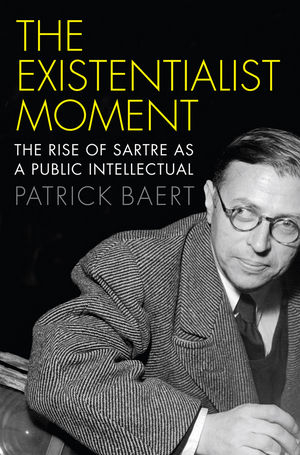
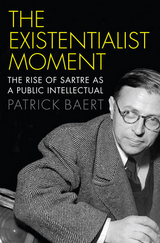
Jean-Paul Sartre is often seen as the quintessential public intellectual, but this was not always the case. Until the mid-1940s he was not so well-known, even in France. Then suddenly, in a very short period of time, Sartre became an intellectual celebrity. How can we explain this remarkable transformation?
The Existentialist Moment retraces Sartre?s career and provides a compelling new explanation of his meteoric rise to fame. Baert takes the reader back to the confusing and traumatic period of the Second World War and its immediate aftermath and shows how the unique political and intellectual landscape in France at this time helped to propel Sartre and existentialist philosophy to the fore. The book also explores why, from the early 1960s onwards, in France and elsewhere, the interest in Sartre and existentialism eventually waned. The Existentialist Moment ends with a bold new theory for the study of intellectuals and a provocative challenge to the widespread belief that the public intellectual is a species now on the brink of extinction.
Patrick Baert is Professor of Social Theory at the University of Cambridge
Choice Outstanding Academic Title for 2015Jean-Paul Sartre is often seen as the quintessential public intellectual, but this was not always the case. Until the mid-1940s he was not so well-known, even in France. Then suddenly, in a very short period of time, Sartre became an intellectual celebrity. How can we explain this remarkable transformation? The Existentialist Moment retraces Sartre's career and provides a compelling new explanation of his meteoric rise to fame. Baert takes the reader back to the confusing and traumatic period of the Second World War and its immediate aftermath and shows how the unique political and intellectual landscape in France at this time helped to propel Sartre and existentialist philosophy to the fore. The book also explores why, from the early 1960s onwards, in France and elsewhere, the interest in Sartre and existentialism eventually waned. The Existentialist Moment ends with a bold new theory for the study of intellectuals and a provocative challenge to the widespread belief that the public intellectual is a species now on the brink of extinction.
Patrick Baert is Professor of Social Theory at the University of Cambridge
Acknowledgements
Introduction
Chapter 1 Occupation, intellectual collaboration and the Resistance
Chapter 2 The purge of collaborationist intellectuals
Chapter 3 Intellectual debates around the purge: responsibility, purity, patriotism
Chapter 4 The autumn of 1945
Chapter 5 Sartre's committed literature in theory and practice
Chapter 6 Rise and demise: a synthesis
Chapter 7 Explaining intellectuals: a proposal
Biblography
Index
Choice Outstanding Academic Title for 2015
"In a brilliant history of Sartre as philosopher and public figure, Patrick Baert creates a new theory of the public intellectual not through their personal intentions (the vocabulary of positioning) but in terms of the consequences of their thought (the vocabulary of efects). The result is a superb contribution both to our understanding of public intellectuals and to the sociology of knowledge."
Bryan S. Turner, The City University of New York
"Why Sartre emerged, from almost nowhere, to become one of the most compelling intellectuals of the 20th century has posed a seemingly intractable challenge for historians and social theorists alike. Patrick Baert cuts this Gordian knot, and develops a new sociological theory of intellectuals along the way. The Existentialist Moment is a deeply researched, conceptually compelling work."
Jeffrey C. Alexander, Yale University
"Baert's The Existentialist Moment gives us a unique opportunity to see precisely what was going on in the French intellectual world in 1945 when Sartre first exploded on the scene. The interactions among French thinkers, against the backdrop of earlier struggles between collaborationists and the Resistance, are vividly portrayed in Baert's fine writing. There is nothing like this book on the market today. It is a gem."
Charles Guignon, University of South Florida
1
OCCUPATION, INTELLECTUAL COLLABORATION AND THE RESISTANCE
To make sense of Sartre’s rise at the end of the war, we shall have to retrace the complex, and at times confusing, trajectory of France under German occupation. In this chapter, we shall discuss how the reality of the war and occupation had significant repercussions for the cultural and intellectual field, redefining its configuration and in the process creating an irreparable schism between two politically opposing factions within the writers’ profession. While this juxtaposition had deeper historical roots, the political context of the war accentuated it and gave it new meaning. It also meant that the opposing factions had very different working conditions and led very different lives. It is important to grasp the intensity of this rift, as well as the unique dilemmas that the war brought about, because they would affect the distinctive cultural sensitivities of the immediate aftermath of the war into which Sartre was able to tap. For this, we will first examine the broad changes brought about by the German occupation and Vichy and then investigate their specific effects on the cultural and intellectual field.
German occupation and Vichy
May and June of 1940 were traumatic for the French population, not least because the initial military stalemate with Germany was followed by a surprisingly swift defeat at the hands of what was supposed to be a technologically inferior army. France and Britain declared war on Germany in September 1939, and then came the so-called Phoney War1 – a period of eight months of military inactivity – which lasted until 10 May 1940 when suddenly Germany invaded the Netherlands, Belgium and Luxemburg, thereby avoiding the Maginot line. Within less than forty days the German forces had penetrated French territory. On 5 June 1940, confronted with the capitulation of Dunkirk and heavy casualties, an exasperated Prime Minister, Paul Reynaud, reshuffled his War Cabinet and brought three army men in to reinvigorate a dwindling morale. Besides General Maxime Weygand, the Commander-in-Chief of the French army, the trio included the newly promoted Brigadier-General Charles de Gaulle and the ageing Marshal Philippe Pétain. For ten days, these men would share the same cabinet table, before opting for dramatically opposed choices. With German soldiers entering Paris on 14 June and six million French people fleeing to the South (plus an additional two million non-French people on the move), their government moved to Tours and then Bordeaux. Two days later, faced with further French capitulation and with ongoing disagreements with Weygand, Reynaud gave way to Pétain who would become the last Prime Minister of the Third Republic and would also be responsible for dissolving it.
The trauma of the First World War was still fresh in the minds of members of the highest ranks of the French military establishment. They were elderly, had experienced the Great War first hand and were anxious to avoid further casualties on that scale. Both Weygand and Pétain decided to renege on the Anglo-French agreement of March 1940 according to which neither France nor Britain would seek an armistice or peace treaty with Germany. Not only did neither trust Britain as an ally, both had little faith in Britain’s ability to withstand the German war machine. On 17 June, Pétain announced the armistice, while de Gaulle, together with other senior officers, left for London and set up the ‘French free forces’. The next day, de Gaulle made his famous broadcast through the BBC, rejecting the armistice and calling on the French to continue the fight against German occupation. After short spells in Bordeaux and Clermont-Ferrand, Pétain’s cabinet eventually settled in the quiet spa town of Vichy, which gave the government its name. The armistice was signed on 22 June and handed Germany control over the North and West of the country, including the complete Atlantic coastline, though in practice the administrative jurisdiction of Vichy would often extend beyond the ‘unoccupied zone’. Besides the occupied and unoccupied zone, there was the ‘forbidden zone’: comprising the Northern departments of Nord and Pas-de-Calais, it was strategically important and under control of the German High Command in Brussels. Finally, there was the annexation of Alsace and Moselle in Lorraine; this part of France is now ‘returned’ to Germany.
This situation would last until November 1942, when Germany finally seized control of the whole of France, prompted by fear of an Allied invasion from North Africa, but even then Vichy continued to administer the country. Pétain’s well-publicized meeting with Hitler on 24 October 1940 conveyed to the French public his commitment to a close relationship with Nazi Germany, and indeed six days later he acknowledged that he had accepted the ‘principle of collaboration’.2 Although this was the first time the notion of collaboration was used so publicly, Pétain only expressed one of the major tenets of the armistice, with article 3 stipulating that the French people ought to ‘collaborate’ with the occupying power.3 Initially this notion of cooperation faced remarkably little resistance: the propaganda reiterated that the war with Britain would be brief, that Germany would be victorious, and that an alliance with the latter would help to maintain internal order. Britain was portrayed as an aggressive imperial power willing to sacrifice French lives for strategic purposes: the assault by the Royal Navy on the French fleet in Mers-el-Kébir in early July 1940 further fuelled this belief. At the beginning of the occupation, some conservatives were concerned that the Nazis might join forces with the French Communist Party, but it soon became apparent, long before the German invasion of Russia made this alliance impossible, that the Germans had no such intentions.
So, early on, collaboration was widely seen as the least of all evils, the possibility for peace and internal stability. Vichy had broad support and was seen as an opportunity for a fresh start. It soon transpired, however, that this collaboration came at a heavy price, literally as France had to cover the occupation costs and had to give up Alsace and Lorraine, but also in numerous other ways: food shortages made everyday life harsh; very few of the 1.6 million French prisoners of war were released; the French army, rebranded as the Army of the Armistice, was substantially reduced and put under control of the German force; French administration as a whole was subject to German control; and eventually more than 600,000 French men were compelled to go and work in Germany after a voluntary system proved unsuccessful. It was particularly this Service du travail obligatoire which made the German occupation unpopular.
On 10 July 1940 the National Assembly voted for its own dissolution, the legal basis of which has been hotly debated ever since. A couple of days later, Pierre Laval became Pétain’s deputy, a position he lost in December of that year but regained in April 1942. The constitutional acts of 11 and 12 July 1940 provided a legal framework for the new French nation. They also gave Pétain a wide range of powers, including the legislative, judiciary and executive, and officially he became ‘Chief of the French nation’.4 Pétain’s Vichy obtained a certain amount of international recognition, something which would be emphasized by defence lawyers during the trials of Vichy politicians and collaborators. No fewer than forty countries, among them the United States and Russia, recognized Vichy as a legitimate government. However, only six countries bothered with an embassy in Vichy but, again, the US was one of them.
Pétain was held in high esteem because of his role in the First World War, in particular his success in the battle of Verdun. The ill-fated Maginot line had been his idea but this seemed hardly to dent his rep-utation; nor did the fact that his overall military vision in this war had been old-fashioned. Eighty-four years old when he headed Vichy, he adopted, from the outset, a fatherly role towards the French people, describing his new position as ‘the gift of my person (to the nation) so as to attenuate her suffering’.5 This grandiose statement set the tone for things to come: the idolatry surrounding his person as well as the Catholic themes of suffering and repentance would become central to the Vichy ideology. Pétain’s tours around the country, the carefully orchestrated rallies in his support, and his rigid control of newspapers and radio maintained a remarkable personality cult which only waned in the latter stages of the war. He portrayed the armistice as a desperate but necessary measure to avoid a repeat of the massacre of the First World War and to protect the French people against the malaise of foreign occupation. The media played a central role in promoting the idolatry surrounding Pétain. Whereas in the occupied zone the Propaganda–Abteilung Frankreich controlled Radio-Paris, in the unoccupied zone la Radiodiffusion nationale promoted the Maréchal and his conservative values.
Very early on, Pétain promoted the ‘National Revolution’,6 a conservative ideology reminiscent of the ‘moral order’ of the 1870s. The term ‘National Revolution’ had been in vogue since the 1930s, and although not frequently used by...
| Erscheint lt. Verlag | 20.8.2015 |
|---|---|
| Sprache | englisch |
| Themenwelt | Geisteswissenschaften ► Philosophie ► Allgemeines / Lexika |
| Geisteswissenschaften ► Philosophie ► Philosophie der Neuzeit | |
| Sozialwissenschaften ► Politik / Verwaltung | |
| Sozialwissenschaften ► Soziologie ► Allgemeine Soziologie | |
| Schlagworte | Existentialism • Existentialismus • Existenzialismus • Gesellschaftstheorie • Kultursoziologie • Philosophie • Philosophy • Sartre, Jean-Paul, existentialism, sociology, intellectuals, Vichy France, French Resistance, history • Social Theory • Sociology • Sociology of Culture • Soziologie |
| ISBN-13 | 9780745685434 / 9780745685434 |
| Informationen gemäß Produktsicherheitsverordnung (GPSR) | |
| Haben Sie eine Frage zum Produkt? |
 EPUB (Adobe DRM)
Kopierschutz: Adobe-DRM
Adobe-DRM ist ein Kopierschutz, der das eBook vor Mißbrauch schützen soll. Dabei wird das eBook bereits beim Download auf Ihre persönliche Adobe-ID autorisiert. Lesen können Sie das eBook dann nur auf den Geräten, welche ebenfalls auf Ihre Adobe-ID registriert sind.
Details zum Adobe-DRM
Dateiformat: EPUB (Electronic Publication)
EPUB ist ein offener Standard für eBooks und eignet sich besonders zur Darstellung von Belletristik und Sachbüchern. Der Fließtext wird dynamisch an die Display- und Schriftgröße angepasst. Auch für mobile Lesegeräte ist EPUB daher gut geeignet.
Systemvoraussetzungen:
PC/Mac: Mit einem PC oder Mac können Sie dieses eBook lesen. Sie benötigen eine
eReader: Dieses eBook kann mit (fast) allen eBook-Readern gelesen werden. Mit dem amazon-Kindle ist es aber nicht kompatibel.
Smartphone/Tablet: Egal ob Apple oder Android, dieses eBook können Sie lesen. Sie benötigen eine
Geräteliste und zusätzliche Hinweise
Buying eBooks from abroad
For tax law reasons we can sell eBooks just within Germany and Switzerland. Regrettably we cannot fulfill eBook-orders from other countries.
aus dem Bereich