


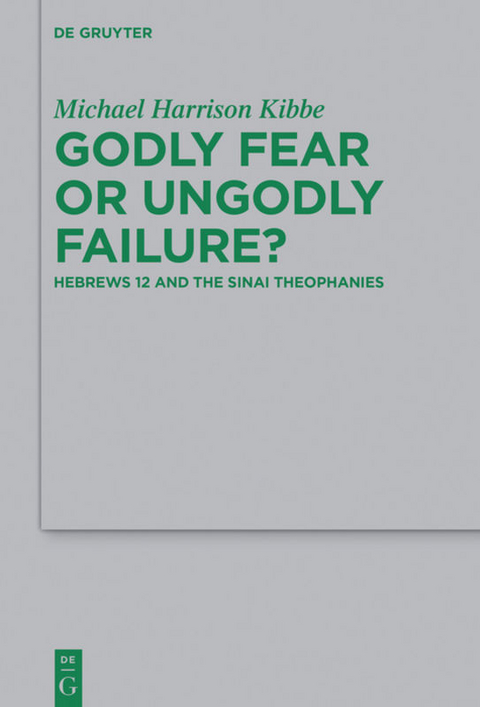
Godly Fear or Ungodly Failure?
Hebrews 12 and the Sinai Theophanies
Seiten
2016
De Gruyter (Verlag)
978-3-11-042657-1 (ISBN)
De Gruyter (Verlag)
978-3-11-042657-1 (ISBN)

Die Reihe Beihefte zur Zeitschrift für die neutestamentliche Wissenschaft (BZNW) ist eine der renommiertesten internationalen Buchreihen zur neutestamentlichen Wissenschaft. Seit 1923 publiziert sie wegweisende Forschungsarbeiten zum frühen Christentum und angrenzenden Themengebieten. Die Reihe ist historisch-kritisch verankert und steht neuen methodischen Ansätzen, die unser Verständnis des Neuen Testaments befördern, gleichfalls offen gegenüber.
A cursory glance at Hebrews' critique of Israel's fear at Sinai in Heb 12:18-29 suggests that the author has misunderstood or manipulated his sources. In the Pentateuch, the appointment of Moses as Israel's mediator receives explicit approval (Exod 19:9; Deut 5:28), while Heb 12:25 labels their request for mediation a "refusal" to heed the word of God. This book argues that Hebrews' use of the Sinai narratives resides on a complex trajectory established by four points: the Sinai covenant according to Exodus, the reenactment of that covenant according to Deuteronomy, the call for a NEW covenant according to Jeremiah, and the present reality of that covenant established by God and mediated by Jesus Christ.The basis for Hebrews' critique arises from its insight that while Israel's request established covenant-from-a-distance, Jesus demonstrates that true covenant mediation brings two parties into a single space. The purpose for Hebrews critique lies in its summons to Zion, the mountain on which Jesus sits at the right hand of God as the high priestly mediator of the new covenant.
A cursory glance at Hebrews' critique of Israel's fear at Sinai in Heb 12:18-29 suggests that the author has misunderstood or manipulated his sources. In the Pentateuch, the appointment of Moses as Israel's mediator receives explicit approval (Exod 19:9; Deut 5:28), while Heb 12:25 labels their request for mediation a "refusal" to heed the word of God. This book argues that Hebrews' use of the Sinai narratives resides on a complex trajectory established by four points: the Sinai covenant according to Exodus, the reenactment of that covenant according to Deuteronomy, the call for a NEW covenant according to Jeremiah, and the present reality of that covenant established by God and mediated by Jesus Christ.The basis for Hebrews' critique arises from its insight that while Israel's request established covenant-from-a-distance, Jesus demonstrates that true covenant mediation brings two parties into a single space. The purpose for Hebrews critique lies in its summons to Zion, the mountain on which Jesus sits at the right hand of God as the high priestly mediator of the new covenant.
Michael Kibbe, Moody Bible Institute-Spokane, Spokane, WA, USA.
"Kibbe is to be commended for a well-written piece of scholarship that contains helpful insights into Hebrews."
Gareth Lee Cockerill in: Journal of The Evangelical Theological Society (2018), 666-668
"This study is interesting, well researched and well presented. Highly recommended."
Svetlana Khobnya in: Journal for the Study of the New Testament 40.5 (2018), 99-100
| Erscheinungsdatum | 11.04.2016 |
|---|---|
| Reihe/Serie | Beihefte zur Zeitschrift für die neutestamentliche Wissenschaft ; 216 |
| Verlagsort | Berlin/Boston |
| Sprache | englisch |
| Maße | 155 x 230 mm |
| Gewicht | 565 g |
| Themenwelt | Geisteswissenschaften ► Religion / Theologie ► Christentum |
| Schlagworte | Hebrews • Moses • Sinai • Zion |
| ISBN-10 | 3-11-042657-9 / 3110426579 |
| ISBN-13 | 978-3-11-042657-1 / 9783110426571 |
| Zustand | Neuware |
| Informationen gemäß Produktsicherheitsverordnung (GPSR) | |
| Haben Sie eine Frage zum Produkt? |
Mehr entdecken
aus dem Bereich


aus dem Bereich
und was sie über die Kirche verraten
Buch | Hardcover (2024)
C.H.Beck (Verlag)
CHF 39,90


