


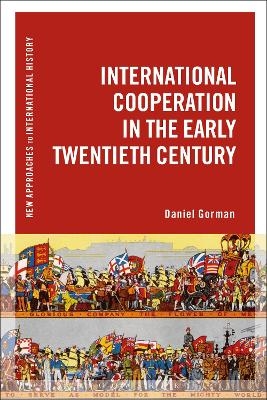
International Cooperation in the Early Twentieth Century
Seiten
2019
Bloomsbury Academic (Verlag)
978-1-4725-6794-9 (ISBN)
Bloomsbury Academic (Verlag)
978-1-4725-6794-9 (ISBN)
The early 20th-century world experienced a growth in international cooperation, and yet the dominant historical view of the period has long been one of national, military, and social divisions rather than connections. While the history of international cooperation has attracted increased historical attention over the past decade, much historical analysis of international affairs, especially of the earlier 20th century, remains state-centric. International Cooperation in the Early Twentieth Century revises this historical consensus by providing a more focused and detailed analysis of the many ways in which people, especially outside of the circumscribed world of high politics, interacted with each other across borders in the early decades of the 20th century.
Daniel Gorman focuses on international cooperation, various forms of cultural internationalism, imperial and anti-imperial internationalism, and the growth of cosmopolitan ideas. The book also seeks to incorporate a non-Western focus alongside the transatlantic core of early 20th-century internationalism by interweaving analyses of international anti-colonial networks, ideas emanating from non-Western sites of influence such as Japan, China and Turkey, the emergence of networks of international indigenous peoples in resistance to a state-centric international system, and diaspora and transnational ethno-cultural-religious identity networks.
Daniel Gorman focuses on international cooperation, various forms of cultural internationalism, imperial and anti-imperial internationalism, and the growth of cosmopolitan ideas. The book also seeks to incorporate a non-Western focus alongside the transatlantic core of early 20th-century internationalism by interweaving analyses of international anti-colonial networks, ideas emanating from non-Western sites of influence such as Japan, China and Turkey, the emergence of networks of international indigenous peoples in resistance to a state-centric international system, and diaspora and transnational ethno-cultural-religious identity networks.
Daniel Gorman is Associate Professor in the Department of History at the University of Waterloo, Canada. He is author of The Emergence of International Society in the 1920s (2012) and Imperial Citizenship: Empire and the Question of Belonging (2007).
1. Introduction
2. Early 20th Century International, Imperial and Anti-Imperial Cooperation
3. The First World War
4. The Production of International Knowledge
5. Empire and its Opponents
6. International and Imperial Institutions
7. International Law
8. Synergies: Functional and Technical Cooperation
9. Cultural Internationalism
10. Social Movements and Non-Governmental Activism
11. Towards a Better World: International Humanitarianism
12. Conclusion
Bibliography
Index
| Erscheinungsdatum | 16.05.2019 |
|---|---|
| Reihe/Serie | New Approaches to International History |
| Verlagsort | London |
| Sprache | englisch |
| Maße | 156 x 234 mm |
| Gewicht | 499 g |
| Themenwelt | Geschichte ► Allgemeine Geschichte ► Neuzeit (bis 1918) |
| Sozialwissenschaften ► Politik / Verwaltung ► Staat / Verwaltung | |
| ISBN-10 | 1-4725-6794-3 / 1472567943 |
| ISBN-13 | 978-1-4725-6794-9 / 9781472567949 |
| Zustand | Neuware |
| Informationen gemäß Produktsicherheitsverordnung (GPSR) | |
| Haben Sie eine Frage zum Produkt? |
Mehr entdecken
aus dem Bereich

aus dem Bereich
Geschichte einer wilden Handlung
Buch | Hardcover (2024)
C.H.Beck (Verlag)
CHF 47,60


