


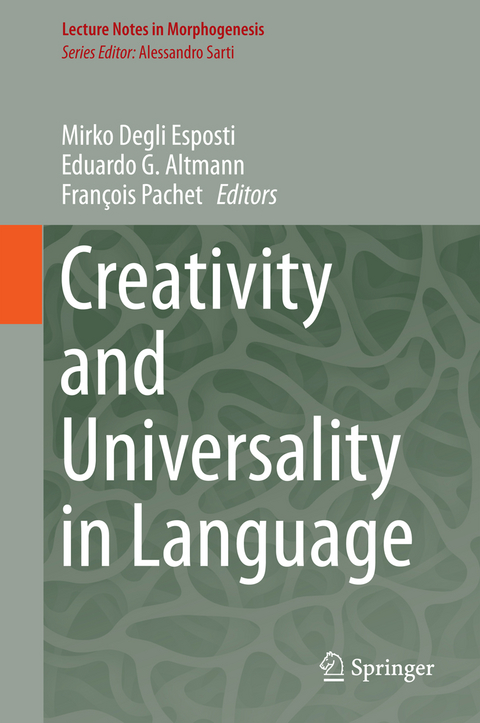
Creativity and Universality in Language
Springer International Publishing (Verlag)
978-3-319-24401-3 (ISBN)
This book collects research contributions concerning quantitative approaches to characterize originality and universality in language. The target audience comprises researchers and experts in the field but the book may also be beneficial for graduate students.
Creativity might be considered as a morphogenetic process combining universal features with originality. While quantitative methods applied to text and music reveal universal features of language and music, originality is a highly appreciated feature of authors, composers, and performers.
In this framework, the different methods of traditional problems of authorship attribution and document classification provide important insights on how to quantify the unique features of authors, composers, and styles. Such unique features contrast, and are restricted by, universal signatures, such as scaling laws in word-frequency distribution, entropy measures, long-range correlations, among others. This interplay between innovation and universality is also an essential ingredient of methods for automatic text generation.Innovation in language becomes relevant when it is imitated and spread to other speakers and musicians. Modern digital databases provide new opportunities to characterize and model the creation and evolution of linguistic innovations on historical time scales, a particularly important example of the more general problem of spreading of innovations in complex social systems.
This multidisciplinary book combines scientists from various different backgrounds interested in quantitative analysis of variations (synchronic and diachronic) in language and music. The aim is to obtain a deeper understanding of how originality emerges, can be quantified, and propagates.Universality and Creativity in Language.- Introduction to the Volume.- Statistical laws in linguistics.- Complexity and universality in the long-range order of words.- Symmetry and Universality in Language Change.- Dynamics on expanding spaces: modeling the emergence of novelties.- Generating non-plagiaristic Markov sequences with max order Sampling.- Integrating Purpose and Revision into a Computational Model of Literary Generation.- Detection of computer generated papers in scientific literature.- Universality of stylistic traits in texts.- Dynamics of Style and the case of the Diario Postumo by Eugenio Montale: a quantitative approach.- Universality and Creativity: The usage of Language in Gender and Irony.- Computational Approaches to the Analysis of Human Creativity.- Meaning and Creativity in Language.
"The volume as a whole gives a richly detailed overview of the long-term, flourishing research on the mathematical statistical approach to properties of written natural language. The chapters and the references provide details of this inventive investigation of the inherent and variable properties of natural language." (Alice Davison, Computing Reviews, computingreviews.com, October, 2016)
| Erscheinungsdatum | 08.10.2016 |
|---|---|
| Reihe/Serie | Lecture Notes in Morphogenesis |
| Zusatzinfo | XII, 208 p. 52 illus., 40 illus. in color. |
| Verlagsort | Cham |
| Sprache | englisch |
| Maße | 155 x 235 mm |
| Gewicht | 486 g |
| Themenwelt | Geisteswissenschaften ► Sprach- / Literaturwissenschaft ► Sprachwissenschaft |
| Schlagworte | Complex Systems • Computational Linguistics • Creativity in Language and Music • Humanities, Social Sciences and Law • language evolution • language translation and linguistics • Mathematical Models of Textual Data • music • Philosophy of Language • Synchronic and Diachronic Variations in Language • Universal laws • Universal Laws |
| ISBN-10 | 3-319-24401-9 / 3319244019 |
| ISBN-13 | 978-3-319-24401-3 / 9783319244013 |
| Zustand | Neuware |
| Informationen gemäß Produktsicherheitsverordnung (GPSR) | |
| Haben Sie eine Frage zum Produkt? |
aus dem Bereich


