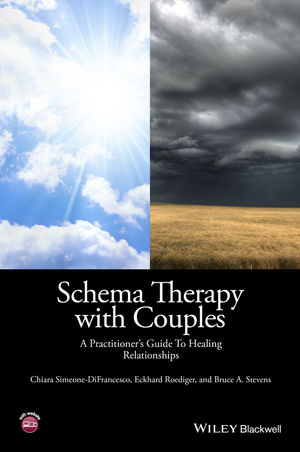
Schema Therapy with Couples (eBook)
John Wiley & Sons (Verlag)
978-1-118-97271-7 (ISBN)
- Shows how the distinctive features of ST make it ideal for addressing the cognitive and emotion-focused problems typical in couple relationships
- Presents and integrates a series of innovative tools and interventions such as Schema Therapy with Needs versus Wants, Mode Cycle Clash Cards, limited re-parenting visualization, and chair work
- Authored by an international team of experts in couples therapy and Schema Therapy
Chiara Simeone-DiFrancesco founded Wisconsin Family Growth & Reconciliation Center LLC, working with couples for 25 years in private practice. Chiara now directs the Marriage & Family Schema Therapy Institute, a division of the non-profit Healing International, Inc. she co-founded in 1986. A former Lieutenant in the US Public Health Service Commissioned Corps, she is founder and chair of the ISST Subcommittee & Workgroup of Marital and Couples Schema Therapy.
Eckhard Roediger is a Neurologist, Psychiatrist, and Psychotherapist based in Frankfurt, Germany. He is a former chief physician of the Salus Klinik Hospital, and is currently Director of the Frankfurt Schema Therapy Institute and President of the ISST. He is the author of several German language books on Schema Therapy.
Bruce A. Stevens (PhD Boston University, 1987) holds the Wicking Chair of Ageing and Practical Theology at Charles Sturt University and is the director of the Centre of Ageing and Pastoral Studies. He was previously Associate Professor in clinical psychology at the University of Canberra where he convened the program with over 60 graduate students from 2009-2014. He is an endorsed Clinical and Forensic Psychologist with a part-time private practice at Canberra Clinical and Forensic Psychology, a practice he founded in the early 1990's. He has been chair of the Canberra section of the Clinical College of the Australian Psychological Society. He gives many professional workshops on couple therapy throughout Australia. He has is a trainer in Schema Therapy with both individual and couple accreditation with the ISST.
Schema Therapy for Couples represents the first practitioner guide to detail effective Schema Therapy techniques in couple and relationship therapy. Shows how the distinctive features of ST make it ideal for addressing the cognitive and emotion-focused problems typical in couple relationships Presents and integrates a series of innovative tools and interventions such as Schema Therapy with Needs versus Wants, Mode Cycle Clash Cards, limited re-parenting visualization, and chair work Authored by an international team of experts in couples therapy and Schema Therapy
Chiara Simeone-DiFrancesco founded Wisconsin Family Growth & Reconciliation Center LLC, working with couples for 25 years in private practice. Chiara now directs the Marriage & Family Schema Therapy Institute, a division of the non-profit Healing International, Inc. she co-founded in 1986. A former Lieutenant in the US Public Health Service Commissioned Corps, she is founder and chair of the ISST Subcommittee & Workgroup of Marital and Couples Schema Therapy. Eckhard Roediger is a Neurologist, Psychiatrist, and Psychotherapist based in Frankfurt, Germany. He is a former chief physician of the Salus Klinik Hospital, and is currently Director of the Frankfurt Schema Therapy Institute and President of the ISST. He is the author of several German language books on Schema Therapy. Bruce A. Stevens (PhD Boston University, 1987) holds the Wicking Chair of Ageing and Practical Theology at Charles Sturt University and is the director of the Centre of Ageing and Pastoral Studies. He was previously Associate Professor in clinical psychology at the University of Canberra where he convened the program with over 60 graduate students from 2009-2014. He is an endorsed Clinical and Forensic Psychologist with a part-time private practice at Canberra Clinical and Forensic Psychology, a practice he founded in the early 1990's. He has been chair of the Canberra section of the Clinical College of the Australian Psychological Society. He gives many professional workshops on couple therapy throughout Australia. He has is a trainer in Schema Therapy with both individual and couple accreditation with the ISST.
List of Figures and Tables vii
About the Authors viii
Preface x
Acknowledgments xiii
Abbreviations xiv
Introduction xv
About the Companion Website xvii
1 What Schema Therapy Offers 1
2 The Initial Contract and First Interview 13
3 Relationship Assessment 29
4 Understanding the Origins of Relational Styles 45
5 Foundations for Evidence?]Based Practice in Couple Therapy 57
6 Schemas and Modes 69
7 Approaching Schema Therapy for Couples 95
8 Mode Mapping and Mode Cycle Clash?]cards 109
9 Interventions in Couple Treatment 139
10 Common Problems in Couple Therapy, Including Affairs, Forgiveness, and Violence 173
11 Differentiating Needs from Wants, and the Challenge of Integration 215
12 Building Friendship, Building the Healthy Adult 239
Appendix A: Self-care for the Couple Therapist 253
References 261
Index of Therapy Tools and Interventions 271
Index 273
UK/ROW
British Journal of Psychology (author request)
British Journal of Clinical Psychology (author request)
British Journal of Medical Psychology (author request)
British Journal of Health Psychology (author request)
The Psychologist
North America
PsycCritiques x3
Journal of Marital and Family Therapy (author request)
The American Journal of Psychology (author request)
The American Journal of Psychotherapy (author request)
American Psychologist (author request)
Monitor on Psychology (author request)
Journal of Cognitive Psychotherapy (author request)
Journal of Cross-Cultural PsychologyJournal of Marriage and Family
(author request)
The Family Journal, Counseling and Therapy for Couples and Families
(author request)
Journal of Couple and Relationship Therapy (author request)
Psychotherapy Networker magazine (author request)
"Schema Therapy with Couples is a very helpful addition to the clinical couples' therapy literature, integrating the individual challenges people face in their own growth with managing a relationship with someone else who also faces their own individual challenges. Drs. DiFrancesco, Roediger, and Stevens provide a guide through this very difficult but everyday terrain that every couples therapist must navigate."
John Gottman, Ph.D., Author of The Seven Principles for Making Marriage Work
"In 25 years of treating couples and closely following the literature, this is the most significant development I have seen. Schema Therapy with Couples provides a highly developed, systems-oriented theoretical model. With its foundation in schema therapy, this approach can deftly deal with the most severely dysfunctional couples by focusing on personality dysfunction, change at a deep cognitive-emotional level, and potent emotive techniques. This is an extraordinary volume, chock-full of figures, instructive clinical examples, and powerful clinical interventions, that will undoubtedly influence how you treat couples."
Lawrence P. Riso, PhD, Professor of Clinical Psychology, American School of Professional Psychology at Argosy University, Washington DC
"For several years, the authors of this book have been active in a schema therapy for couples workgroup and now share their own insights and those of colleagues. They show how the central concepts and approach to case formulation and intervention in schema therapy provide a coherent integrative framework, and offer a set of guiding and enabling principles as well as practical examples of how to implement specific schema therapy interventions. Rich in clinical examples, this book will enable readers to encounter the distinctive contribution of the schema therapy approach to couples therapy."
David Edwards, PhD, Professor of Psychology, Rhodes University and Schema Therapy Institute of South Africa
"This book teaches the basics of couples in conflict, and provides a deeper, need-based understanding of what goes wrong in relationships. Therapists are offered a toolkit to meet, understand, evaluate and help couples to stay together despite interpersonal turmoil. Schema Therapy with Couples opens a new window of understanding and provides innovative ways to help."
Gerhard Zarbock, PhD, Clinical psychologist, Director of IVAH, Hamburg, Germany, co-author of Mindfulness for Therapists
1
What Schema Therapy Offers
1.1 What is Hidden, What is Seen
For couples, the most common clashes are around the “rough edges” of personality. Indeed, there is a great silence in relationship therapy about the influence of personality disorders. Research has established that such traits are very common. Only 23 percent of the general population is relatively free of them; over 70 percent of people “have some degree of personality disturbance” (Yang et al., 2010).
It makes sense that character traits will cause relationship difficulties. We are attracted to a personality but live with a character. If there are long-term character problems, which is another way of describing personality vulnerability, then relationship difficulties are inevitable.
Richard had a history of many short-term relationships, which were perhaps more sexual “flings” to avoid boredom. He would leave when lovers became more “needy”. He had been sexually abused as a child and never experienced warmth or protection by a parent or step-parent. He knew only criticism. Eventually, he married Carol because he wanted a stable relationship to raise children. When he had an affair, it was devastating to his wife. It was hard to even talk issues through because Richard avoided conflict. A lot was happening in this relationship that was far from obvious.
Some couples deny any problems, even to the point of separation and divorce, but there is a long history of hidden clashes underlying the deterioration of their relationship.
Reflect: What has been your most difficult couple to treat? Why? Do you recognize possible traits of personality disorder?
1.2 Listening to the Evidence
There is currently a crisis in relationships, and couples commonly present for therapy. So why not simply use the available evidence-based treatment for relationships? The answer is not straightforward. There is good research. John Gottman (1999) has contributed enormously to what we know through his “Love Lab.” He has provided years of longitudinal data on couple processes. This includes easy-to-understand principles thoroughly grounded in extensive research. This can inform our practice. While Gottman and his colleagues have not yet produced randomized controlled trials, his work would meet the criteria of the American Psychological Association’s policy statement on evidence-based practice in psychology: “the integration of the best available research with clinical expertise in the context of patient characteristics, culture, and preferences” (see APA, 2006).
Sexton and Gordon (2009) distinguished three levels of evidence:
- evidence-informed interventions based on pre-existing evidence
- promising interventions, but preliminary results not replicated
- evidence-based treatments with systematic high-quality evidence demonstrating efficacy with clinical problems that the interventions are designed to address.
There is some Level 3 support for behavioral marital therapy (Jacobson & Margolin, 1979), cognitive behavioral marital therapy (Baucom & Epstein, 1990), integrative couple therapy (Jacobson & Christensen, 1996), and emotion-focused therapy for couples (EFT-C; Greenberg & Goldman, 2008).
In our experience, EFT-C works with many, and perhaps most, couples. But there is no specifically evidence-based therapy for couples with personality disorder (or for couples with strong traits, even if not diagnosed). What exists is evidence of the effectiveness of individual treatment for individuals with personality disorder, initially borderline personality disorder (BPD). It makes clinical sense that difficult couples may need an enhanced approach with ST or dialectical behavior therapy (Linehan, 1993). Both employ stronger interventions aimed at changing ingrained aspects of character. A 2010 review concluded that dialectical behavior therapy has Level 3 and ST has Level 2 evidence for effectiveness with adults diagnosed with BPD (APS, 2010, p. 112). A study of ST treatment of BPD inpatients using groups has reported large effect sizes (Farrell & Shaw, 2012), and a study has recently indicated the effectiveness of ST with other personality disorders (Bamelis et al., 2014).
We believe that ST has significant advantages over dialectical behavior therapy,2 so applying ST to working with couples (schema therapy for couples, ST-C) is the focus of this book. We hope that it may prove to have some of the strengths already demonstrated by ST case conceptualization and interventions in individual and group therapy.
1.3 Beyond Just Cognitive Therapy
One of the strengths of ST is its origins in cognitive therapy, which has the advantage of conceptual clarity and ease of understanding. Now, in the twenty-first century, it incorporates a good deal more than talk. This includes both non-verbal cognitions (imagery) and embodiment techniques (Rosner et al., 2004). It is essentially integrative.
Aaron Beck (1963) initiated the “cognitive revolution” and developed what is now extensively researched cognitive behavioral therapy for the treatment of depression. This approach was then applied to the whole range of psychological disorders. But cognitive behavioral therapy did not prove as effective with the personality disordered, which led to “third wave” therapies, including dialectical behavior therapy and ST.
While Beck referred to schemas, it was more in the sense of clusters of negative beliefs about the self. A similar understanding of schemata is found in the work of Theodore Millon, in which patterns of dysfunction are foundational to personality disorder (Millon, 1990, p. 10). Jesse Wright and colleagues followed in this approach and noted that people typically have a mix of different kinds of schemas: “even patients with the most severe symptoms or profound despair have adaptive schemas that can help them cope … efforts to uncover and strengthen positively oriented beliefs can be quite productive” (Wright et al., 2006, p. 174).
1.4 Jeff Young and the Development of Schema Therapy
ST was developed from cognitive therapy as a means of treating difficult people. Jeffery Young et al. (2003) linked maladaptive schemas to neglect and toxic childhood experiences. They reflect the unfulfilled yet important needs of the child and represent adaptations to negative experiences, such as family quarrels, rejection, hostility, or aggression from parents, educators or peers, as well as inadequate parental care and support (van Genderen et al., 2012). This approach has more of an emotional focus and a willingness to explore the childhood/adolescent origins of psychological problems.
Young identified a comprehensive set of early maladaptive schemas, which were defined as “self-defeating emotional and cognitive patterns that begin early in our development and repeat throughout life” (Young et al., 2003, p. 7). Schemas are identified by clinical observation (Arntz & Jacob, 2013). The expression of such patterns has different levels of severity and pervasiveness. The idea of schema activation is fundamental to an understanding of Young’s contribution. A more severe schema is distinguished by how readily it is activated, the intensity of affect and how long distress lasts (Young et al., 2003, p. 9).
ST provides a blueprint for the child and later adult’s world. While schemas might have had some survival value for the child (Kellogg, 2004), by adulthood they are “inaccurate, dysfunctional, and limiting, although strongly held and frequently not in the person’s conscious awareness” (Farrell & Shaw, 2012, p. 9).
Young et al.’s (2003) understanding of schemas drew on a variety of sources. Indeed, they outlined parallels and differences with major approaches, including Beck’s “reformulated” model, psychoanalytic theory, Bowlby’s attachment theory (especially internal working models), and emotion-focused therapy (EFT). ST has integrated techniques adapted from transactional analysis and gestalt therapy (Edwards & Arntz, 2012). Jeff Young (2012) also described ST as an individual therapy with systemic implications. There is a breadth, applicability and ease of understanding that encourages a broader application.
Young (1999, p. 20) also identified needs of childhood in five “domains,” which can be seen as five tasks for therapy:
- connection and acceptance
- autonomy and performance
- realistic limits
- inner-directed ness and self-expression
- spontaneity and pleasure.
1.5 The Schema Model
Young identified the following 18 schemas: Abandonment (instability), Mistrust-Abuse, Emotional Deprivation, Defectiveness-Shame, Social Isolation (alienation), Dependence Incompetence, Vulnerability to Harm or Illness, Enmeshment (undeveloped self), Failure (to achieve), Entitlement Grandiosity, Insufficient Self-control (or self-discipline), Subjugation, Self-Sacrifice, Approval Seeking (recognition seeking), Negativity Pessimism, Emotional Inhibition, Unrelenting Standards (hyper-criticalness), and Punitiveness. Maladaptive schemas hinder people from recognizing, experiencing, and fulfilling their own needs...
| Erscheint lt. Verlag | 23.7.2015 |
|---|---|
| Sprache | englisch |
| Themenwelt | Geisteswissenschaften ► Psychologie ► Klinische Psychologie |
| Medizin / Pharmazie ► Gesundheitsfachberufe | |
| Medizin / Pharmazie ► Medizinische Fachgebiete ► Psychiatrie / Psychotherapie | |
| Schlagworte | Couples & Family Clinical Psychology • Familientherapie • Family Therapy • Klinische Psychologie • Klinische Psychologie / Familien u. Paare • Paartherapie • Psychologie • Psychology • Psychotherapie • Psychotherapie u. Beratung • Psychotherapy & Counseling • Schema Therapy, ST, schema modes, schema coaching, psychotherapy, cognitive therapy, behaviour therapy, couples therapy, relationship therapy, marital therapy, mode cycle clash cards, needs, psychology |
| ISBN-10 | 1-118-97271-6 / 1118972716 |
| ISBN-13 | 978-1-118-97271-7 / 9781118972717 |
| Informationen gemäß Produktsicherheitsverordnung (GPSR) | |
| Haben Sie eine Frage zum Produkt? |
 EPUB (Adobe DRM)
Kopierschutz: Adobe-DRM
Adobe-DRM ist ein Kopierschutz, der das eBook vor Mißbrauch schützen soll. Dabei wird das eBook bereits beim Download auf Ihre persönliche Adobe-ID autorisiert. Lesen können Sie das eBook dann nur auf den Geräten, welche ebenfalls auf Ihre Adobe-ID registriert sind.
Details zum Adobe-DRM
Dateiformat: EPUB (Electronic Publication)
EPUB ist ein offener Standard für eBooks und eignet sich besonders zur Darstellung von Belletristik und Sachbüchern. Der Fließtext wird dynamisch an die Display- und Schriftgröße angepasst. Auch für mobile Lesegeräte ist EPUB daher gut geeignet.
Systemvoraussetzungen:
PC/Mac: Mit einem PC oder Mac können Sie dieses eBook lesen. Sie benötigen eine
eReader: Dieses eBook kann mit (fast) allen eBook-Readern gelesen werden. Mit dem amazon-Kindle ist es aber nicht kompatibel.
Smartphone/Tablet: Egal ob Apple oder Android, dieses eBook können Sie lesen. Sie benötigen eine
Geräteliste und zusätzliche Hinweise
Buying eBooks from abroad
For tax law reasons we can sell eBooks just within Germany and Switzerland. Regrettably we cannot fulfill eBook-orders from other countries.
aus dem Bereich