


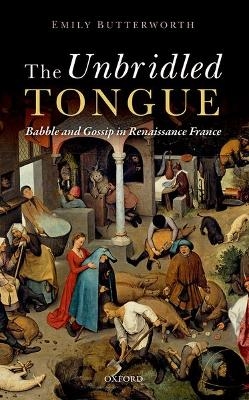
The Unbridled Tongue
Babble and Gossip in Renaissance France
Seiten
2016
Oxford University Press (Verlag)
978-0-19-966230-2 (ISBN)
Oxford University Press (Verlag)
978-0-19-966230-2 (ISBN)
The Unbridled Tongue is a book about talking too much and why it was considered not just inadvisable but dangerous in sixteenth-century Europe. Drawing on a wide range of sources and approaches, it is the first book to address Renaissance literary portrayals of gossip and rumour in a social, religious, political, and historical frame.
The Unbridled Tongue looks at gossip, rumour, and talking too much in Renaissance France in order to uncover what was specific about these practices in the period. Taking its cue from Erasmus's Lingua, in which both the subjective and political consequences of an idle and unbridled tongue are emphasised, the book investigates the impact of gossip and rumour on contemporary conceptions of identity and political engagement. Emily Butterworth discusses prescriptive literature on the tongue and theological discussions of Pentecost and prophecy, and then covers nearly a century in chapters focused on a single text: Rabelais's Tiers Livre, Marguerite de Navarre's Heptaméron, Ronsard's Discours des misères de ce temps, Montaigne's 'Des boyteux', Brantôme's Dames galantes and the anonymous Caquets de l'accouchée. In covering the 'long sixteenth century', the book is able to investigate the impact of the French Wars of Religion on perceptions of gossip and rumour, and place them in the context of an emerging public sphere of political critique and discussion, principally through the figure of the 'public voice' which, although it was associated with unruly utterance, was nevertheless a powerful rhetorical tool for the expression of grievances. The Cynic virtue of parrhesia, or free speech, is similarly ambivalent in many accounts, oscillating between bold truth-telling (liberté) and disordered babble (licence). Drawing on modern and pre-modern theories of the uses and function of gossip, the book argues that, despite this ambivalence in descriptions of the tongue, gossip and idle talk were finally excluded from the public sphere by being associated with the feminine and the irrational.
The Unbridled Tongue looks at gossip, rumour, and talking too much in Renaissance France in order to uncover what was specific about these practices in the period. Taking its cue from Erasmus's Lingua, in which both the subjective and political consequences of an idle and unbridled tongue are emphasised, the book investigates the impact of gossip and rumour on contemporary conceptions of identity and political engagement. Emily Butterworth discusses prescriptive literature on the tongue and theological discussions of Pentecost and prophecy, and then covers nearly a century in chapters focused on a single text: Rabelais's Tiers Livre, Marguerite de Navarre's Heptaméron, Ronsard's Discours des misères de ce temps, Montaigne's 'Des boyteux', Brantôme's Dames galantes and the anonymous Caquets de l'accouchée. In covering the 'long sixteenth century', the book is able to investigate the impact of the French Wars of Religion on perceptions of gossip and rumour, and place them in the context of an emerging public sphere of political critique and discussion, principally through the figure of the 'public voice' which, although it was associated with unruly utterance, was nevertheless a powerful rhetorical tool for the expression of grievances. The Cynic virtue of parrhesia, or free speech, is similarly ambivalent in many accounts, oscillating between bold truth-telling (liberté) and disordered babble (licence). Drawing on modern and pre-modern theories of the uses and function of gossip, the book argues that, despite this ambivalence in descriptions of the tongue, gossip and idle talk were finally excluded from the public sphere by being associated with the feminine and the irrational.
Emily Butterworth is a Senior Lecturer in French at King's College London. She is the author of Poisoned Words: Slander and Satire in Early Modern France, and articles on gossip, scandal, obscenity, and other forms of deviant and excessive language in the early modern period. She is co-investigator on the AHRC-funded project 'Gossip and Nonsense: Excessive Language in the French Renaissance'.
Introduction: Unbridled Tongues ; Too Much Talk ; Speaking in Tongues: Pentecost and Prophecy ; Masks: Rabelais ; Noise: Heptameron ; Licence: Ronsard ; Theatre: Montaigne ; Court: Brantome ; Women: Les Caquets de l'accouchee ; Conclusion
| Zusatzinfo | 7 black-and-white halftones |
|---|---|
| Verlagsort | Oxford |
| Sprache | englisch |
| Maße | 141 x 222 mm |
| Gewicht | 418 g |
| Themenwelt | Geschichte ► Allgemeine Geschichte ► Neuzeit (bis 1918) |
| Geisteswissenschaften ► Geschichte ► Regional- / Ländergeschichte | |
| Geisteswissenschaften ► Sprach- / Literaturwissenschaft ► Anglistik / Amerikanistik | |
| Geisteswissenschaften ► Sprach- / Literaturwissenschaft ► Literaturwissenschaft | |
| ISBN-10 | 0-19-966230-4 / 0199662304 |
| ISBN-13 | 978-0-19-966230-2 / 9780199662302 |
| Zustand | Neuware |
| Informationen gemäß Produktsicherheitsverordnung (GPSR) | |
| Haben Sie eine Frage zum Produkt? |
Mehr entdecken
aus dem Bereich

aus dem Bereich
Geschichte einer wilden Handlung
Buch | Hardcover (2024)
C.H.Beck (Verlag)
CHF 47,60


