


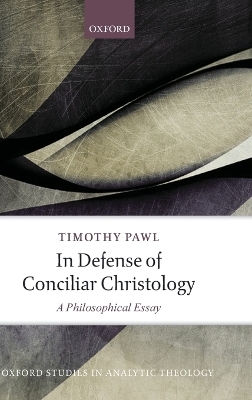
In Defense of Conciliar Christology
A Philosophical Essay
Seiten
2016
Oxford University Press (Verlag)
978-0-19-876592-9 (ISBN)
Oxford University Press (Verlag)
978-0-19-876592-9 (ISBN)
This book offers a philosophical investigation into the systematic coherence of the Christology developed by the first seven Ecumenical Councils (from the First Council of Nicaea in ad 325 to the Second Council of Nicaea in ad 787).
This work presents a historically informed, systematic exposition of the Christology of the first seven Ecumenical Councils of undivided Christendom, from the First Council of Nicaea in 325 AD to the Second Council of Nicaea in 787 AD. Assuming the truth of Conciliar Christology for the sake of argument, Timothy Pawl considers whether there are good philosophical arguments that show a contradiction or incoherence in that doctrine. He presents the definitions of important terms in the debate and a helpful metaphysics for understanding the incarnation.
In Defense of Conciliar Christology discusses three types of philosophical objections to Conciliar Christology. Firstly, it highlights the fundamental philosophical problem facing Christologyâhow can one thing be both God and man, when anything deserving to be called "God" must have certain attributes, and yet it seems that nothing that can aptly be called "man" can have those same attributes? It then considers the argument that if the Second Person of the Holy Trinity were immutable or atemporal, as Conciliar Christology requires, then that Person could not become anything, and thus could not become man. Finally, Pawl addresses the objection that if there is a single Christ then there is a single nature or will in Christ. However, if that conditional is true, then Conciliar Christology is false, since it affirms the antecedent of the conditional to be true, but denies the truth of the consequent. Pawl defends Conciliar Christology against these charges, arguing that all three philosophical objections fail to show Conciliar Christology inconsistent or incoherent.
This work presents a historically informed, systematic exposition of the Christology of the first seven Ecumenical Councils of undivided Christendom, from the First Council of Nicaea in 325 AD to the Second Council of Nicaea in 787 AD. Assuming the truth of Conciliar Christology for the sake of argument, Timothy Pawl considers whether there are good philosophical arguments that show a contradiction or incoherence in that doctrine. He presents the definitions of important terms in the debate and a helpful metaphysics for understanding the incarnation.
In Defense of Conciliar Christology discusses three types of philosophical objections to Conciliar Christology. Firstly, it highlights the fundamental philosophical problem facing Christologyâhow can one thing be both God and man, when anything deserving to be called "God" must have certain attributes, and yet it seems that nothing that can aptly be called "man" can have those same attributes? It then considers the argument that if the Second Person of the Holy Trinity were immutable or atemporal, as Conciliar Christology requires, then that Person could not become anything, and thus could not become man. Finally, Pawl addresses the objection that if there is a single Christ then there is a single nature or will in Christ. However, if that conditional is true, then Conciliar Christology is false, since it affirms the antecedent of the conditional to be true, but denies the truth of the consequent. Pawl defends Conciliar Christology against these charges, arguing that all three philosophical objections fail to show Conciliar Christology inconsistent or incoherent.
Timothy Pawl is Associate Professor of Philosophy at the University of St. Thomas, in St. Paul.
1. The Content of Conciliar Christology ; 2. Definitions and Necessary Conditions ; 3. The Theory Enfleshed ; 4. The Fundamental Problem ; 5. Denying the Predications ; 6. Denying "In the same Way" ; 7. Denying the Incompatibility ; 8. Immutability, Impassibility, and Atemporality ; 9. Number Troubles ; Bibliography
| Erscheint lt. Verlag | 24.3.2016 |
|---|---|
| Reihe/Serie | Oxford Studies In Analytic Theology |
| Verlagsort | Oxford |
| Sprache | englisch |
| Maße | 162 x 235 mm |
| Gewicht | 534 g |
| Themenwelt | Geisteswissenschaften ► Philosophie ► Metaphysik / Ontologie |
| Religion / Theologie ► Christentum ► Kirchengeschichte | |
| ISBN-10 | 0-19-876592-4 / 0198765924 |
| ISBN-13 | 978-0-19-876592-9 / 9780198765929 |
| Zustand | Neuware |
| Informationen gemäß Produktsicherheitsverordnung (GPSR) | |
| Haben Sie eine Frage zum Produkt? |
Mehr entdecken
aus dem Bereich
aus dem Bereich
die Macht des Dunklen in unserer Zeit und wie wir ihr entgegentreten
Buch | Hardcover (2025)
Verlag Herder
CHF 27,90


