


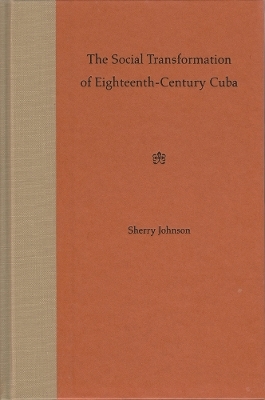
The Social Transformation of Eighteenth-century Cuba
Seiten
2001
University Press of Florida (Verlag)
978-0-8130-2097-6 (ISBN)
University Press of Florida (Verlag)
978-0-8130-2097-6 (ISBN)
A study of colonial Cuban history. It challenges existing interpretations of Cuban history by advancing an alternative to the ""sugar is forever"" thesis. In doing so, Sherry Johnson provides answers to fundamental questions regarding Cuban identity in the 19th century.
Sherry Johnson's revisionist study contributes to a new understanding of colonial Cuban history in several ways. Most important, it challenges existing interpretations of Cuban history by advancing an alternative to the ""sugar is forever"" thesis. In doing so, Johnson provides answers to fundamental questions regarding Cuban identity in the 19th century. Johnson advances a wealth of demographic data to document the contribution of the military, particularly military spending, to social, spatial, and economic change on the island long before sugar became the principal engine of its economy. She also shows how immigration had an impact on the elite and middling ranks, analyzes family life in the city, and explains how the consequences of reform resonated to the lowest ranks of Cuban society. In addition, she establishes how the death of the Spanish monarch Charles III in 1788 brought a brutal purge of Cuban society and a new, detested captain-general to power in 1790. The political repercussions of this hated regime were felt well into the 19th century, she argues, in the genesis of a popular discourse against Spanish colonialism, sugar, and slavery.
Sherry Johnson's revisionist study contributes to a new understanding of colonial Cuban history in several ways. Most important, it challenges existing interpretations of Cuban history by advancing an alternative to the ""sugar is forever"" thesis. In doing so, Johnson provides answers to fundamental questions regarding Cuban identity in the 19th century. Johnson advances a wealth of demographic data to document the contribution of the military, particularly military spending, to social, spatial, and economic change on the island long before sugar became the principal engine of its economy. She also shows how immigration had an impact on the elite and middling ranks, analyzes family life in the city, and explains how the consequences of reform resonated to the lowest ranks of Cuban society. In addition, she establishes how the death of the Spanish monarch Charles III in 1788 brought a brutal purge of Cuban society and a new, detested captain-general to power in 1790. The political repercussions of this hated regime were felt well into the 19th century, she argues, in the genesis of a popular discourse against Spanish colonialism, sugar, and slavery.
Sherry Johnson is assistant professor of history and Cuban studies at Florida International University. She is the author of articles on Cuban and Florida history in such journals as Florida Historical Quarterly, Hispanic American Historical Review, Cuban Studies, and Colonial Latin American Historical Review.
| Erscheint lt. Verlag | 31.12.2001 |
|---|---|
| Zusatzinfo | 3 figures, notes, bibliography, index |
| Verlagsort | Florida |
| Sprache | englisch |
| Maße | 161 x 235 mm |
| Gewicht | 509 g |
| Themenwelt | Geschichte ► Allgemeine Geschichte ► Neuzeit (bis 1918) |
| Geisteswissenschaften ► Geschichte ► Regional- / Ländergeschichte | |
| Geschichte ► Teilgebiete der Geschichte ► Kulturgeschichte | |
| Geschichte ► Teilgebiete der Geschichte ► Sozialgeschichte | |
| Geschichte ► Teilgebiete der Geschichte ► Wirtschaftsgeschichte | |
| ISBN-10 | 0-8130-2097-2 / 0813020972 |
| ISBN-13 | 978-0-8130-2097-6 / 9780813020976 |
| Zustand | Neuware |
| Informationen gemäß Produktsicherheitsverordnung (GPSR) | |
| Haben Sie eine Frage zum Produkt? |
Mehr entdecken
aus dem Bereich



aus dem Bereich
Geschichte einer wilden Handlung
Buch | Hardcover (2024)
C.H.Beck (Verlag)
CHF 47,60


