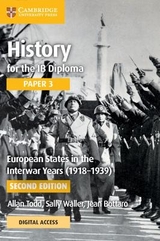
History for the IB Diploma Paper 3 European States in the Interwar Years (1918–1939)
Cambridge University Press (Verlag)
978-1-316-50646-2 (ISBN)
- Titel erscheint in neuer Auflage
- Artikel merken
Chapter 1. Introduction; Chapter 2. Germany: Unit 1. Weimar Germany, 1918-1929: 2.1. How did the new government of Germany address the constitutional, political, economic and social challenges it faced in 1918–1919?; 2.2. To what extent were the problems of Weimar Germany between 1918 and 1923 caused by the Treaty of Versailles?; 2.3. In what ways did economic, financial and social issues cause problems for the new state?; 2.4. What were the political consequences of the economic problems?; 2.5. To what extent were the Stresemann years between 1924 and 1929 a 'golden era' for Weimar Germany?; Unit 2. Germany and Hitler: 2.6. How did Hitler come to power in the 'crisis years' of 1929 to 1933?; 2.7. How did Hitler consolidate his Nazi dictatorship in the years 1933-1934?; 2.8. What political policies did Hitler use to build the National Socialist State before 1939?; 2.9. What were Hitler's main economic and social policies in the years 1933 to 1939?; 2.10. What was the nature of the Nazi State?; 2.11. What was the extent of resistance to the Nazi State?; Chapter 3. Italy: Unit 1. From Liberalism to Fascism, 1918-1924: 3.1. What was the condition of Italy before 1918?; 3.2. What were the main problems affecting Italy in the years 1918-1922?; 3.3. What political factors aided the rise of Mussolini's Fascist Party, 1919-1920?; 3.4. How did Mussolini become prime minister in 1922?; 3.5. What were Mussolini's main actions 1922-1924?; Unit 2. Establishment and consolidation of the Fascist state, 1925-1939: 3.6. How did Mussolini consolidate his power in the period 1925-1939?; 3.7. What impact did Mussolini's policies have on Italy; 3.8. How successful were Mussolini's main social policies?; 3.9. What was the nature of the Fascist state in Italy?; Chapter 4. Spain: Unit 1. Spain 1918-1930: From Monarchy to Republic: 4.1. What were Spain's main underlying problems before the First World War?; 4.2. How did the First World War affect economic and political developments in Spain before 1923?; 4.3. What were the main developments in Spain from 1923-1930?; Unit 2. The Second Republic and the Spanish Civil War, 1930-1939: 4.4. Why did the Second Republic face problems 1931-1933?; 4.5. What were the immediate causes of the Spanish Civil War?; 4.6. What were the main features of the Spanish Civil War?; 4.7. How important was foreign intervention in explaining the Nationalists' victory in the civil war?; Chapter 5. France: Unit 1. France, 1918-1929: 5.1. What was the impact of the First World War on France?; 5.2. What was the state of the French economy during the 1920s?; 5.3. What were the main developments in French politics between 1918 and 1929?; 5.4. Which social issues were significant in France in the inter-war years?; 5.5. What cultural trends were evident in the 1920s?; Unit 2. France, 1929-1940: 5.6. How did the Great Depression affect France?; 5.7. What was the Popular Front and how successful was it as a government?; 5.8. What caused the collapse of the Third Republic?; Chapter 6. Exam practice; Further Reading; Index.
| Reihe/Serie | IB Diploma |
|---|---|
| Zusatzinfo | Worked examples or Exercises |
| Verlagsort | Cambridge |
| Sprache | englisch |
| Maße | 153 x 228 mm |
| Gewicht | 580 g |
| Themenwelt | Schulbuch / Wörterbuch |
| Geschichte ► Allgemeine Geschichte ► Neuzeit (bis 1918) | |
| Geschichte ► Allgemeine Geschichte ► 1918 bis 1945 | |
| Geisteswissenschaften ► Geschichte ► Regional- / Ländergeschichte | |
| ISBN-10 | 1-316-50646-0 / 1316506460 |
| ISBN-13 | 978-1-316-50646-2 / 9781316506462 |
| Zustand | Neuware |
| Informationen gemäß Produktsicherheitsverordnung (GPSR) | |
| Haben Sie eine Frage zum Produkt? |
aus dem Bereich