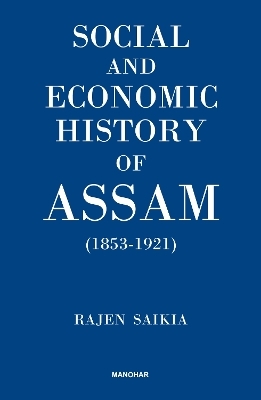
Social and Economic History of Assam (1853-1921)
Manohar Publishers and Distributors (Verlag)
978-81-7304-344-4 (ISBN)
- Titel nicht im Sortiment
- Artikel merken
Introduction of the ryotwari land system, increase in cultivated acreage, introduction of cash crops, commercialization of agriculture and how a large section of marginalized peasantry broke into the labour market have been studied in depth. The author gives an interesting interpretation of the peasant uprisings in Kamrup and Darrang in the early 1890s.
He plumbs the origin of the Assamese middle class and shows how its class personality crystallized in a process of cooperation and confrontation. He marks out the creative and constructive role of the middle class so characteristically trivialized by many.
The impact of tea industry has been studied from a new perspective. Exploration of coal, petroleum, exploitation of the forest resources, floral and faunal disturbances have also been discussed.
This is regional history, but it fully takes into account the all-India background.
Rajen Saikia taught History at Nowgong Girls' College. A recipient of the Sahitya Akademi translation award and Assam Publication Board award for historical research, Dr Saikia was the Chief Editor of the Asamiya Viswakosh, History volumes published by the Asam Sahitya Sabha. Presently he is engaged in a Political History of Assam Project of the Government of Assam for the post-colonial era.
Preface
1. Erosion of the Ruling Elite
(1) Introduction 11
(2) Listening to their tale 16
(3) The Zamindars of Goalpara 41
2. Decline of Handicrafts and Survival of Handloom
(1) Dyes 50
(2) Woodcarving and Ivory Carving 53
(3) Gold Washing 58
(4) Jewellers' Crafts 61
(5) Ironmaking 63
(6) Salt, Paper and Bell Metal Works 65
(7) Pottery 66
(8) Domestic Crafts 67
(9) Survival of Handloom 67
3. Agriculture and Peasantry
(1) Anandararn on Agriculture: 1853 81
(2) The districts 84
(3) Dynamics of Cotton and Jute 88
(4) Mauzadar: A Mixed Blessing 93
(5) The Rich and the Poor: Face to Face 94
(6) Agents of Destruction: Jui, Pani, Yuin 99
(7) Peasants' Protest 104
(8) Agricultural Labourers 110
(9) Literature on Agriculture 113
(10) Some Experiments 114
(11) Elites' Attitude 116
4. The Changing Social Spectrum
(1) Boat and Man 123
(2) Fabulous Forest 130
(3) Love for Chinese Labour 137
(4) A Canal from Karachi to Sadiya? 139
(5) Island of Changelessness 140
(6) Savings Bank 142
(7) Discovery and Development of Tea 144
(8) Petroleum and Coal 149
5. The Origin and Growth of the Assamese Middle Class 159
(1) A Compound Product 159
(2) Colonial Bureaucracy 164
(3) English Education 168
(4) Role of Tea 180
6. Middle Class Sensibility: Ideas and Issues 193
(1) Anatomy of the Language Dispute 193
(2) Response to Reform Movements 204
(3) Opium: A Sticky Situation 213
7. Conclusion 225
Bibliography 237
Index 247
| Erscheint lt. Verlag | 20.11.2024 |
|---|---|
| Verlagsort | New Delhi |
| Sprache | englisch |
| Maße | 150 x 230 mm |
| Gewicht | 650 g |
| Themenwelt | Geschichte ► Allgemeine Geschichte ► Neuzeit (bis 1918) |
| Geisteswissenschaften ► Geschichte ► Regional- / Ländergeschichte | |
| Geschichte ► Teilgebiete der Geschichte ► Kulturgeschichte | |
| Geschichte ► Teilgebiete der Geschichte ► Sozialgeschichte | |
| Geschichte ► Teilgebiete der Geschichte ► Wirtschaftsgeschichte | |
| ISBN-10 | 81-7304-344-2 / 8173043442 |
| ISBN-13 | 978-81-7304-344-4 / 9788173043444 |
| Zustand | Neuware |
| Informationen gemäß Produktsicherheitsverordnung (GPSR) | |
| Haben Sie eine Frage zum Produkt? |
aus dem Bereich