


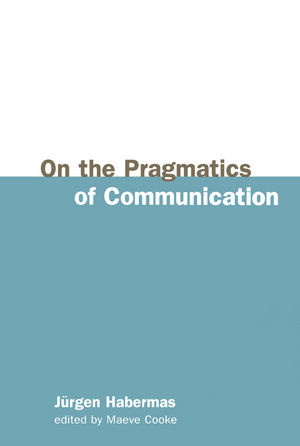
On the Pragmatics of Communication (eBook)
John Wiley & Sons (Verlag)
978-0-7456-9437-5 (ISBN)
Jurgen Habermas is Professor of Philosophy Emeritus at the University of Frankfurt.
This volume brings together Habermas's key writings on language and communication. Including some classic texts as well as new material which is published here for the first time, this book is a detailed and up-to-date introduction to Habermas's formal pragmatics, which is a vital aspect of his social theory. Written from 1976 to 1996, the essays show the extent to which formal pragmatics underpins Habermas's theory of communicative action. They are presented in chronological order, so that the reader can trace developments and revisions in Habermas's thought. The volume includes a critical discussion of Searle's theory of meaning, and Richard Rorty's neopragmatism. It concludes with Habermas's recent defence of his theory of communicative action, in which he reaffirms his view that interpretative understanding inescapably involves evaluation. This book will be an indispensable text for students and academics who want a clear and accessible introduction to the development of Habermas's theory of communication and its relation to his broader social and political theory.
Jurgen Habermas is Professor of Philosophy Emeritus at the University of Frankfurt.
Introduction: Maeve Cooke.
1. What is Universal Pragmatics? (1976).
2. Social Action, Purposive Activity, and Communication
(1981).
3. Communicative Rationality and the Theories of Meaning and
Action (1986).
4. Actions, Speech Acts, Linguistically Mediated Interactions,
and the Lifeworld (1988).
5. Comments on John Searle's 'Meaning, Communication, and
Representation' (1988).
6. Toward a Critique of the Theory of Meaning (1988).
7. Some Further Clarifications of the Concept of Communicative
Rationality (1996).
8. Richard Rorty's Pragmatic Turn (1996).
9. On the Distinction between Poetic and Communicative Uses of
Language (1985).
10. Questions and Counterquestions (1985).
Selected Bibliography and Further Reading.
Index.
Jürgen Habermas has been awarded the prestigious
'Friedenspreis des deutschen Buchhandels' prize for 2001
"These new books by Habermas will be indispensable for years to
come [and will] undoubtedly make provocative reading." Anthony
Elliott, The Australian
1
What Is Universal Pragmatics? (1976)
I
The task of universal pragmatics is to identify and reconstruct universal conditions of possible mutual understanding (Verständigung)1 In other contexts, one also speaks of “general presuppositions of communication,” but I prefer to speak of general presuppositions of communicative action because I take the type of action aimed at reaching understanding to be fundamental. Thus I start from the assumption (without undertaking to demonstrate it here) that other forms of social action—for example, conflict, competition, strategic action in general—are derivatives of action oriented toward reaching understanding (Verständigung). Furthermore, since language is the specific medium of reaching understanding at the sociocultural stage of evolution, I want to go a step further and single out explicit speech actions from other forms of communicative action. I shall ignore nonverbal actions and bodily expressions.2
The Validity Basis of Speech
Karl-Otto Apel proposes the following formulation in regard to the general presuppositions of consensual speech acts: to identify such presuppositions we must, he thinks, leave the perspective of the observer of behavioral facts and call to mind “what we must necessarily always already presuppose in regard to ourselves and others as normative conditions of the possibility of reaching understanding; and in this sense, what we must necessarily always already have accepted.”3 Apel here uses the aprioristic perfect (immer schon: always already) and adds the mode of necessity in order to express the transcendental constraint to which we, as speakers, are subject as soon as we perform or understand or respond to a speech act. In or after the performance of this act, we can become aware that we have involuntarily made certain asssumptions, which Apel calls “normative conditions of the possibility of reaching understanding.” The adjective “normative” may give rise to misunderstanding. One can say, however, that the general and unavoidable—in this sense transcendental—conditions of possible mutual understanding have a normative content when one thinks not only of the validity dimension of norms of action or evaluation, or even of the validity dimension of rules in general, but also of the validity basis of speech across its entire spectrum. As a preliminary, I want to indicate briefly what I mean by the “validity basis of speech.”
I shall develop the thesis that anyone acting communicatively must, in performing any speech act, raise universal validity claims and suppose that they can be vindicated (einlösen). Insofar as she wants to participate in a process of reaching understanding, she cannot avoid raising the following—and indeed precisely the following—validity claims. She claims to be
The speaker must choose an intelligible (verständlich) expression so that speaker and hearer can comprehend one another. The speaker must have the intention of communicating a true (wahr) proposition (or a propositional content, the existential presuppositions of which are satisfied) so that the hearer can share the knowledge of the speaker. The speaker must want to express her intentions truthfully (wahrhaftig) so that the hearer can find the utterance of the speaker credible (can trust her). Finally, the speaker must choose an utterance that is right (richtig) with respect to prevailing norms and values so that the hearer can accept the utterance, and both speaker and hearer can, in the utterance, thereby agree with one another with respect to a recognized normative background. Moreover, communicative action can continue undisturbed only as long as all participants suppose that the validity claims they reciprocally raise are raised justifiably.
The aim of reaching understanding (Verständigung) is to bring about an agreement (Einverständnis) that terminates in the intersubjective mutuality of reciprocal comprehension, shared knowledge, mutual trust, and accord with one another. Agreement is based on recognition of the four corresponding validity claims: comprehensibility, truth, truthfulness, and rightness. We can see that the word “Verständigung” is ambiguous. In its narrowest meaning it indicates that two subjects understand a linguistic expression in the same way; in its broadest meaning it indicates that an accord exists between two subjects concerning the rightness of an utterance in relation to a mutually recognized normative background. In addition, the participants in communication can reach understanding about something in the world, and they can make their intentions understandable to one another.
If full agreement, embracing all four of these components, were a normal state of linguistic communication, it would not be necessary to analyze the process of reaching understanding from the dynamic perspective of bringing about an agreement. The typical states are in the gray areas between, on the one hand, lack of understanding and misunderstanding, intentional and involuntary untruthfulness, concealed and open discord, and, on the other hand, preexisting or achieved consensus. Reaching understanding is the process of bringing about an agreement on the presupposed basis of validity claims that are mutually recognized. In everyday life, we start from a background consensus pertaining to those interpretations taken for granted among participants. As soon as this consensus is shaken, and as soon as the presupposition that the validity claims are satisfied (or could be vindicated) is suspended in the case of at least one of the four claims, communicative action cannot be continued.
The task of mutual interpretation, then, is to achieve a new definition of the situation that all participants can share. If this attempt fails, one is basically confronted with the alternatives of switching to strategic action, breaking off communication altogether, or recommencing action oriented toward reaching understanding at a different level, the level of argumentative speech (for purposes of discursively examining the problematic validity claims, which are now regarded as hypothetical). In what follows, I shall take into consideration only consensual speech acts, leaving aside both discourse and strategic action.
In communicative action, participants presuppose that they know what mutual recognition of reciprocally raised validity claims means. If in addition they can rely on a shared definition of the situation and thereupon act consensually, the background consensus includes the following:
Thus I distinguish (i) the conditions for the validity of a grammatical sentence, true proposition, truthful intentional expression, or normatively correct utterance appropriate to its context from (ii) the claims with which speakers demand intersubjective recognition for the well-formedness of a sentence, truth of a proposition, truthfulness of an intentional expression, and rightness of a speech act, as well as from (iii) the vindication of justifiably raised validity claims. Vindication means that the proponent, whether through appeal to intuitions and experiences or through arguments and action consequences, justifies the claim’s worthiness to be recognized and brings about a suprasubjective recognition of its validity. In accepting a validity claim raised by the speaker, the hearer recognizes the validity of the symbolic structures; that is, he recognizes that a sentence is grammatical, a statement true, an intentional expression truthful, or an utterance correct. The validity of these symbolic structures is justified by virtue of the fact that they satisfy certain adequacy conditions; but the meaning of the validity consists in their worthiness to be recognized that is, in the guarantee that intersubjective recognition can be brought about under suitable conditions.4
I have proposed the name “universal pragmatics”5 for the research program aimed at reconstructing the universal validity basis of speech.6 I would now like to delimit the theme of this research program in a preliminary way. Thus before passing on (in part II) to the theory of speech acts, I shall prefix a few guiding remarks dealing with (i) an initial delimitation of the object domain of the proposed program of universal pragmatics; (ii) an elucidation of the procedure of rational reconstruction, as opposed to an empirical-analytic procedure in the narrower sense; (iii) a few...
| Erscheint lt. Verlag | 30.12.2014 |
|---|---|
| Sprache | englisch |
| Themenwelt | Geisteswissenschaften ► Sprach- / Literaturwissenschaft ► Sprachwissenschaft |
| Sozialwissenschaften ► Politik / Verwaltung | |
| Sozialwissenschaften ► Soziologie ► Allgemeine Soziologie | |
| Schlagworte | action • Book • Brings • Classic • Communication & Media Studies • Essays • extent • First • formal • Gesellschaftstheorie • habermass • Key • Kommunikation u. Medienforschung • language • Material • New • Political Philosophy & Theory • Political Science • Politikwissenschaft • Politische Philosophie u. Politiktheorie • Pragmatics • pragmatics underpins • Social • Social Theory • Sociology • Soziologie • texts • theory • Time • uptodate introduction • vital aspect • Volume • Writings |
| ISBN-10 | 0-7456-9437-3 / 0745694373 |
| ISBN-13 | 978-0-7456-9437-5 / 9780745694375 |
| Informationen gemäß Produktsicherheitsverordnung (GPSR) | |
| Haben Sie eine Frage zum Produkt? |
 EPUB (Adobe DRM)
Kopierschutz: Adobe-DRM
Adobe-DRM ist ein Kopierschutz, der das eBook vor Mißbrauch schützen soll. Dabei wird das eBook bereits beim Download auf Ihre persönliche Adobe-ID autorisiert. Lesen können Sie das eBook dann nur auf den Geräten, welche ebenfalls auf Ihre Adobe-ID registriert sind.
Details zum Adobe-DRM
Dateiformat: EPUB (Electronic Publication)
EPUB ist ein offener Standard für eBooks und eignet sich besonders zur Darstellung von Belletristik und Sachbüchern. Der Fließtext wird dynamisch an die Display- und Schriftgröße angepasst. Auch für mobile Lesegeräte ist EPUB daher gut geeignet.
Systemvoraussetzungen:
PC/Mac: Mit einem PC oder Mac können Sie dieses eBook lesen. Sie benötigen eine
eReader: Dieses eBook kann mit (fast) allen eBook-Readern gelesen werden. Mit dem amazon-Kindle ist es aber nicht kompatibel.
Smartphone/Tablet: Egal ob Apple oder Android, dieses eBook können Sie lesen. Sie benötigen eine
Geräteliste und zusätzliche Hinweise
Buying eBooks from abroad
For tax law reasons we can sell eBooks just within Germany and Switzerland. Regrettably we cannot fulfill eBook-orders from other countries.
aus dem Bereich


