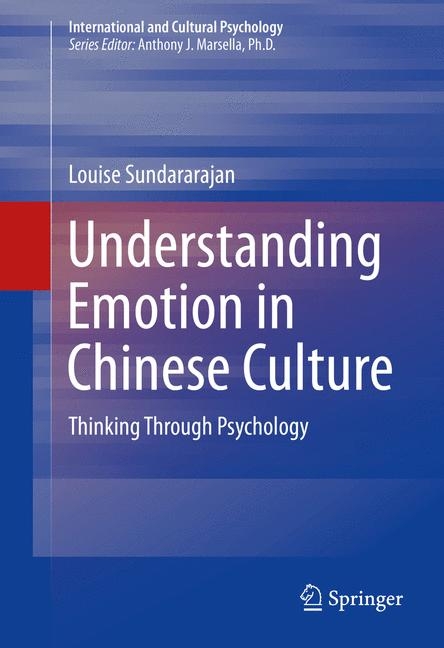
Understanding Emotion in Chinese Culture (eBook)
210 Seiten
Springer International Publishing (Verlag)
978-3-319-18221-6 (ISBN)
This mind-opening take on indigenous psychology presents a multi-level analysis of culture to frame the differences between Chinese and Western cognitive and emotive styles. Eastern and Western cultures are seen here as mirror images in terms of rationality, relational thinking, and symmetry or harmony. Examples from the philosophical texts of Confucianism, Daoism, Buddhism, and classical poetry illustrate constructs of shading and nuancing emotions in contrast to discrete emotions and emotion regulation commonly associated with traditional psychology. The resulting text offers readers bold new understandings of emotion-based states both familiar (intimacy, solitude) and unfamiliar (resonance, being spoiled rotten), as well as larger concepts of freedom, creativity, and love.
Included among the topics:
- The mirror universes of East and West.
- In the crucible of Confucianism.
- Freedom and emotion: Daoist recipes for authenticity and creativity.
- Chinese creativity, with special focus on solitude and its seekers.
- Savoring, from aesthetics to the everyday.
- What is an emotion? Answers from a wild garden of knowledge.
Understanding Emotion in Chinese Culture has a wealth of research and study potential for undergraduate and graduate courses in affective science, cognitive psychology, cultural and cross- cultural psychology, indigenous psychology, multicultural studies, Asian psychology, theoretical and philosophical psychology, anthropology, sociology, international psychology, and regional studies.
Louise Sundararajan was born in Yunnan, China, and grew up in Taiwan. She received her BA in English Literature from Tunghai University, Taiwan, her Ph.D. in History of Religions from Harvard University, and her Ed.D. in Counseling Psychology from Boston University. She chairs the Task Force on Indigenous Psychology, which is joined by near two hundred researchers from around the globe. She served as past president of The International Society for the Study of Human Ideas on Ultimate Reality and Meaning, and also past president of the Society for Humanistic Psychology (Division 32 of the American Psychological Association). She is recipient of the Abraham Maslow Award for 2014, from Division 32 of APA. She is a Fellow of the American Psychological Association, and also a member of the Board of Directors for the International Society for Research on Emotions. She serves on the editorial boards of The Humanistic Psychologist, and Journal of Humanistic Psychology. She is Associate Editor for Journal of Theoretical and Philosophical Psychology. She has published extensively on topics related to culture and emotions. Outside academia, she practices psychology as a forensic psychologist, and enjoys the family life of a grandmother.
Louise Sundararajan was born in Yunnan, China, and grew up in Taiwan. She received her BA in English Literature from Tunghai University, Taiwan, her Ph.D. in History of Religions from Harvard University, and her Ed.D. in Counseling Psychology from Boston University. She chairs the Task Force on Indigenous Psychology, which is joined by near two hundred researchers from around the globe. She served as past president of The International Society for the Study of Human Ideas on Ultimate Reality and Meaning, and also past president of the Society for Humanistic Psychology (Division 32 of the American Psychological Association). She is recipient of the Abraham Maslow Award for 2014, from Division 32 of APA. She is a Fellow of the American Psychological Association, and also a member of the Board of Directors for the International Society for Research on Emotions. She serves on the editorial boards of The Humanistic Psychologist, and Journal of Humanistic Psychology. She is Associate Editor for Journal of Theoretical and Philosophical Psychology. She has published extensively on topics related to culture and emotions. Outside academia, she practices psychology as a forensic psychologist, and enjoys the family life of a grandmother.
Part 1 Conceptual Foundations for the analysis of Chinese Emotions.- The Mirror Universes of East and West.- Harmony: A Delicate Dance of Symmetry.- In the Crucible of Confucianism.- On the Wings of Daoism.- Part II. Tracing Emotions daintily through Things Psychologically Chinese.- Heart-Aching Love (Teng, 疼).- The Art of Intimacy.- Freedom and Emotion: Daoist recipes for Authenticity and Creativity.- Being Spoiled Rotten (Sajiao 撒嬌): Lessons in Gratitude.- Part III. Chinese Creativity.- Chinese Creativity, with special focus on Solitude and its Seekers.- Savoring (Pin wei 品味), from Aesthetics to the Everyday.- Emptiness (Kong): Insight-based Emotional Transformations.- Part IV: Conclusion.- What is an Emotion? Answers from a Wild Garden of Knowledge.
| Erscheint lt. Verlag | 6.7.2015 |
|---|---|
| Reihe/Serie | International and Cultural Psychology | International and Cultural Psychology |
| Zusatzinfo | XX, 210 p. 7 illus., 6 illus. in color. |
| Verlagsort | Cham |
| Sprache | englisch |
| Themenwelt | Geisteswissenschaften ► Psychologie |
| Schlagworte | Chinese Civilization • Chinese creativity • Chinese emotions • Chinese poetics • Confucianism • cross-cultural psychology • Empathy • Filial Piety • Harmony • hierarchy-based emotions • Indigenous Psychology • individualism versus collectivism • Mindfulness • Morality • social mindfulness • Taoism • taoism-based emotions • tight versus loose cultures |
| ISBN-10 | 3-319-18221-8 / 3319182218 |
| ISBN-13 | 978-3-319-18221-6 / 9783319182216 |
| Informationen gemäß Produktsicherheitsverordnung (GPSR) | |
| Haben Sie eine Frage zum Produkt? |
 PDF (Wasserzeichen)
DRM: Digitales Wasserzeichen
Dieses eBook enthält ein digitales Wasserzeichen und ist damit für Sie personalisiert. Bei einer missbräuchlichen Weitergabe des eBooks an Dritte ist eine Rückverfolgung an die Quelle möglich.
Dateiformat: PDF (Portable Document Format)
Mit einem festen Seitenlayout eignet sich die PDF besonders für Fachbücher mit Spalten, Tabellen und Abbildungen. Eine PDF kann auf fast allen Geräten angezeigt werden, ist aber für kleine Displays (Smartphone, eReader) nur eingeschränkt geeignet.
Systemvoraussetzungen:
PC/Mac: Mit einem PC oder Mac können Sie dieses eBook lesen. Sie benötigen dafür einen PDF-Viewer - z.B. den Adobe Reader oder Adobe Digital Editions.
eReader: Dieses eBook kann mit (fast) allen eBook-Readern gelesen werden. Mit dem amazon-Kindle ist es aber nicht kompatibel.
Smartphone/Tablet: Egal ob Apple oder Android, dieses eBook können Sie lesen. Sie benötigen dafür einen PDF-Viewer - z.B. die kostenlose Adobe Digital Editions-App.
Buying eBooks from abroad
For tax law reasons we can sell eBooks just within Germany and Switzerland. Regrettably we cannot fulfill eBook-orders from other countries.
aus dem Bereich