


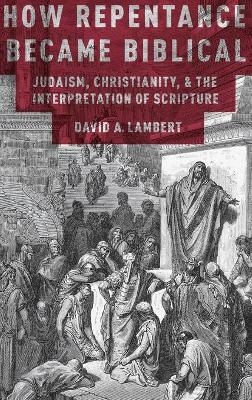
How Repentance Became Biblical
Judaism, Christianity, and the Interpretation of Scripture
Seiten
2016
Oxford University Press Inc (Verlag)
9780190212247 (ISBN)
Oxford University Press Inc (Verlag)
9780190212247 (ISBN)
How Repentance Became Biblical explores the rise of repentance as a concept within early forms of Judaism and Christianity and how it has informed the interpretation of the Hebrew Bible, or Old Testament. It develops alternative accounts for many of the ancient phenomena identified as penitential.
How Repentance Became Biblical tells the story of repentance as a concept. Many today, in both secular and religious contexts, assume it to be a natural and inevitable component of our lives. But where did it originate? How did it become so prominent within Western religious traditions and, by extension, contemporary culture? What purposes does it serve? This book identifies repentance as a product of the Hellenistic period, where it was taken up within emerging forms of Judaism and Christianity as a mode of subjective control. Lambert argues that, along with the rise of repentance, a series of interpretive practices, many of which remain in effect to this day, was put into place whereby repentance is read into the Bible and the Bible, especially the Hebrew Bible, or Old Testament, comes to be seen as repentance's source. Ancient Israelite rituals, such as fasting, prayer, and confession, all of which are incorporated later on within various religious communities as forms of penitential discipline, are understood as external signs of internal remorse. Hebrew terms and phrases, such as the prophetic injunction to "return to YHWH," are read as ancient representations of the concept, repentance. Prophetic literature as a whole is seen as serving a pedagogical purpose, as aiming at the reformation of Israel as a nation. Furthermore, it is assumed that, on the basis of the Bible, sectarians living in the late Second Temple period, from the Dead Sea sect to the early Jesus movement, believed that their redemption depended upon their repentance. In fact, the penitential framework within which the Bible is interpreted tells us the most about our own interpretive tendencies, about how we privilege notions of interiority, autonomy, and virtue. The book develops other frameworks for explaining the biblical phenomena in their ancient contexts, based on alternative views of the body, power, speech, and the divine, and, thereby, offers a new account of repentance's origins.
How Repentance Became Biblical tells the story of repentance as a concept. Many today, in both secular and religious contexts, assume it to be a natural and inevitable component of our lives. But where did it originate? How did it become so prominent within Western religious traditions and, by extension, contemporary culture? What purposes does it serve? This book identifies repentance as a product of the Hellenistic period, where it was taken up within emerging forms of Judaism and Christianity as a mode of subjective control. Lambert argues that, along with the rise of repentance, a series of interpretive practices, many of which remain in effect to this day, was put into place whereby repentance is read into the Bible and the Bible, especially the Hebrew Bible, or Old Testament, comes to be seen as repentance's source. Ancient Israelite rituals, such as fasting, prayer, and confession, all of which are incorporated later on within various religious communities as forms of penitential discipline, are understood as external signs of internal remorse. Hebrew terms and phrases, such as the prophetic injunction to "return to YHWH," are read as ancient representations of the concept, repentance. Prophetic literature as a whole is seen as serving a pedagogical purpose, as aiming at the reformation of Israel as a nation. Furthermore, it is assumed that, on the basis of the Bible, sectarians living in the late Second Temple period, from the Dead Sea sect to the early Jesus movement, believed that their redemption depended upon their repentance. In fact, the penitential framework within which the Bible is interpreted tells us the most about our own interpretive tendencies, about how we privilege notions of interiority, autonomy, and virtue. The book develops other frameworks for explaining the biblical phenomena in their ancient contexts, based on alternative views of the body, power, speech, and the divine, and, thereby, offers a new account of repentance's origins.
David Lambert is an assistant professor of Religious Studies at the University of North Carolina at Chapel Hill, where he teaches courses on the Hebrew Bible and its history of interpretation. He received his undergraduate and graduate training at Harvard University in the Department of Near Eastern Languages and Civilizations.
Preface ; Introduction: The Penitential Lens ; Part I - Rites ; 1. Fasting and the Artistry of Distress ; 2. The Logic of Appeal ; 3. Articulating Sin ; Part II - Language and Pedagogy ; 4. A Material (Re)turn to YHWH ; 5. Power and the Prophetic Utterance ; Part III - Religion ; 6. Agency and Redemption ; 7. The Genealogy of Repentance ; Postscript
| Erscheint lt. Verlag | 21.1.2016 |
|---|---|
| Verlagsort | New York |
| Sprache | englisch |
| Maße | 155 x 239 mm |
| Gewicht | 522 g |
| Themenwelt | Geschichte ► Teilgebiete der Geschichte ► Religionsgeschichte |
| Religion / Theologie ► Christentum ► Kirchengeschichte | |
| Geisteswissenschaften ► Religion / Theologie ► Judentum | |
| ISBN-13 | 9780190212247 / 9780190212247 |
| Zustand | Neuware |
| Informationen gemäß Produktsicherheitsverordnung (GPSR) | |
| Haben Sie eine Frage zum Produkt? |
Mehr entdecken
aus dem Bereich


aus dem Bereich
von der Antike bis zur Gegenwart
Buch | Softcover (2025)
C.H.Beck (Verlag)
CHF 16,80


