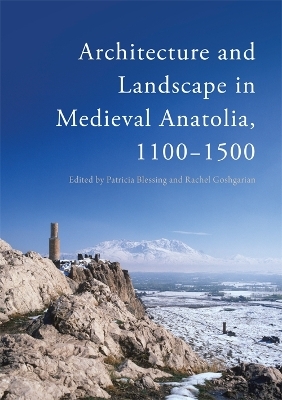
Architecture and Landscape in Medieval Anatolia, 1100-1500
Edinburgh University Press (Verlag)
978-1-4744-1129-5 (ISBN)
Anatolia was home to a large number of polities in the medieval period. Given its location at the geographical and chronological juncture between Byzantines and the Ottomans, its story tends to be read through the Seljuk experience. This obscures the multiple experiences and spaces of Anatolia under the Byzantine empire, Turko-Muslim dynasties contemporary to the Seljuks, the Mongol Ilkhanids, and the various beyliks of eastern and western Anatolia.
This book looks beyond political structures and towards a reconsideration of the interactions between the rural and the urban; an analysis of the relationships between architecture, culture and power; and an examination of the region’s multiple geographies. In order to expand historiographical perspectives it draws on a wide variety of sources (architectural, artistic, documentary and literary), including texts composed in several languages (Arabic, Armenian, Byzantine Greek, Persian and Turkish).
Original in its coverage of this period from the perspective of multiple polities, religions and languages, this volume is also the first to truly embrace the cultural complexity that was inherent in the reality of daily life in medieval Anatolia and surrounding regions.
Patricia Blessing is Assistant Professor of Art History at Pomona College. She completed her PhD in the Department of Art and Archaeology at Princeton University in 2012 and is the author of Rebuilding Anatolia after the Mongol Conquest: Islamic Architecture in the Lands of Rūm, 1240-1330 ( 2014). Rachel Goshgarian is Assistant Professor of History at Lafayette College. She is co-author of the first Armenian grammar published in Turkey in over 100 years, Kendi Kendine Ermenice, with Sukru Ilicak (2006).
List of Illustrations and TablesAcknowledgementsForeword, Scott RedfordIntroduction – Space and Place: Applications to Medieval Anatolia, Patricia Blessing and Rachel Goshgarian
Part I. Building: Masons and InfrastructureChapter 2. Craftsmen in Medieval Anatolia: Methods and Mobility, Richard McClaryChapter 3. Stones for Travelers: Notes on the Masonry of Seljuk Road Caravanserais, Cinzia Tavernari
Part II. Social Groups: Akhis and FutuwwaChapter 4. Suggestions on the Social Meaning, Structure and Functions of Akhi Communities and their Hospices in Medieval Anatolia, İklil SelçukChapter 5. Social Graces and Urban Spaces: Brotherhood and the Ambiguities of Masculinity and Religious Practice in Late Medieval Anatolia, Rachel Goshgarian
Part III. Exchange: Islamic and Christian ArchitectureChapter 6. Transformation of the ‘Sacred’ Image of a Byzantine Cappadocian Settlement, Fatma Gül ÖztürkChapter 7. The ‘Islamicness’ of Some Decorative Patterns in the Church of Tigran Honents in Ani, Mattia Guidetti
Part IV. Frameworks: Language, Geography and IdentityChapter 8. Harvesting Garden Semantics in Late Medieval Anatolia, Nicolas TrépanierChapter 9. All Quiet on the Eastern Frontier? The Contemporaries of Early Ottoman Architecture in Eastern Anatolia, Patricia BlessingChapter 10. The ‘Dual Identity’ of Mahperi Khatun: Piety, Patronage and Marriage across Frontiers in Seljuk Anatolia, Suzan Yalman
Notes on ContributorsBibliographyIndex
| Zusatzinfo | 64 black and white illustrations, 16 colour illustrations |
|---|---|
| Verlagsort | Edinburgh |
| Sprache | englisch |
| Maße | 172 x 244 mm |
| Gewicht | 789 g |
| Themenwelt | Kunst / Musik / Theater ► Kunstgeschichte / Kunststile |
| Geschichte ► Allgemeine Geschichte ► Mittelalter | |
| Geisteswissenschaften ► Geschichte ► Regional- / Ländergeschichte | |
| Geisteswissenschaften ► Religion / Theologie ► Islam | |
| Technik ► Architektur | |
| ISBN-10 | 1-4744-1129-0 / 1474411290 |
| ISBN-13 | 978-1-4744-1129-5 / 9781474411295 |
| Zustand | Neuware |
| Informationen gemäß Produktsicherheitsverordnung (GPSR) | |
| Haben Sie eine Frage zum Produkt? |
aus dem Bereich