


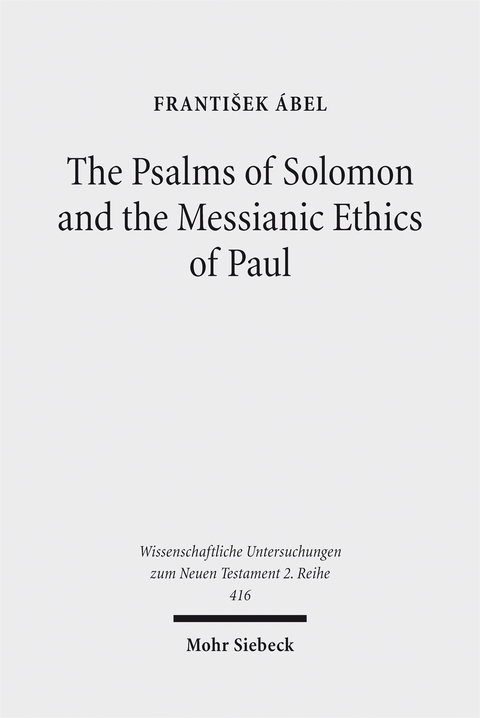
The Psalms of Solomon and the Messianic Ethics of Paul
Seiten
František Ábel untersucht die Rolle und den Einfluss jüdischer Pseudepigraphen bezüglich der theologischen Ansichten des Paulus. Der Autor zeigt durch eine detaillierte Analyse und Untersuchung bestimmter Teile dieses Textes, dass diese deuterokanonische Schrift einen beachtlichen Hintergrund für das Verständnis der Gestaltung und Entwicklung der messianischen Ethik des Paulus bieten kann.
Frantisek Ábel explores one of the topical issues of Paul's theology, namely the role and influence of the Jewish Pseudo-epigraphs, literature written during Greek and early Roman periods (4th century BCE to the 2nd century CE), on Paul's theological thinking. Within this corpus the idea of eschatological concepts, such as the concept regarding the coming of the Messiah and the Last Judgment in particular, arises frequently. It is similar in the case of the Psalms of Solomon with the Last Judgment as the main topic of this pseudepigraphon. Through close analysis and exploration of particular parts of this work, the author proposes that this deuterocanonical writing could form a considerable background for the proper understanding of Paul's messianic ethics. From this point of view, Paul's teaching on justification should be understood as one that is reflective of God's grace, while at the same time expressing faith and deeds as necessary for salvation.
Frantisek Ábel explores one of the topical issues of Paul's theology, namely the role and influence of the Jewish Pseudo-epigraphs, literature written during Greek and early Roman periods (4th century BCE to the 2nd century CE), on Paul's theological thinking. Within this corpus the idea of eschatological concepts, such as the concept regarding the coming of the Messiah and the Last Judgment in particular, arises frequently. It is similar in the case of the Psalms of Solomon with the Last Judgment as the main topic of this pseudepigraphon. Through close analysis and exploration of particular parts of this work, the author proposes that this deuterocanonical writing could form a considerable background for the proper understanding of Paul's messianic ethics. From this point of view, Paul's teaching on justification should be understood as one that is reflective of God's grace, while at the same time expressing faith and deeds as necessary for salvation.
Born 1964; 2006 PhD; 2006-12 assistant professor at the New Testament Department of the Evangelical Lutheran Theological Faculty of Comenius University in Bratislava; 2007-11 assistant dean of academic affairs, since 2013 associate professor.
| Erscheint lt. Verlag | 4.7.2016 |
|---|---|
| Reihe/Serie | Wissenschaftliche Untersuchungen zum Neuen Testament 2. Reihe |
| Verlagsort | Tübingen |
| Sprache | englisch |
| Maße | 156 x 234 mm |
| Gewicht | 567 g |
| Themenwelt | Religion / Theologie ► Christentum ► Bibelausgaben / Bibelkommentare |
| Geisteswissenschaften ► Religion / Theologie ► Judentum | |
| Geisteswissenschaften ► Sprach- / Literaturwissenschaft ► Literaturwissenschaft | |
| Schlagworte | Doctrine • Doctrine of Justification • Grace • Judaism • Justice • Justification • messianic • of • Second • Second Temple Judaism • Temple |
| ISBN-13 | 9783161539916 / 9783161539916 |
| Zustand | Neuware |
| Informationen gemäß Produktsicherheitsverordnung (GPSR) | |
| Haben Sie eine Frage zum Produkt? |
Mehr entdecken
aus dem Bereich

aus dem Bereich
Buch | Softcover (2021)
De Gruyter (Verlag)
CHF 44,90


