Scott Soames is Distinguished Professor of Philosophy and director of the School of Philosophy at the University of Southern California. He is the author of many books, including The Analytic Tradition in Philosophy, Volume 1; Analytic Philosophy in America; Philosophy of Language; Philosophical Essays; and Philosophical Analysis in the Twentieth Century (all Princeton).
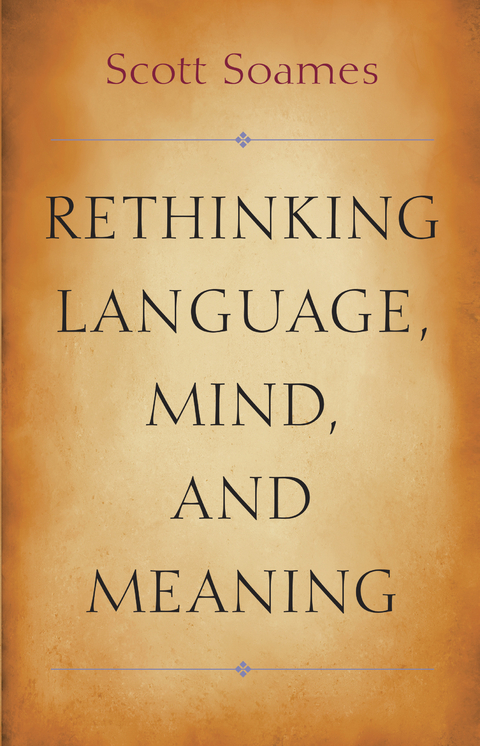
In this book, Scott Soames argues that the revolution in the study of language and mind that has taken place since the late nineteenth century must be rethought. The central insight in the reigning tradition is that propositions are representational. To know the meaning of a sentence or the content of a belief requires knowing which things it represents as being which ways, and therefore knowing what the world must be like if it is to conform to how the sentence or belief represents it. These are truth conditions of the sentence or belief. But meanings and representational contents are not truth conditions, and there is more to propositions than representational content. In addition to imposing conditions the world must satisfy if it is to be true, a proposition may also impose conditions on minds that entertain it. The study of mind and language cannot advance further without a conception of propositions that allows them to have contents of both of these sorts. Soames provides it.He does so by arguing that propositions are repeatable, purely representational cognitive acts or operations that represent the world as being a certain way, while requiring minds that perform them to satisfy certain cognitive conditions. Because they have these two types of content-one facing the world and one facing the mind-pairs of propositions can be representationally identical but cognitively distinct. Using this breakthrough, Soames offers new solutions to several of the most perplexing problems in the philosophy of language and mind.
Scott Soames is Distinguished Professor of Philosophy and director of the School of Philosophy at the University of Southern California. He is the author of many books, including The Analytic Tradition in Philosophy, Volume 1; Analytic Philosophy in America; Philosophy of Language; Philosophical Essays; and Philosophical Analysis in the Twentieth Century (all Princeton).
| Erscheint lt. Verlag | 26.5.2015 |
|---|---|
| Reihe/Serie | Carl G. Hempel Lecture Series | Carl G. Hempel Lecture Series |
| Verlagsort | Princeton |
| Sprache | englisch |
| Themenwelt | Geisteswissenschaften ► Philosophie ► Allgemeines / Lexika |
| Geisteswissenschaften ► Philosophie ► Sprachphilosophie | |
| Geisteswissenschaften ► Sprach- / Literaturwissenschaft ► Sprachwissenschaft | |
| Schlagworte | 2C (psychedelics) • Addition • A priori and a posteriori • arithmetic • Ascription • awareness • Category mistake • clause • Cognition • Conjecture (textual criticism) • Content clause • Contradiction • Definite description • Demonstrative • Denotation • Denotation (semiotics) • Description • de se • Determination • Epistemology • Existence • Explanation • Falsity • Foundations of mathematics • Frege's puzzle • Gottlob Frege • Grammatical person • Hilary Putnam • imperative mood • Individuation • inference • Instance (computer science) • Intention • intentionality • Kripke • Latitudinarianism (philosophy) • Lecture • linguistic description • Linguistics • Logic • logical consequence • logicism • Mathematics • Meaning (linguistics) • Mental representation • Modal Logic • Modal operator • Natural kind • natural language • New Thought • Ontology • Philosopher • Philosophy of Language • philosophy of mathematics • Philosophy of mind • Phrase • Physicalism • Predicate (grammar) • Predicate (mathematical logic) • Prediction • Presupposition • pronoun • Proposition • propositional attitude • Propositional function • Publication • Quantification (science) • Quantifier (linguistics) • reason • referent • Requirement • result • Rule of inference • Saul Kripke • Scott Soames • Semantic property • Semantics • Sense and reference • Sentence (linguistics) • Singular term • Speech Act • Subject (grammar) • Suggestion • syllogism • Terminology • Theorem • Theoretical Linguistics • theory • Thought • truism • Truth • Truth condition • Truth value • Two-dimensionalism • Uncertainty • Understanding • Unity of the proposition • utterance • Uttering • Verb |
| ISBN-10 | 1-4008-6633-2 / 1400866332 |
| ISBN-13 | 978-1-4008-6633-5 / 9781400866335 |
| Informationen gemäß Produktsicherheitsverordnung (GPSR) | |
| Haben Sie eine Frage zum Produkt? |
 PDF (Wasserzeichen)
Größe: 959 KB
DRM: Digitales Wasserzeichen
Dieses eBook enthält ein digitales Wasserzeichen und ist damit für Sie personalisiert. Bei einer missbräuchlichen Weitergabe des eBooks an Dritte ist eine Rückverfolgung an die Quelle möglich.
Dateiformat: PDF (Portable Document Format)
Mit einem festen Seitenlayout eignet sich die PDF besonders für Fachbücher mit Spalten, Tabellen und Abbildungen. Eine PDF kann auf fast allen Geräten angezeigt werden, ist aber für kleine Displays (Smartphone, eReader) nur eingeschränkt geeignet.
Systemvoraussetzungen:
PC/Mac: Mit einem PC oder Mac können Sie dieses eBook lesen. Sie benötigen dafür einen PDF-Viewer - z.B. den Adobe Reader oder Adobe Digital Editions.
eReader: Dieses eBook kann mit (fast) allen eBook-Readern gelesen werden. Mit dem amazon-Kindle ist es aber nicht kompatibel.
Smartphone/Tablet: Egal ob Apple oder Android, dieses eBook können Sie lesen. Sie benötigen dafür einen PDF-Viewer - z.B. die kostenlose Adobe Digital Editions-App.
Buying eBooks from abroad
For tax law reasons we can sell eBooks just within Germany and Switzerland. Regrettably we cannot fulfill eBook-orders from other countries.
 EPUB (Adobe DRM)
Kopierschutz: Adobe-DRM
Adobe-DRM ist ein Kopierschutz, der das eBook vor Mißbrauch schützen soll. Dabei wird das eBook bereits beim Download auf Ihre persönliche Adobe-ID autorisiert. Lesen können Sie das eBook dann nur auf den Geräten, welche ebenfalls auf Ihre Adobe-ID registriert sind.
Details zum Adobe-DRM
Dateiformat: EPUB (Electronic Publication)
EPUB ist ein offener Standard für eBooks und eignet sich besonders zur Darstellung von Belletristik und Sachbüchern. Der Fließtext wird dynamisch an die Display- und Schriftgröße angepasst. Auch für mobile Lesegeräte ist EPUB daher gut geeignet.
Systemvoraussetzungen:
PC/Mac: Mit einem PC oder Mac können Sie dieses eBook lesen. Sie benötigen eine
eReader: Dieses eBook kann mit (fast) allen eBook-Readern gelesen werden. Mit dem amazon-Kindle ist es aber nicht kompatibel.
Smartphone/Tablet: Egal ob Apple oder Android, dieses eBook können Sie lesen. Sie benötigen eine
Geräteliste und zusätzliche Hinweise
Buying eBooks from abroad
For tax law reasons we can sell eBooks just within Germany and Switzerland. Regrettably we cannot fulfill eBook-orders from other countries.
aus dem Bereich