


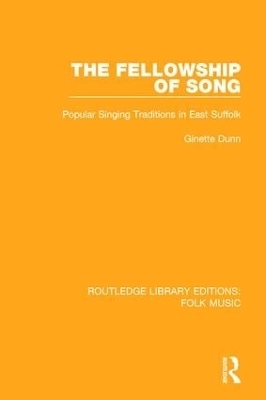
The Fellowship of Song
Popular Singing Traditions in East Suffolk
Seiten
2015
Routledge (Verlag)
978-1-138-95202-7 (ISBN)
Routledge (Verlag)
978-1-138-95202-7 (ISBN)
Originally published in 1980. This book focuses on traditional singing in two small English villages, studying in detail an activity which goes to the core of the communal life in any village and demonstrates how song becomes the lifeblood of the traditions of rural life.
Originally published in 1980. Song is perhaps the strongest form of traditional culture. Its vigour and energy represent the power of the community from which it springs. This book focuses on traditional singing in two small English villages. It studies in detail an activity which goes to the core of the communal life in any village and demonstrates how song becomes the lifeblood of the traditions of rural life.
In many ways traditional singing is highly subversive because its practice is an affirmation of community and a denial of the fragmentation of modern society. The songs sung, those remembered, the singers now dead whose lives are recalled each time an old favourite is performed, all connect the present with the past. The primary aesthetic concern within these singing traditions is that a man should sing, whatever the objective quality of his performance; and a song should tell a good story. The individual singer assumes a special role in performance since he becomes spokesman for a group and gives voice not only to personal but also to social concerns, dynamics and emotions.
Originally published in 1980. Song is perhaps the strongest form of traditional culture. Its vigour and energy represent the power of the community from which it springs. This book focuses on traditional singing in two small English villages. It studies in detail an activity which goes to the core of the communal life in any village and demonstrates how song becomes the lifeblood of the traditions of rural life.
In many ways traditional singing is highly subversive because its practice is an affirmation of community and a denial of the fragmentation of modern society. The songs sung, those remembered, the singers now dead whose lives are recalled each time an old favourite is performed, all connect the present with the past. The primary aesthetic concern within these singing traditions is that a man should sing, whatever the objective quality of his performance; and a song should tell a good story. The individual singer assumes a special role in performance since he becomes spokesman for a group and gives voice not only to personal but also to social concerns, dynamics and emotions.
Dunn, Ginette
Preface. Introduction: Village Life and Work, 1880-1975 Part 1 1. Men’s Singing Institutions: An Evening in the Blaxhall Ship 2. The Women 3. The Young People Part 2 4. Learning and the Singer’s Role 5. Song Ownership 6. Aesthetics. Epilogue. Appendices
| Reihe/Serie | Routledge Library Editions: Folk Music |
|---|---|
| Verlagsort | London |
| Sprache | englisch |
| Maße | 156 x 234 mm |
| Gewicht | 520 g |
| Themenwelt | Kunst / Musik / Theater ► Musik ► Pop / Rock |
| Geschichte ► Teilgebiete der Geschichte ► Kulturgeschichte | |
| Sozialwissenschaften | |
| ISBN-10 | 1-138-95202-8 / 1138952028 |
| ISBN-13 | 978-1-138-95202-7 / 9781138952027 |
| Zustand | Neuware |
| Informationen gemäß Produktsicherheitsverordnung (GPSR) | |
| Haben Sie eine Frage zum Produkt? |
Mehr entdecken
aus dem Bereich



aus dem Bereich
Die Revolution des Gemeinen Mannes
Buch | Softcover (2024)
C.H.Beck (Verlag)
CHF 16,80
vom Mittelalter bis zur Gegenwart
Buch | Softcover (2024)
C.H.Beck (Verlag)
CHF 16,80
Eine Geschichte des Geschmacks
Buch | Hardcover (2025)
C.H.Beck (Verlag)
CHF 49,95


