


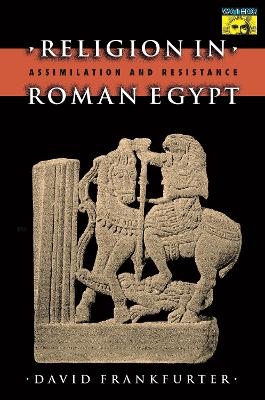
Religion in Roman Egypt
Assimilation and Resistance
Seiten
2000
Princeton University Press (Verlag)
978-0-691-07054-4 (ISBN)
Princeton University Press (Verlag)
978-0-691-07054-4 (ISBN)
Examines the complex fate of classical Egyptian religion during the centuries from the period when Christianity first made its appearance in Egypt to when it became the region's dominant religion. This book describes how an ancient culture maintained itself while also being transformed through influences such as Hellenism, and Roman government.
This exploration of cultural resilience examines the complex fate of classical Egyptian religion during the centuries from the period when Christianity first made its appearance in Egypt to when it became the region's dominant religion (roughly 100 to 600 C.E. Taking into account the full range of witnesses to continuing native piety--from papyri and saints' lives to archaeology and terracotta figurines--and drawing on anthropological studies of folk religion, David Frankfurter argues that the religion of Pharonic Egypt did not die out as early as has been supposed but was instead relegated from political centers to village and home, where it continued a vigorous existence for centuries. In analyzing the fate of the Egyptian oracle and of the priesthoods, the function of magical texts, and the dynamics of domestic cults, Frankfurter describes how an ancient culture maintained itself while also being transformed through influences such as Hellenism, Roman government, and Christian dominance.
Recognizing the special characteristics of Egypt, which differentiated it from the other Mediterranean cultures that were undergoing simultaneous social and political changes, he departs from the traditional "decline of paganism/triumph of Christianity" model most often used to describe the Roman period. By revealing late Egyptian religion in its Egyptian historical context, he moves us away from scenarios of Christian triumph and shows us how long and how energetically pagan worship survived.
This exploration of cultural resilience examines the complex fate of classical Egyptian religion during the centuries from the period when Christianity first made its appearance in Egypt to when it became the region's dominant religion (roughly 100 to 600 C.E. Taking into account the full range of witnesses to continuing native piety--from papyri and saints' lives to archaeology and terracotta figurines--and drawing on anthropological studies of folk religion, David Frankfurter argues that the religion of Pharonic Egypt did not die out as early as has been supposed but was instead relegated from political centers to village and home, where it continued a vigorous existence for centuries. In analyzing the fate of the Egyptian oracle and of the priesthoods, the function of magical texts, and the dynamics of domestic cults, Frankfurter describes how an ancient culture maintained itself while also being transformed through influences such as Hellenism, Roman government, and Christian dominance.
Recognizing the special characteristics of Egypt, which differentiated it from the other Mediterranean cultures that were undergoing simultaneous social and political changes, he departs from the traditional "decline of paganism/triumph of Christianity" model most often used to describe the Roman period. By revealing late Egyptian religion in its Egyptian historical context, he moves us away from scenarios of Christian triumph and shows us how long and how energetically pagan worship survived.
David Frankfurter is Associate Professor of History and Religious Studies at the University of New Hampshire. He is the author of Elijah in Upper Egypt: The Apocalypse of Elijah and Early Egyptian Christianity.
AcknowledgmentsAbbreviationsOverture: The Armor of Horus31Scope and Method52Religion and Temples373The Local Scope of Religious Belief974Mutations of the Egyptian Oracle1455Priest to Magician: Evolving Modes of Religious Authority1986The Scriptorium as Crucible of Religious Change2387Idiom, Ideology, and Iconoclasm: A Prolegomenon to the Conversion of Egypt265Select Bibliography285Index307
| Erscheint lt. Verlag | 5.11.2000 |
|---|---|
| Reihe/Serie | Bollingen Series |
| Zusatzinfo | 1 Maps |
| Verlagsort | New Jersey |
| Sprache | englisch |
| Maße | 152 x 235 mm |
| Gewicht | 510 g |
| Themenwelt | Geschichte ► Allgemeine Geschichte ► Vor- und Frühgeschichte |
| Geschichte ► Allgemeine Geschichte ► Altertum / Antike | |
| Geisteswissenschaften ► Geschichte ► Regional- / Ländergeschichte | |
| Religion / Theologie ► Christentum ► Kirchengeschichte | |
| ISBN-10 | 0-691-07054-7 / 0691070547 |
| ISBN-13 | 978-0-691-07054-4 / 9780691070544 |
| Zustand | Neuware |
| Informationen gemäß Produktsicherheitsverordnung (GPSR) | |
| Haben Sie eine Frage zum Produkt? |
Mehr entdecken
aus dem Bereich


aus dem Bereich
Reise in die Römerzeit
Buch | Hardcover (2025)
Galiani Berlin (Verlag)
CHF 44,75
auf den Spuren der frühen Zivilisationen
Buch | Hardcover (2023)
C.H.Beck (Verlag)
CHF 27,95


