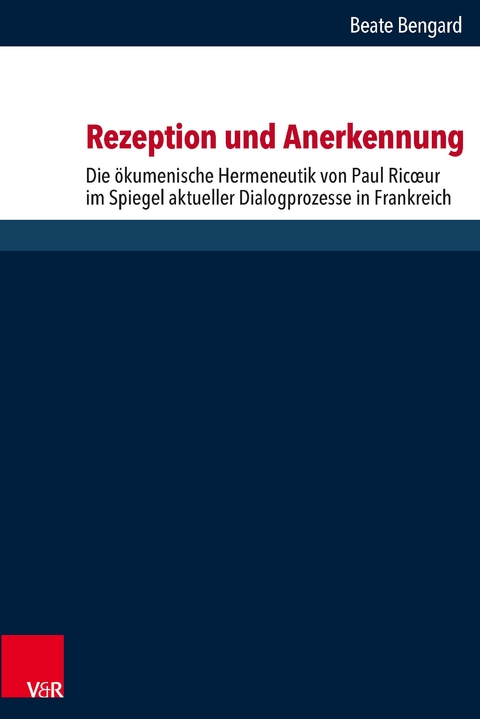
Rezeption und Anerkennung
Vandenhoeck & Ruprecht (Verlag)
9783525564493 (ISBN)

Beate Bengard deals with the ecumenical hermeneutics of the French philosopher Paul Ricoeur. His theory is of interest for ecumenical theology particularly in the area of ecumenical reception. The specificity of ecumenical reception is that it requires the acceptation of otherness - of the alterity - of the ecumenical partner. Obviously, this process goes far beyond the ratification of ecumenical documents. In order to clarify the process of reception, a hermeneutical model is needed which explains the interrelation of the interpersonal recognition of otherness, the reception of texts, as well as of changing collective identities. A complex model of the reception process is deduced from the theory of Paul Ricoeur and Ricoeur's model is compared with three concrete ecumenical processes in France. This shows there is a high degree of accordance between these ecumenical examples and Ricoeur's hermeneutical process. The conclusion points to ways in which this contributes to building an ecumenical culture inspired by Ricoeur's philosophy.
Dr. theol. Beate Bengard studierte Evangelische Theologie, Französistik und Frankreichstudien in Dresden, Leipzig, Lausanne, Paris und Strasbourg. 2007-2013 arbeitete sie als wissenschaftliche Mitarbeiterin an der Theologischen Fakultät der Universität Leipzig. 2014-2015 forschte sie als Postdoktorandin am "Fonds Ricœur" in Paris. Seit 2016 ist sie als wissenschaftliche Mitarbeiterin an der Theologischen Fakultät der Ernst-Moritz-Arndt-Universität Greifswald tätig.
Beate Bengard deals with the ecumenical hermeneutics of the French philosopher Paul Ricoeur. His theory is of interest for ecumenical theology particularly in the area of ecumenical reception. The specificity of ecumenical reception is that it requires the acceptation of otherness - of the alterity - of the ecumenical partner. Obviously, this process goes far beyond the ratification of ecumenical documents. In order to clarify the process of reception, a hermeneutical model is needed which explains the interrelation of the interpersonal recognition of otherness, the reception of texts, as well as of changing collective identities. A complex model of the reception process is deduced from the theory of Paul Ricoeur and Ricoeur's model is compared with three concrete ecumenical processes in France. This shows there is a high degree of accordance between these ecumenical examples and Ricoeur's hermeneutical process. The conclusion points to ways in which this contributes to building an ecumenical culture inspired by Ricoeur's philosophy.
| Erscheint lt. Verlag | 16.9.2015 |
|---|---|
| Reihe/Serie | Forschungen zur systematischen und ökumenischen Theologie ; Band 151 |
| Verlagsort | Göttingen |
| Sprache | deutsch |
| Maße | 160 x 237 mm |
| Gewicht | 714 g |
| Themenwelt | Religion / Theologie ► Christentum ► Kirchengeschichte |
| Schlagworte | Frankreich; Religion • Hermeneutik • Ökumene • Ökumenische Theologie • Paul • Religionsphilosophie • Ricœur • Ricoeur, Paul • Ricœur, Paul • Systematische Theologie |
| ISBN-13 | 9783525564493 / 9783525564493 |
| Zustand | Neuware |
| Informationen gemäß Produktsicherheitsverordnung (GPSR) | |
| Haben Sie eine Frage zum Produkt? |
aus dem Bereich