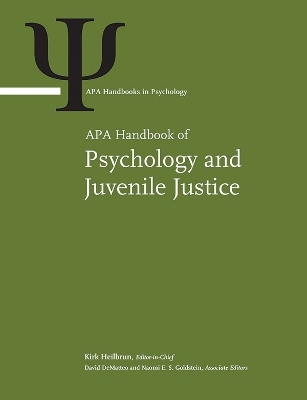
APA Handbook of Psychology and Juvenile Justice
American Psychological Association (Verlag)
978-1-4338-1967-4 (ISBN)
The APA Handbook of Psychology and Juvenile Justice consolidates and advances knowledge about the legal, scientific, and applied foundations of the juvenile justice system.
In addition to an overview of the area, it contains chapters in the following sections:
Relevant Law (focusing on important legislation and on U.S. Supreme Court decisions from Kent and Gault to Eddings, Roper, Graham, and Miller-Jackson, and on the relevant legal theory of preventive justice for adolescents)
Human Development (describing research on adolescent development and brain development as they apply to behavior in the juvenile justice context)
Patterns of Offending (including evidence about offending in juveniles and the persistence vs. desistance into adulthood)
Risk Factors for Offending (evidence about risk factors for juvenile offending including Risk-Need-Responsivity theory, juvenile psychopathy, substance abuse, gangs, and trauma/adverse experience, as well as threat assessment and bullying prevention in schools)
Forensic Assessment (assessing risk, needs/amenability, and sophistication-maturity as part of legal decisions on commitment, transfer, and reverse transfer, as well as legal decisions on Miranda waiver capacity and competence to stand trial)
Interventions (evidence on risk-reducing interventions, both in the community and in residential placement, including for specialized offending of sexual offenders)
Training and Ethics (including the updated MacArthur curriculum on adolescents in the juvenile justice system and an analysis of the ethical issues particular to juvenile justice)
Kirk Heilbrun, PhD, is a professor and interim head of the department of psychology at Drexel University, and codirector of the Pennsylvania Mental Health and Justice Center of Excellence. He received his doctorate in clinical psychology in 98 from the University of Texas at Austin and completed postdoctoral fellowship training from 98 to 982 in psychology and criminal justice at Florida State University. His current research focuses on juvenile and adult offenders, legal decision-making, forensic evaluation associated with such decision-making, and diversion. Dr. Heilbrun is the author of numerous articles on forensic assessment, violence risk assessment and risk communication, and the treatment of offenders with mental disorders, and he has published books (Principles of Forensic Mental Health Assessment, 2 Forensic Mental Health Assessment: A Casebook, with Geoffrey R. Marczyk and David DeMatteo, 2 2 Forensic Mental Health Assessment: A Casebook, Second Edition, with David DeMatteo, Stephanie Brooks Holliday, and Casey LaDuke, 2 4 Juvenile Delinquency: Prevention, Assessment, and Intervention, with Naomi E. Sevin Goldstein and Richard E. Redding, 2 5 Wrightsman's Psychology and the Legal System, Sixth Edition, with Edie Greene, William H. Fortune, and Michael T. Nietzel, 2 Wrightsman's Psychology and the Legal System, Seventh Edition, with Edie Greene, 2 Wrightsman's Psychology and the Legal System, Eighth Edition, with Edie Greene, 2 3 Foundations of Forensic Mental Health Assessment, with Thomas Grisso and Alan Goldstein, 2 9 Evaluating the Risk of Violence in Adults, 2 9 and The Sequential Intercept Model and Criminal Justice: Promoting Community Alternatives for Individuals With Severe Mental Illness, with Patricia A. Griffin, Edward P. Mulvey, David DeMatteo, and Carol A. Schubert, 2 5). His practice interests also center on forensic assessment, and he directs a clinic in this area in the department of psychology at Drexel University. He is board certified in clinical psychology and in forensic psychology (American Board of Professional Psychology) and has previously served as president of both APA Division 4 (American Psychology-Law Society), and the American Board of Forensic Psychology. Dr. Heilbrun received the 2 4 Distinguished Contributions to Forensic Psychology Award and the 2 8 Beth Clark Distinguished Service Contribution Award from the American Academy of Forensic Psychology.
Editorial Board
About the Editor-in-Chief
Contributors
Series Preface
Introduction
I. Overview
Psychology and Juvenile Justice: Human Development, Law, Science, and Practice
Kirk Heilbrun, David DeMatteo, Naomi E. S. Goldstein, Benjamin Locklair, Megan Murphy, and Christy Giallella
II. Law
Children in the Justice System: The Legal Framework
Marsha Levick and Jessica Feierman
Preventive Justice for Adolescents
Christopher Slobogin
III. Human Development
Human Development and Juvenile Justice
Elizabeth P. Shulman and Laurence Steinberg
Adolescent Brain Development: Implications to the Juvenile Criminal Justice System
Beatriz Luna and Catherine Wright
Adolescent Development, Mental Disorder, and Decision-Making in Delinquent Youths
Alison G. Nagel, Lucy A. Guarnera, and N. Dickon Reppucci
IV. Patterns of Offending
Serious Questions About Serious Juvenile Offenders: Patterns of Offending and Offenses
Jennifer L. Woolard and Erika Fountain
Desistance and Life-Course Persistence: Findings From Longitudinal Studies Using Group-Based Trajectory Modeling of Antisocial Behavior
Michael A. Russell and Candice L. Odgers
V. Risk Factors for Offending
Risk, Need, and Responsivity in Juveniles
Robert D. Hoge
Juvenile Psychopathy: Appropriate and Inappropriate Uses in Legal Proceedings
Gina M. Vincent, Eva R. Kimonis, and Alisa Clark
School-Based Risk Factors, Bullying, and Threat Assessment
Dewey Cornell and Anna Heilbrun
Disrupting the School-to-Prison Pipeline: Strategies to Reduce the Risk of School-Based Zero Tolerance Policies Resulting in Juvenile Justice Involvement
Brian P. Daly, Aimee K. Hildenbrand, Emily Haney-Caron, Naomi E. S. Goldstein, Meghann Galloway, and David DeMatteo
Substance Use and Substance Use Disorders as Risk Factors for Juvenile Offending
Laurie Chassin, Andre D. Mansion, Brandon Nichter, and Danielle Pandika
Gangs
Wesley G. Jennings and Jennifer M. Reingle Gonzalez
Trauma, Adverse Experience, and Offending
Amanda D. Zelechoski
VI. Forensic Assessment
Forensic Assessment of Juveniles
Kirk Heilbrun and Benjamin Locklair
Risk Assessment With Juveniles
David DeMatteo, Melinda Wolbransky, and Casey LaDuke
Distinguishing and Assessing Treatment Needs and Amenability to Rehabilitation
Robert T. Kinscherff
Developmental Maturity and Sophistication amp ndash Maturity: Learning More About Its Purpose and Assessment
Randall T. Salekin, Emily A. M. MacDougall, and Natalie A. Harrison
Forensic Uses of Clinical Assessment Instruments
Robert P. Archer and Linda J. Baum
Transfer and Commitment of Youth in the United States: Law, Policy, and Forensic Practice
Kimberly Larson and Thomas Grisso
Evaluation of Miranda Waiver Capacity
Naomi E. S. Goldstein, Sharon Messenheimer Kelley, Lindsey Peterson, Leah Brogan, Heather Zelle, and Christina Riggs Romaine
Evaluation and Restoration of Competency to Stand Trial
Janet I. Warren, Shelly L. Jackson, and Jessica Jones Coburn
VII. Interventions and Costs
Risk Reduction Interventions for Adolescent Offenders
Jodi L. Viljoen, Etta Brodersen, Catherine Shaffer, and Robert J. McMahon
Trauma-Informed Juvenile Justice Systems and Approaches
Jessica Feierman and Julian D. Ford
Community-Based Interventions for Juvenile Offenders
Scott W. Henggeler
Intervening in the Community to Treat Trauma in Young Men of Color
John Rich, Erica J. Harris, Sandra L. Bloom, Linda Rich, and Theodore Corbin
Residential Interventions With Justice-Involved Youth
Keith R. Cruise, Samantha L. Morin, and Katelyn Affleck
Sexual Offending: Assessment and Intervention
Robert A. Prentky, Sue Righthand, and Raina Lamade
VIII. Training and Ethics
Training Mental Health and Juvenile Justice Professionals in Juvenile Screening, Assessment, and Evaluation
Lourdes M. Rosado and Mary Ann Scali
Ethical Issues in Psychology and Juvenile Justice
Gerald P. Koocher and Robert T. Kinscherff
Index
| Erscheint lt. Verlag | 30.9.2015 |
|---|---|
| Reihe/Serie | APA Handbooks in Psychology® Series |
| Verlagsort | Washington DC |
| Sprache | englisch |
| Maße | 216 x 279 mm |
| Themenwelt | Geisteswissenschaften ► Psychologie ► Entwicklungspsychologie |
| Recht / Steuern ► EU / Internationales Recht | |
| Recht / Steuern ► Strafrecht ► Besonderes Strafrecht | |
| Recht / Steuern ► Strafrecht ► Kriminologie | |
| Sozialwissenschaften ► Soziologie ► Allgemeine Soziologie | |
| ISBN-10 | 1-4338-1967-8 / 1433819678 |
| ISBN-13 | 978-1-4338-1967-4 / 9781433819674 |
| Zustand | Neuware |
| Informationen gemäß Produktsicherheitsverordnung (GPSR) | |
| Haben Sie eine Frage zum Produkt? |
aus dem Bereich