


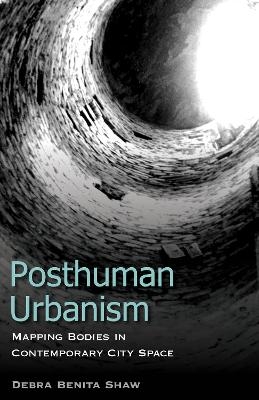
Posthuman Urbanism
Mapping Bodies in Contemporary City Space
Seiten
2017
Rowman & Littlefield International (Verlag)
978-1-78348-080-7 (ISBN)
Rowman & Littlefield International (Verlag)
978-1-78348-080-7 (ISBN)
Posthuman Urbanism explores what it means to live in an urban environment with reference to posthuman theory. The book argues that contemporary science and technology offers radically different ways for changing the way we live in city spaces today.
The World Health Organisation estimates that, by 2030, six out of every ten people in the world will live in a city. But what does it mean to inhabit the city in the twenty-first century?
Posthuman Urbanism evaluates the relevance and usefulness of posthuman theory to understanding the urban subject and its conditions of possibility. It argues that contemporary science and technology is radically changing the way that we understand our bodies and that understanding ourselves as 'posthuman' offers new insights into urban inequalities.
By analysing the relationship between the biological sciences and cities from the nineteenth-century onward as it is expressed in architecture, popular culture and case studies of contemporary insurgent practices, a case is made for posthuman urbanism as a significant concept for changing the meaning of urban space. It answers the question of how we can change ourselves to change the way we live with others, both human and non-human, in a rapidly urbanising world.
The World Health Organisation estimates that, by 2030, six out of every ten people in the world will live in a city. But what does it mean to inhabit the city in the twenty-first century?
Posthuman Urbanism evaluates the relevance and usefulness of posthuman theory to understanding the urban subject and its conditions of possibility. It argues that contemporary science and technology is radically changing the way that we understand our bodies and that understanding ourselves as 'posthuman' offers new insights into urban inequalities.
By analysing the relationship between the biological sciences and cities from the nineteenth-century onward as it is expressed in architecture, popular culture and case studies of contemporary insurgent practices, a case is made for posthuman urbanism as a significant concept for changing the meaning of urban space. It answers the question of how we can change ourselves to change the way we live with others, both human and non-human, in a rapidly urbanising world.
Debra Benita Shaw is a Reader in Cultural Theory at the University of East London. She is the author of Women Science & Fiction (2000), Technoculture: The Key Concepts (2008) and co-editor (with Maggie Humm) of Radical Space: Exploring Politics and Practice (2016).
Preface/ Part 1: Political Anatomies Of Bodies And Cities/ Introduction/ 1 Darwin's Monsters/ 2 Metropolitan Others/ 3 Science & The Architectural Imaginary/ 4 Posthuman Urbanism/ Part 2: Monsters In The Metropolis/ 5 Parasites & Scavengers/ 6 Pirates and Vagabonds/ 7 Posturban Psychogeographies/ Conclusion: Towards a Posthuman Cartography of Urban Space
| Zusatzinfo | 4 b/w photos; |
|---|---|
| Sprache | englisch |
| Maße | 151 x 231 mm |
| Gewicht | 331 g |
| Themenwelt | Geisteswissenschaften ► Philosophie ► Philosophie der Neuzeit |
| Sozialwissenschaften ► Ethnologie | |
| Sozialwissenschaften ► Politik / Verwaltung ► Politische Systeme | |
| Sozialwissenschaften ► Politik / Verwaltung ► Politische Theorie | |
| Sozialwissenschaften ► Politik / Verwaltung ► Staat / Verwaltung | |
| Sozialwissenschaften ► Soziologie | |
| ISBN-10 | 1-78348-080-7 / 1783480807 |
| ISBN-13 | 978-1-78348-080-7 / 9781783480807 |
| Zustand | Neuware |
| Informationen gemäß Produktsicherheitsverordnung (GPSR) | |
| Haben Sie eine Frage zum Produkt? |
Mehr entdecken
aus dem Bereich


aus dem Bereich
ein Dialog mit Simone Weil
Buch | Softcover (2025)
Matthes & Seitz Berlin (Verlag)
CHF 19,55


