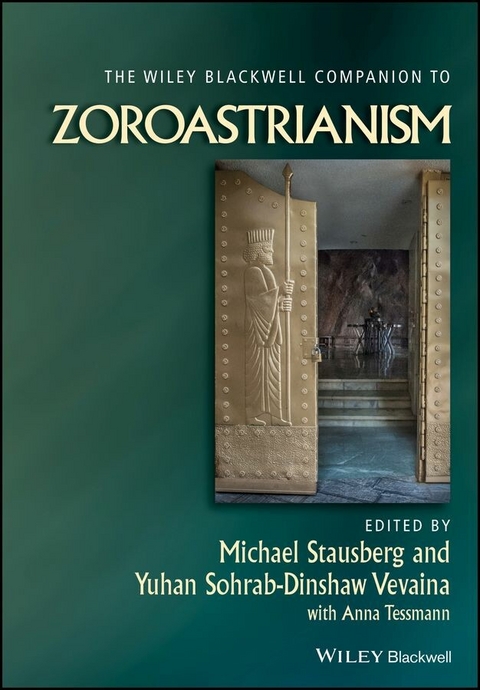
- Evenly divided into five thematic sections beginning with an introduction to Zoroaster/Zarathustra and concluding with the intersections of Zoroastrianism and other religions
- Reflects the global nature of Zoroastrian studies with contributions from 34 international authorities from 10 countries
- Presents Zoroastrianism as a cluster of dynamic historical and contextualized phenomena, reflecting the current trend to move away from textual essentialism in the study of religion
Michael Stausberg is Professor of Religion at the University of Bergen and a member of the Norwegian Academy of Science and Letters. His books in English include Religion and Tourism: Crossroads, Destinations, and Encounters (2011), Zarathustra and Zoroastrianism (2008), and as editor or co-editor Defining Magic (2013), The Routledge Handbook of Research Methods in the Study of Religions (2011), Contemporary Theories of Religion (2009) and Theorizing Rituals (2 vols., 2006/2007). Dr. Stausberg has published widely on Zarathustra and Zoroastrianism in German; he is co-editor, with Steven Engler, of the journal Religion.
Yuhan Sohrab-Dinshaw Vevaina is a Lecturer in Religious Studies at Stanford University. After completing his Ph.D. in 2007 at Harvard University, he served as Postdoctoral Fellow in the Undergraduate Core Curriculum and as the Lecturer on Old Iranian in the Department of Near Eastern Languages and Civilizations. Dr. Vevaina is the author of several articles in peer-reviewed journals and edited volumes and in 2010 he received a fellowship from the National Endowment for the Humanities, U.S.A. He is currently working on a book project on Zoroastrian hermeneutics in Late Antiquity.
This is the first ever comprehensive English-language survey of Zoroastrianism, one of the oldest living religions Evenly divided into five thematic sections beginning with an introduction to Zoroaster/Zarathustra and concluding with the intersections of Zoroastrianism and other religions Reflects the global nature of Zoroastrian studies with contributions from 34 international authorities from 10 countries Presents Zoroastrianism as a cluster of dynamic historical and contextualized phenomena, reflecting the current trend to move away from textual essentialism in the study of religion
Michael Stausberg is Professor of Religion at the University of Bergen and a member of the Norwegian Academy of Science and Letters. His books in English include Religion and Tourism: Crossroads, Destinations, and Encounters (2011), Zarathustra and Zoroastrianism (2008), and as editor or co-editor Defining Magic (2013), The Routledge Handbook of Research Methods in the Study of Religions (2011), Contemporary Theories of Religion (2009) and Theorizing Rituals (2 vols., 2006/2007). Dr. Stausberg has published widely on Zarathustra and Zoroastrianism in German; he is co-editor, with Steven Engler, of the journal Religion. Yuhan Sohrab-Dinshaw Vevaina is a Lecturer in Religious Studies at Stanford University. After completing his Ph.D. in 2007 at Harvard University, he served as Postdoctoral Fellow in the Undergraduate Core Curriculum and as the Lecturer on Old Iranian in the Department of Near Eastern Languages and Civilizations. Dr. Vevaina is the author of several articles in peer-reviewed journals and edited volumes and in 2010 he received a fellowship from the National Endowment for the Humanities, U.S.A. He is currently working on a book project on Zoroastrian hermeneutics in Late Antiquity.
Notes on Contributors ix
Acknowledgments xi
Aims and Scope xiii
A Note on Transcriptions xix
Abbreviations xxiii
Introduction: Scholarship on Zoroastrianism 1
Michael Stausberg and Yuhan Sohrab-Dinshaw Vevaina
Part I Zarathustra Revisited 19
1 Zarathustra's Time and Homeland: Geographical Perspectives 21
Frantz Grenet
2 Zarathustra's Time and Homeland: Linguistic Perspectives 31
Almut Hintze
3 Interpretations of Zarathustra and the Gat¯ ha¯s 39 a The Gat¯ has¯ 39
Helmut Humbach
b The Ga¯tha¯s, Said to Be of Zarathustra 44
Jean Kellens
c Dimensions of the Ga¯tha¯s as Poetry 51
Martin Schwartz
d The Ga¯tha¯s as Myth and Ritual 59
Prods Oktor Skjærvø
4 Zarathustra: Post-Gathic Trajectories 69
Michael Stausberg
Part II Periods, Regions, and Contexts 83
5 Religion and Politics in Pre-Islamic Iran 85
Albert de Jong
6 Zoroastrianism under Islamic Rule 103
Touraj Daryaee
7 Armenian and Georgian Zoroastrianism 119
Albert de Jong
8 Zoroastrianism in Central Asia 129
Frantz Grenet
9 Zoroastrianism in the Far East 147
Takeshi Aoki
10 The Parsis 157
John R. Hinnells
11 Zoroastrians in Modern Iran 173
Michael Stausberg
12 The Zoroastrian Diaspora 191
John R. Hinnells
Part III Structures, Discourses, and Dimensions 209
13 Theologies and Hermeneutics 211
Yuhan Sohrab-Dinshaw Vevaina
14 Cosmologies and Astrology 235
Antonio Panaino
15 Myths, Legends, Eschatologies 259
Carlo G. Cereti
16 Gender 273
Jenny Rose
17 Law in Pre-Modern Zoroastrianism 289
Maria Macuch
18 Law and Modern Zoroastrians 299
Mitra Sharafi
Part IV Practices and Sites 313
19 Ethics 315
Alberto Cantera
20 Prayer 333
Firoze M. Kotwal and Philip G. Kreyenbroek
21 Purity and Pollution / The Body 345
Alan V. Williams
22 Rituals 363
Michael Stausberg and Ramiyar P. Karanjia
23 Festivals and the Calendar 379
Jenny Rose
24 Religious Sites and Physical Structures 393
Jamsheed K. Choksy
Part V Intersections 407
25 Early India and Iran 409
Prods Oktor Skjærvø
26 Judaism 423
Yaakov Elman and Shai Secunda
27 The Classical World 437
Martin L. West
28 From Mithetara to Roman Mithras 451
Richard L. Gordon
29 Christianity 457
Marco Frenschkowski
30 Manichaeism in Iran 477
Manfred Hutter
31 Islam 491
Shaul Shaked
32 The Yezidi and Yarsan Traditions 499
Philip G. Kreyenbroek
33 The Baha¯'i ¯ Faith 505
Moojan Momen
Part VI Primary Sources 517
34 Primary Sources: Avestan and Pahlavi 519
Miguel Ángel Andrés-Toledo
35 Primary Sources: New Persian 529
Daniel J. Sheffield
36 Primary Sources: Gujarati 543
Daniel J. Sheffield
Bibliography 555
Index of People, Places, and Topics 629
Index Locorum 655
Review copy sent on 20.5.15 to Reference Reviews
Review copy sent on 20.4.15 to Digital Archive of Brief notes & Iran Review
The editors of the Wiley Blackwell Companion to Zoroastrianism ought to be lauded for presenting a superb compendium on the state of scholarship in Zoroastrian Studies. Not only does its treatment of more traditional questions pertaining to Zarathustra's time, homeland, and Gathas evince new and refreshing insights, but an array of novel inquiries into Zoroastrian hermeneutics and cosmogonies, or the issue of gender, provides for an exciting and stimulating read. Altogether, the Wiley Blackwell Companion to Zoroastrianism is a must for the informed and specialized reader alike, and a major contribution to the field for many years to come.
M. Rahim Shayegan, UCLA
Aims and Scope
Even though Zoroastrianism was relatively well studied in the early days of the comparative and historical study of religions (Stausberg 2008a: 562–564), scholarly interest has precipitously declined since, and the study of Zoroastrianism now largely operates in a disintegrated academic landscape (see Stausberg and Vevaina, “Introduction: Scholarship on Zoroastrianism,” this volume). In this volume, thirty-three scholars from ten countries seek to redress this situation by offering a comprehensive view of the state of the art in the study of Zoroastrianism in the early 21st century. While there are various companions to other religions (published in this series or by other publishers), this book is the first of its kind for Zoroastrianism. The scholarly books on Zoroastrianism in general (i.e., not covering specialized studies on particular texts, themes, or periods) published during the past thirty-five years can be divided into the following categories: shorter introductory volumes (Boyce 1979; Nigosian 1993; Clark 1998; Mazdāpūr 2003 [1382 in Persian]; Stausberg 2008b; Rose 2011a; Rose 2011b), selections of textual primary sources (Malandra 1983; Boyce 1984b; Skjærvø 2011a), a multivolume survey of Zoroastrian history and rituals (Stausberg 2002b; 2002c; 2004b), an as yet unfinished massive history of Zoroastrianism (Boyce 1975a; Boyce 1982; Boyce and Grenet with Roger Beck 1991; Boyce and de Jong, forthcoming), a lavishly illustrated volume with introductory essays (Godrej and Mistree 2002), an exhibition catalogue (Stewart 2013), and an ongoing and now largely online encyclopedic project on Iranian civilization that comprises numerous useful entries on Zoroastrian matters (the Encyclopædia Iranica, open access under www.iranicaonline.org). In sum, nothing comparable in scope to the present The Wiley Blackwell Companion to Zoroastrianism has ever been published.
This multi-authored volume is not dominated by one single overarching view of Zoroastrianism. In fact, by putting this volume together we as editors have endeavored to respect the diverse voices of the contributors as we seek to collectively grapple with and perhaps move beyond normative takes on the “essential” identity of Zoroastrianism that can often be found in the older literature. We, the editors, do not believe in such a thing as an essence of Zoroastrianism that would provide the one authentic, real, or normative version of this historically and geographically diverse religion. As scholars we do not judge our sources in this light (even when the sources themselves make such claims), but our interests are of an analytic, critical, and historical nature, where we situate our sources in different historical contexts, attempt to understand them as driven by specific interests, and thus represent this historical diversity to a diverse readership. From our academic perspectives, we do not see Zoroastrianism as something given for one and all times or as simply the outcome of the words of the founder or prophet, but rather as a complex network of dynamic ongoing re-creations that its makers – believers and practitioners – are situated within, continually engage with, and often contest, or that we as scholars identify, in the light of our interpretative frameworks, as related to this trans-historical and transnational entity commonly referred to as “Zoroastrianism.” The latter, for example, is the case with material and visual remains in Central Asia, which make sense when interpreted as evidence for regional variations of Zoroastrianism which are, in certain striking cases, rather divergent from the more familiar cultural productions we find in textual and material sources from pre-modern Persian and the contemporary Iranian and Indian communities (see Grenet, “Zoroastrianism in Central Asia,” this volume). As scholars we are not in a position to arbitrate on the truth-value of any of the various attempts by Zoroastrians to represent the genuine and true vision of their religion as more authentic than that of their rivals, even though we can analyze to what extent these claims are consonant with earlier equally contested interpretations of Zoroastrianism. We therefore see it as our professional responsibility to analyze points of contrast or divergence between different understandings of this faith. What we describe as innovations may be dismissed by some Zoroastrians as aberrations or hailed by others as progress – both normative categories that are equally problematic for historical-critical research. The five main parts of this volume therefore present different facets of this scholarly agenda.
It could seem intuitively plausible for a discussion of Zoroastrianism to start with Zarathustra (Zoroaster), who is traditionally held to be the founder or prophet of the religion that in the modern age came to be called after him. Such a narrative strategy would build on the emphasis placed on Zarathustra in Zoroastrian sources. The inherent risk is simply conceptualizing the history of Zoroastrianism as a mere footnote to Zarathustra and thus placing the development of the religion under the intellectual spell of this remote point of reference. Since the exact time and homeland of Zarathustra continue to remain a matter of dispute, the first two chapters in Part I discuss this problem from both geographical and linguistic perspectives (Frantz Grenet and Almut Hintze respectively). Believers and many scholars alike hold Zarathustra to be the “author” of five enigmatic songs, the Gāthās, which are then often used to reconstruct the original message of the “prophet” and, by extension, “his” religion. The Gāthās, however, have yielded widely contrasting interpretations and translations in the 20th century and therefore, in order to not privilege one reading, we have invited four eminent scholars (Helmut Humbach, Jean Kellens, Martin Schwartz, and Prods Oktor Skjærvø), who have over the past decades made groundbreaking contributions to the understanding of these complex texts, to provide a synthesis of their current thinking on the Gāthās. We hope such a plurality of interpretations will prove stimulating to both specialist and general readers. The final chapter of this first part by Michael Stausberg looks at the trajectories of the figure of Zarathustra in the periods after the Gāthās, when he was cast in the role of the foundational individual by Zoroastrian sources and came to signify whatever ideal the religion was and is supposed to mean in the context in question. The chapter also addresses non-Zoroastrian engagements with the figure of Zarathustra and examines various modern visual representations and discursive appropriations of the “prophet.”
Part II presents a survey of Zoroastrian history and Zoroastrian communities from antiquity to the present and thereby situates the Zoroastrian tradition(s) in different historical and geographical contexts. Three chapters deal with Zoroastrianism and Zoroastrian communities in the course of Iranian history, from the time of the pre-Islamic empires (Albert de Jong) through the pre-modern Islamic periods (Touraj Daryaee) to the modern and contemporary Iranian Zoroastrian communities (Michael Stausberg). Chapters on the Caucasus (Albert de Jong) and Central Asia (Frantz Grenet) in pre- and early Islamic times survey regional versions of Zoroastrianism beyond the Persian orbit; these regions show some rather distinctive characteristics when compared to Persian Zoroastrianism that is often taken as the normative model for the religion. Nowadays, the majority of Zoroastrians live in India, where the Parsis, as they are known and self-identify, can look back to a long history, which is here reviewed by John R. Hinnells. Since colonial times, Parsis and later also Iranian Zoroastrians have settled in large parts of the world; these Zoroastrian diasporas, which have created novel organizational and material infrastructures, comprise multisited networks, where the negotiation of Zoroastrian identities occur with great intensity (John R. Hinnells). During the past twenty years new information technologies have allowed Zoroastrians across the globe to engage in translocal and transnational networks of communication with their fellow practitioners in an unprecedented manner. Via the Silk Road there were mercantile and religious connections to East Asia already in precolonial times, yet the East Asian part of the Zoroastrian world often tends to be overlooked in scholarship. In this volume, Takeshi Aoki reviews the history of Zoroastrianism in East Asian countries from the pre-Islamic period to the contemporary age. In addition, this chapter also provides a survey of East Asian scholarship on Zoroastrianism, which is often ignored in the West regrettably because of language barriers.
Part III of our Companion is called Structures, Discourses, and Dimensions. Instead of merely providing lists of deities and their attributes and narrated actions, Yuhan S.-D. Vevaina discusses theologies and hermeneutics, i.e., reflections as found in Zoroastrian Middle Persian (Pahlavi) sources on the status and functioning of the divine actors and their relationships to humans, the ways these statements are generated in the form of scriptural interpretation, and the teaching and transmission of religious knowledge. Antonio Panaino analyzes the structure of the cosmos and the place of astrology in ancient...
| Erscheint lt. Verlag | 27.4.2015 |
|---|---|
| Reihe/Serie | Blackwell Companions to Religion |
| Blackwell Companions to Religion | Wiley Blackwell Companions to Religion |
| Co-Autor | Anna Tessmann |
| Sprache | englisch |
| Themenwelt | Geisteswissenschaften ► Religion / Theologie ► Weitere Religionen |
| Schlagworte | Baha'i • Central Asia • Christianity • Festivals • Gender • Geschichte • hermeneutics • Hinduism • History • History of Religion • India • Iran • Iranian History • Islam • Judaism • Law and Religion • Manichaeism • Mazdaismus • Middle East • Mithraism • Myth • Near East • Parsismus • Religion • Religion & Theology • Religionsgeschichte • Religionswissenschaft • Religion u. Theologie • Religious History • Religious Studies • Ritual • South Asia • the classics • the Kurds • Zarathustra • Zarathustrismus • Zoroaster • Zoroastrian Studies • Zoroastrismus |
| ISBN-13 | 9781118786277 / 9781118786277 |
| Informationen gemäß Produktsicherheitsverordnung (GPSR) | |
| Haben Sie eine Frage zum Produkt? |
 EPUB (Adobe DRM)
Kopierschutz: Adobe-DRM
Adobe-DRM ist ein Kopierschutz, der das eBook vor Mißbrauch schützen soll. Dabei wird das eBook bereits beim Download auf Ihre persönliche Adobe-ID autorisiert. Lesen können Sie das eBook dann nur auf den Geräten, welche ebenfalls auf Ihre Adobe-ID registriert sind.
Details zum Adobe-DRM
Dateiformat: EPUB (Electronic Publication)
EPUB ist ein offener Standard für eBooks und eignet sich besonders zur Darstellung von Belletristik und Sachbüchern. Der Fließtext wird dynamisch an die Display- und Schriftgröße angepasst. Auch für mobile Lesegeräte ist EPUB daher gut geeignet.
Systemvoraussetzungen:
PC/Mac: Mit einem PC oder Mac können Sie dieses eBook lesen. Sie benötigen eine
eReader: Dieses eBook kann mit (fast) allen eBook-Readern gelesen werden. Mit dem amazon-Kindle ist es aber nicht kompatibel.
Smartphone/Tablet: Egal ob Apple oder Android, dieses eBook können Sie lesen. Sie benötigen eine
Geräteliste und zusätzliche Hinweise
Buying eBooks from abroad
For tax law reasons we can sell eBooks just within Germany and Switzerland. Regrettably we cannot fulfill eBook-orders from other countries.
aus dem Bereich