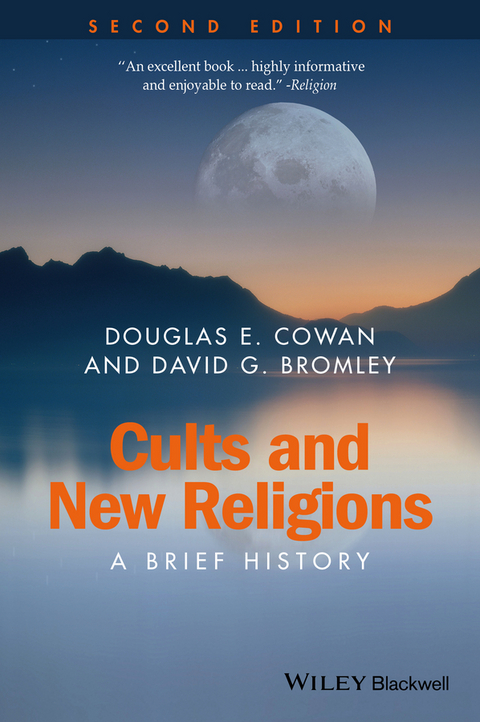
Cults and New Religions (eBook)
John Wiley & Sons (Verlag)
978-1-118-72350-0 (ISBN)
This unparalleled introduction to cults and new religious movements has been completely up-dated and expanded to reflect the latest developments; each chapter reviews the origins, leaders, beliefs, rituals and practices of a NRM, highlighting the specific controversies surrounding each group.
- A fully updated, revised and expanded edition of an unparalleled introduction to cults and new religious movements
- Profiles a number of the most visible, significant, and controversial new religious movements, presenting each group's history, doctrines, rituals, leadership, and organization
- Offers a discussion of the major controversies in which new religious movements have been involved, using each profiled group to illustrate the nature of one of those controversies
- Covers debates including what constitutes an authentic religion, the validity of claims of brainwashing techniques, the implications of experimentation with unconventional sexual practices, and the deeply rooted cultural fears that cults engender
- New sections include methods of studying new religions in each chapter as well as presentations on 'groups to watch'
Douglas E. Cowan is Professor of Religious Studies and Social Development Studies at Renison University College, at the University of Waterloo. He is the author of Cults and New Religious Movements: A Brief History, Cyberhenge: Modern Pagans on the Internet (2005), Bearing False Witness? An Introduction to the Christian Countercult(2003) Sacred Terror: Religion and Horror on the Silver Screen (2008) and Sacred Space: The Quest for Transcendence in Science Fiction Film and Television (2010).
David G. Bromley is Director of the World Religions and Spirituality Project and Professor of Religious Studies and Sociology in the School of World Studies at Virginia Commonwealth University. His most recent publications include Defining Religion: Critical Approaches to Drawing Boundaries Between Sacred and Secular (2003) and Cults, Religion and Violence (2001).
Douglas E. Cowan is Professor of Religious Studies and Social Development Studies at Renison University College, at the University of Waterloo. He is the author of Cults and New Religious Movements: A Brief History, Cyberhenge: Modern Pagans on the Internet (2005), Bearing False Witness? An Introduction to the Christian Countercult(2003) Sacred Terror: Religion and Horror on the Silver Screen (2008) and Sacred Space: The Quest for Transcendence in Science Fiction Film and Television (2010). David G. Bromley is Director of the World Religions and Spirituality Project and Professor of Religious Studies and Sociology in the School of World Studies at Virginia Commonwealth University. His most recent publications include Defining Religion: Critical Approaches to Drawing Boundaries Between Sacred and Secular (2003) and Cults, Religion and Violence (2001).
1 Cults and New Religions: A Primer
2 The Church of Scientology: The Question of Religion
3 Transcendental Meditation: The Questions of Science and Therapy
4 Ramtha and the New Age: The Question of 'Dangerous Cult'
5 The Unification Church/The Family Federation: The Brainwashing/Deprogramming Controversy
6 The Children of God/The Family International: The Issue of Sexuality
7 The Branch Davidians: The Question of Cults, Media, and Violence, Part One
8 Heaven's Gate: The Question of Cults and Violence, Part Two
9 Wicca and Witchcraft: Confronting Age-old Cultural Fears
10 Rethinking Cults: The Significance of New Religious Movements
References
Index
The world of new religions is notoriously complex and diverse. As such, an introductory text must simplify, but without simplification. This updated edition of Cults and New Religious Movements achieves this admirably. With an enviable grasp of contemporary scholarship, Douglas Cowan and David Bromley provide fresh insights into particular groups, events and controversies. This wonderfully erudite and lucid volume should be required reading for all students of new religions.
Christopher Partridge, Lancaster University
An ideal source for those looking for a concise, authoritative introduction to the most important new religions of the past fifty years. The authors carefully and seriously tackle significant questions about the nature of new religions, helping readers navigate a controversial and complicated field.
Benjamin E. Zeller, Lake Forest College
The second edition of Cults and New Religious Movements is an astute and accessible textbook written by two eminent scholars of new religions. Through eight case studies the text examines key issues that arise in relation to new religious movements, thereby shedding light on the study of religions in general. This book is a valuable pedagogical tool that stimulates critical analysis and discussion in the classroom and beyond.
Catherine Wessinger, Loyola University New Orleans
Chapter 2
The Church of Scientology: The Question of Religion
Scientology fulfills the goal of religion by addressing the spiritual nature of man and his role in eternity. Yet it approaches the traditional questions of religion from a standpoint of reason, an approach that science can hardly argue with. The scope of Scientology is immense. The full body of knowledge that comprises the religious Scripture is contained in more than 40 million spoken and written words on the subject – all by L. Ron Hubbard, the source and founder of the Scientology religion.
Church of Scientology International,
Scientology: Theology and Practice of a Contemporary Religion
In a wide variety of publications, the Church of Scientology International (CSI) claims to be “the fastest growing religious movement on Earth” (see, for example, CSI 1998, 2004a, 2004b) and “arguably the only great religion to emerge in the twentieth century” (CSI 1998: 561). From the opening pages of its seminal text, Dianetics (Hubbard [1950] 1990), to the nearly 100 sermons contained in The Background, Ministry, Ceremonies and Sermons of the Scientology Religion (CSI 1999), Scientological literature is filled with similar declarations. The latter, for example, tells us that “Scientology is the most vital movement on Earth today” (CSI 2002: 166), and that “in Scientology, we possess a practical system of ethics and justice, based solely on reason. No such system has ever existed before” (CSI 2002: 389), claims the Church, and “anything religious teachers said or Buddha promised, even the visions of Christianity, are all attained in Scientology as result” (CSI 2002: 503).
The Church of Scientology now claims more than ten million members worldwide, with “more than 11,000 churches, missions and affiliated groups across 167 nations” (Frago 2013) – nearly double the number of organizations it reported when we published the first edition of this book in 2008. Independent assessments, however, do not support these lofty claims. Rather, they suggest a US membership numbering only in the tens of thousands, with a sharp decline in even these modest numbers over the past few years. Historian Hugh Urban, for example, points out that according to the American Religious Identification Survey, membership fell “significantly from 55,000 in 2001 to 25,000 in 2008” (2011: 206).
While it is often in the nature of religion to make hyperbolic and exclusivist claims – many religious traditions have their own version of extra ecclesiam nulla salus (“outside the church there is no salvation”) – most are at least regarded as religions. Scientology, however, has struggled for acceptance on that very issue. Officially recognized by Australia in 1982, for example, the Church was banned for many years prior to that. On October 1, 1993, after a two-decade battle for reinstatement, the US Internal Revenue Service restored the Church’s 501(c)3 tax exempt status as an “exclusively religious or charitable organization.” A week later, thousands of Scientologists gathered in Los Angeles to hear the official announcement and to celebrate what the Church considers an “historic victory for religious freedom” (CSI 2002: 236). In other countries, their struggle has been less successful. While Italian courts ruled in 2000 that Scientology does qualify as a religion, and New Zealand granted the Church limited tax exemption in 2002, its application for charitable status in England and Wales was denied a year earlier (Meek 1999). In 2013, the question of whether Scientology is a religion came before the United Kingdom’s highest court when two Scientologists wanted to be married in London’s Queen Victoria Street org (see below for an explanation of this term). At the time of this writing, the court has reserved judgment (Bowcott 2013).
Over the past decade and a half, though, many western European countries have opposed recognizing Scientology as a legitimate religion. In 1997, a Greek court “called the Church of Scientology a danger to society and ordered it to close” (Carassava 1997). In 1998, after a two-year investigation by Die Enquete-Kommission “Sogenannte Sekten und Psychogruppen” (the Commission of Inquiry into So-called Sects and Psychocults), the Church of Scientology was listed as one of a number of groups German authorities considered dangerous enough to label verfassungsfeindlich, a threat to the security of the constitution (Hexham and Poewe 1999; Richardson and Introvigne 2001). Among other things, Germans were urged to boycott films starring Tom Cruise, arguably the most recognizable Scientologist in the world; Scientologists were forbidden from joining the Christian Democratic Party, and were subject to a regime of government surveillance (Staunton 1996). Similarly, under the 2000 About–Picard Law, France included Scientology among nearly 175 groups it considered a danger to society. Since various branches of the French government had been in conflict with the Church for nearly a decade at that point, many commentators saw Scientology as one of the principal targets of what is arguably the harshest anti-sect legislation in Europe.
Though these actions were criticized by religious leaders, scholars, legislators, and human rights advocates worldwide (see, for example, Kyriazopolous 2001; Richardson and Introvigne 2001; Schoen 2002), and some of the proscriptions imposed in Germany have been reversed, the stigma remains for Scientology and its struggle for recognition continues. However these controversies are resolved, though, whether for the Church of Scientology or for other marginalized religious groups, two principal questions lay at their heart: What is a “religion,” and do these groups or movements legitimately qualify?
L. Ron Hubbard and the Origins of Scientology
Whatever its actual membership numbers, Scientology begins (and in many ways ends) with Lafayette Ronald Hubbard (1911–1986), a moderately successful science fiction writer who has become “the source and founder of the Scientology religion” (CSI 2002 : xii). Without Hubbard the Church of Scientology would not exist, and the devotion to his writings that marks Scientology today ensures that his influence will dominate for the foreseeable future. Indeed, the Church so values Hubbard’s voluminous output that a special organization, the Church of Spiritual Technology, is engraving his entire corpus on steel plates that the Church insists will last for more than a thousand years. Once engraved, these plates will be stored in specially designed titanium containers buried deep in the New Mexico mountains. In the event of a global catastrophe, Scientologists believe that Hubbard’s teachings will be crucial for rebuilding civilization (Leiby 2005).
As is often the case with new religious movements, critics and devotees tend to agree on the broad outlines of the founder’s life, but diverge dramatically over the details. So it is with the Church of Scientology and L. Ron Hubbard. Born in Tilden, Nebraska, Hubbard’s father was a Navy ensign, his mother the daughter of a small-town veterinarian. By all accounts, while growing up the redheaded young Ron was convinced he was destined for greatness. By the late 1930s, he was supporting himself writing pulp science fiction stories for such magazines as Astounding and Unknown. Indeed, between 1929 and 1941, he claims to have published 15 million words (CSI 1994: 11), the equivalent of 200 mass-market novels. Hubbard was commissioned into the US Naval Reserve several months before the Japanese attack on Pearl Harbor, and worked in a variety of capacities through World War II. Though there is considerable dispute about whether he ever saw any real combat, his military career ended at Oak Knoll Naval Hospital in Oakland, California, a few days after Japan surrendered.
Hubbard returned to writing in the late 1940s, and in 1950 published both the seminal article on Dianetics – the precursor to Scientology – in Astounding Science Fiction, and the full-length treatment, Dianetics, which he subtitled The Modern Science of Mental Health (Hubbard [1950] 1990). Putatively meaning “through the soul,” Dianetics taught that the true spiritual essence of the human being – to which some religions refer as the soul or the spirit, but which Hubbard later called the “thetan” – was trapped and restricted by a myriad of “past experiences of loss, pain and unconsciousness” (CSI 2002: 16). Through “dianetic therapy,” these harmful accretions were “cleared” and the person returned to what Hubbard considered the normal state of human being.
Through such works as the 16-volume L. Ron Hubbard Series: The Complete Biographical Encyclopedia, which are issued under the auspices of the Author Services Center, the Church paints a rather more dramatic portrait of Scientology’s founder. For Scientologists, his is “a life like no other.” His father, for example, is routinely referred to as a “naval commander,” and Ron a precocious boy who excelled in everything he tried. While the family was living in Helena, Montana, young Ron is said to have befriended members of the local Blackfoot tribe, who taught him their secrets and initiated him as a...
| Erscheint lt. Verlag | 27.4.2015 |
|---|---|
| Reihe/Serie | Blackwell Brief Histories of Religion |
| Blackwell Brief Histories of Religion | Wiley Blackwell Brief Histories of Religion |
| Sprache | englisch |
| Themenwelt | Geisteswissenschaften ► Religion / Theologie ► Weitere Religionen |
| Schlagworte | Cults, new religions, new religious movements, rituals, brainwashing, experimentation, Falun Gong, Scientology, Moonies, Unificationism, researching new religions, sociology of religion, new religious movements, social movements, social problems, world religions, introduction to religious studies, Transcendental Meditation, The Family International, the Ramtha School of Enlightenment, the Branch Davidians, Heaven's Gate, and Wicca, L. Ron Hubbard, Origins of Scientology, Science and Therapy, Transcendental • Religion & Theology • Religion, Issues & Current Affairs • Religionsfragen u. aktuelle Probleme • Religionssoziologie • Religionswissenschaft • Religion u. Theologie • Religious Studies • Sociology • Sociology of Religion • Soziologie |
| ISBN-10 | 1-118-72350-3 / 1118723503 |
| ISBN-13 | 978-1-118-72350-0 / 9781118723500 |
| Informationen gemäß Produktsicherheitsverordnung (GPSR) | |
| Haben Sie eine Frage zum Produkt? |
 EPUB (Adobe DRM)
Kopierschutz: Adobe-DRM
Adobe-DRM ist ein Kopierschutz, der das eBook vor Mißbrauch schützen soll. Dabei wird das eBook bereits beim Download auf Ihre persönliche Adobe-ID autorisiert. Lesen können Sie das eBook dann nur auf den Geräten, welche ebenfalls auf Ihre Adobe-ID registriert sind.
Details zum Adobe-DRM
Dateiformat: EPUB (Electronic Publication)
EPUB ist ein offener Standard für eBooks und eignet sich besonders zur Darstellung von Belletristik und Sachbüchern. Der Fließtext wird dynamisch an die Display- und Schriftgröße angepasst. Auch für mobile Lesegeräte ist EPUB daher gut geeignet.
Systemvoraussetzungen:
PC/Mac: Mit einem PC oder Mac können Sie dieses eBook lesen. Sie benötigen eine
eReader: Dieses eBook kann mit (fast) allen eBook-Readern gelesen werden. Mit dem amazon-Kindle ist es aber nicht kompatibel.
Smartphone/Tablet: Egal ob Apple oder Android, dieses eBook können Sie lesen. Sie benötigen eine
Geräteliste und zusätzliche Hinweise
Buying eBooks from abroad
For tax law reasons we can sell eBooks just within Germany and Switzerland. Regrettably we cannot fulfill eBook-orders from other countries.
aus dem Bereich