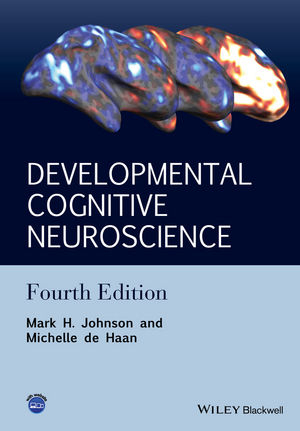
Developmental Cognitive Neuroscience (eBook)
336 Seiten
Wiley-Blackwell (Verlag)
978-1-118-93809-6 (ISBN)
- Offers a comprehensive introduction to all issues relating to the nature of brain-behaviour relationships and development
- New or greatly expanded coverage of topics such as epigenetics and gene expression, cell migration and stem cells, sleep and learning/memory, socioeconomic status and development of prefrontal cortex function
- Includes a new chapter on educational neuroscience, featuring the latest findings on the application of cognitive neuroscience methods in school-age educational contexts
- Includes a variety of student-friendly features such as chapter-end discussion, practical applications of basic research, and material on recent technological breakthroughs
Mark H. Johnson is Director of the Centre for Brain and Cognitive Development at Birkbeck College, University of London, UK. He is the author of more than 300 papers, has written or edited ten books, is an elected Fellow of several academic societies, and is a former editor-in-chief of the Wiley-Blackwell Journal of Developmental Science.
Michelle de Haan is Reader in Developmental Cognitive Neuroscience in the Institute of Child Health at University College London, UK, and Honorary Principal Neuropsychologist for Great Ormond Street Hospital for Children NHS Trust.Mark H. Johnson is Director of the Centre for Brain and Cognitive Development at Birkbeck College, University of London, UK. He is the author of more than 300 papers, has written or edited ten books, is an elected Fellow of several academic societies, and is a former editor-in-chief of the Wiley-Blackwell Journal of Developmental Science. Michelle de Haan is Reader in Developmental Cognitive Neuroscience in the Institute of Child Health at University College London, UK, and Honorary Principal Neuropsychologist for Great Ormond Street Hospital for Children NHS Trust.
List of Figures viii
List of Tables xi
Preface to the First Edition xii
Preface to the Fourth Edition xiv
Acknowledgements xv
Abbreviations xix
About the Companion Website xxi
1 The Biology of Change 1
2 Methods and Populations 17
3 From Gene to Brain 32
4 Building a Brain 43
5 Vision, Orienting, and Attention 83
6 Perceiving and Acting in a World of Objects 110
7 Perceiving and Acting in the Social World 121
8 Learning and Long-Term Memory 153
9 Language 166
10 Prefrontal Cortex, Working Memory, and Decision-Making 183
11 Cerebral Lateralization 197
12 Educational Neuroscience 205
13 Interactive Specialization 221
14 Toward an Integrated Developmental Cognitive Neuroscience 240
References 251
Index 300
"Johnson and de Haan continue to provide an excellent overview of a vast and fast moving field. The new method for imaging the human brain while at rest provides support for the interactive specialization framework that organizes the research reported in this new edition."
Michael Posner, Professor Emeritus, Department of Psychology and Institute of Neuroscience, University of Oregon
"Johnson and de Haan have done an incredible service to the field with this important book. It's a must for experts and students alike. It is extremely thorough and well-written, covering an interdisciplinary field in a way that is both informative and exciting."
Dima Amso, Associate Professor, Department of Cognitive, Linguistic, and Psychological Sciences, Brown University
"A tour de force for those interested in the intersection of brain and cognitive development; beautifully written, thoroughly researched and highly accessible. This landmark book should be required reading for anyone interested in the intersection of brain, development and cognition."
Charles A. Nelson III, Professor of Pediatrics and Neuroscience, Harvard Medical School, Harvard Graduate School of Education and Boston Children's Hospital
Acknowledgements
Figure 1.2 © Mark H. Johnson
Figure 1.3 from Waddington, C.H. (1975). The Evolution of an Evolutionist. New York, USA: Cornell University Press. Copyright © 1975 by C.H. Waddington. Reprinted by permission of the author's estate.
Figure 2.1 reprinted from Neuroscience and Biobehavioural Reviews, 34(3), Lloyd-Fox, S., Blasi, A., & Elwell, C.E., Illuminating the developing brain: The past, present and future of functional near infrared spectroscopy, 269–284, Copyright (2010), with permission from Elsevier.
Figure 2.2 reprinted by permission of Michael Crabtree.
Figure 2.3 reprinted by permission of Sarah Lloyd-Fox.
Figure 2.4 images courtesy of Dr. Sean Deoni, King's College London and Advanced Baby Imaging Lab, Brown University.
Figure 3.1 from Stiles, J. (2008). The fundamentals of brain development: Integrating nature and nurture. Cambridge, MA.: Harvard University Press. Copyright © 2008 by the President and Fellows of Harvard College. Reprinted by permission of the publisher.
Figure 3.2 from Cornish, K. M., Turk, J., Wilding, J., Sudhalter, V., Munir, F., Kooy F., & Hagerman R. (2004). Annotation: Deconstructing the attention in Fragile X syndrome: A developmental neuropsychological approach. Journal of Child Psychology and Psychiatry, 45, 1042–1053. Copyright © 2004, John Wiley and Sons. Reprinted by permission of the publisher.
Figure 4.1 © Mark H. Johnson.
Figure 4.2 © Mark H. Johnson.
Figure 4.3 from Maxwell Cowan, W. (1979). The development of the brain. Reproduced with permission. Copyright © 1979 Scientific American, Inc. All rights reserved.
Figure 4.4 images courtesy of the Centre for NeuroImaging Sciences, King’s College London and the Birkbeck-UCL Centre for NeuroImaging.
Figure 4.5 from LeRoy Conel, J. (1939–1967). The postnatal development of the human cerebral cortex, vols I–VIII. Cambridge, MA: Harvard University Press, Copyright © 1939, 1941, 1947, 1951, 1955, 1959, 1963, 1967 by the President and Fellows of Harvard College. Reprinted by permission of the publisher.
Figure 4.6 from Stiles, J. (2008). The fundamentals of brain development: Integrating nature and nurture. Cambridge, MA: Harvard University Press. Copyright © 2008 by the President and Fellows of Harvard College. Reprinted by permission of the publisher.
Figure 4.7 from Fransson, P., Skiöld, B., Horsch, S., Nordell, A., Blennow, M., Lagercrantz H., and Aden, U. (2007). Resting-state networks in the infant brain. Proceedings of the National Academy of Sciences, USA, 104, 15531–15536. Copyright (2007) National Academy of Sciences, U.S.A. Reprinted by permission of the publisher.
Figure 4.8 reprinted from Trends in Cognitive Sciences, 9, Casey, B. J., Tottenham, N., Liston, C., & Durston, S., Imaging the developing brain: what have we learned about cognitive development?, 104–110, Copyright (2005), with permission from Elsevier. Which is a modified version of a figure from Thompson, R. A. and Nelson, C. A. (2001). Developmental science and the media: Early brain development. American Psychologist, 56, 5–15.
Figure 4.9 © Mark H. Johnson.
Figure 4.10 reprinted from Trends in Neuroscience, 29, Toga, A.W., Thompson, P. M., & Sowell, E. R., Mapping brain maturation, 148–158, Copyright (2006), with permission from Elsevier.
Figure 4.11 reprinted by permission from Macmillan Publishers Ltd: Nature, 440, 676–679, copyright (2006).
Figure 4.12 from Brodmann, K. in Brodal, A. (Eds.) (1981). Neurological Anatomy in Relation to Clinical Medicine, 3rd Ed, Oxford University Press, Figure 12.2 from p. 791. By permission of Oxford University Press, USA.
Figure 4.13 from Rakic, P. (1987). Intrinsic and extrinsic determinants of neocortical parcellation: a radial unit model. In Rakic P. and Singer W. (Eds.) Neurobiology of Neocortex. Report of the Dahelm workshop on Neurobiology of Neocortex, Berlin, 17–22 May 1987. Copyright © 1987, John Wiley and Sons. Reprinted by permission of the publisher.
Figure 4.14 reprinted from Trends in the Neurosciences, 12(10), O'Leary, D.D.M., Do cortical areas emerge from a protocortex?, 400–406, Copyright (1989), with permission from Elsevier.
Figure 4.15 from Chugani, H. T., Phelps M. E., and Mazziotta J. C. (1987). Positron emission tomography study of human brain functional development. Annals of Neurology, 22(4), 487–497. Copyright © 1987 American Neurological Association. Reproduced by permission of John Wiley & Sons.
Figure 5.1 from Atkinson, J. and Braddick, O. (2003). Neurobiological models of normal and abnormal visual development, in de Haan, M. and Johnson, M. H. (Eds.), The Cognitive Neuroscience of Development, Hove, UK: Psychology Press. Copyright © 2003 Psychology Press. Reproduced by permission of the publisher.
Figure 5.2 from Miller, K. D, Keller J. B., and Stryker M. P. (1989). Ocular dominance column development: analysis and simulation, Science, 245, 605–615. Reprinted with permission of the AAAS.
Figure 5.3 from Held, R. (1985). Binocular vision: behavioural and neuronal development. In Mehler, J. and Fox, R. (Eds.), Neonate Cognition: Beyond the Blooming, Buzzing Confusion. Copyright © 1985 Prof. Richard Held. Reproduced by permission of the author.
Figure 5.4 from Schiller, P. H. (1998). The neural control of visually guided eye movements. In Richards, J. E. (Eds.), Cognitive Neuroscience of Attention. Copyright © 1998 Lawrence Erlbaum Associates, Inc., Mahwah, New Jersey. Reproduced by permission of the publisher.
Figure 5.5 reprinted from Journal of Experimental Child Psychology, 59, Gilmore, R. O., & Johnson, M. H., Working memory in infancy: Six-month-olds' performance on two versions of the oculomotor delayed response task, 397–418, Copyright (1995), with permission from Elsevier.
Figure 5.6 from Csibra, G., Tucker, L. A., Volein, A., and Johnson, M.H. (2000). Cortical development and saccade planning: The ontogeny of the spike potential, NeuroReport, 11, 1069–1073. Reproduced by permission of Lippincott Williams & Wilkins.
Figure 5.7 © Mark H. Johnson.
Figure 5.8 from Richards, J. E. and Casey, B. J. (1991). Heart rate variability during attention phases in young infants. Psychophysiology, 28(1), 43–53. Copyright © 2007, John Wiley and Sons. Reprinted by permission of the publisher.
Figure 6.1 from Goodale, M. A., Jacobson, L. S., Milner, A. D., and Perrett, D. I. (1994). The nature and limits of orientation and pattern processing supporting visuomotor control in a visual form agnosic. Journal of Cognitive Neuroscience, 6(1), 43–56. Copyright © 1994, Massachusetts Institute of Technology. Reprinted by permission of MIT Press Journals.
Figure 6.2 from Mareschal, D., Plunkett, K., and Harris, P. (1999). A computational and neuropsychological account of object- oriented behaviours in infancy. Developmental Science, 2, 306–317. Blackwell Publishers Ltd. 1999. Reproduced by permission of the publisher.
Figure 6.3 from Kaufman, J., Csibra, G., & Johnson, M. H. (2003). Representing occluded objects in the human infant brain. Proceedings of the Royal Society B: Biology Letters, 270/S2, 140–143. Reproduced by permission of the Royal Society and the authors.
Figure 7.1 © Mark H. Johnson.
Figure 7.2 from Johnson, M. H. and Morton, J. (1991). Biology and cognitive development: The case of face recognition. Oxford: Blackwell. Reprinted by permission of John Wiley and Sons.
Figure 7.3 from Bednar, J. A., & Miikkulainen, R. (2003). Learning innate face preferences, Neural Computation, 15(7), 1525–1557. Copyright © 2003 by the Massachusetts Institute of Technology. Additional Credit: Goren, C. C., Sarty, M., and Wu, P. Y .K. (1975). Visual following and pattern discrimination of face-like stimuli by newborn infants, Pediatrics, 56, 544–549 and Johnson, M. H. and Morton, J. (1991). Biology and Cognitive Development: The Case of Face Recognition, Oxford: Blackwell Publishing, Figure 2.3, p. 31. Reproduced by permission of John Wiley and Sons.
Figure 7.4 © Mark H. Johnson.
Figure 7.5 from Johnson, M. H. (2005). Sub-cortical face processing. Nature Reviews Neuroscience, 6, 766–774. Reprinted by permission of Nature Publishing Group.
Figure 7.6 from Scherf, K. S., Behrmann, M., Humphreys, K., and Luna, B. (2007). Visual category-selectivity for faces, places and objects emerges along different developmental trajectories. Developmental Science, 10, F15–F30. Copyright © 2007, John Wiley and Sons. Reprinted by permission of the publisher.
Figure 7.7 from Farroni, T., Johnson, M. H., Brockbank, M., and Simion, F. (2000). Infants’ use of gaze direction to cue attention: The importance of...
| Erscheint lt. Verlag | 24.4.2015 |
|---|---|
| Sprache | englisch |
| Themenwelt | Geisteswissenschaften ► Psychologie ► Allgemeine Psychologie |
| Geisteswissenschaften ► Psychologie ► Biopsychologie / Neurowissenschaften | |
| Geisteswissenschaften ► Psychologie ► Entwicklungspsychologie | |
| Geisteswissenschaften ► Psychologie ► Verhaltenstherapie | |
| Schlagworte | Cognitive Neuropsychology & Cognitive Neuroscience • Developmental Psychology • educational neuroscience, brain development, brain behaviour, adolescent development, brain development, cognitive development, cognition, education, epigenetics, gene expression, prefrontal cortex, brain, developmental psychology, cognitive psychology • Entwicklungspsychologie • Kognitive Neuropsychologie u. Neurowissenschaft • Kognitive Psychologie • Psychologie • Psychology |
| ISBN-10 | 1-118-93809-7 / 1118938097 |
| ISBN-13 | 978-1-118-93809-6 / 9781118938096 |
| Informationen gemäß Produktsicherheitsverordnung (GPSR) | |
| Haben Sie eine Frage zum Produkt? |
 EPUB (Adobe DRM)
Kopierschutz: Adobe-DRM
Adobe-DRM ist ein Kopierschutz, der das eBook vor Mißbrauch schützen soll. Dabei wird das eBook bereits beim Download auf Ihre persönliche Adobe-ID autorisiert. Lesen können Sie das eBook dann nur auf den Geräten, welche ebenfalls auf Ihre Adobe-ID registriert sind.
Details zum Adobe-DRM
Dateiformat: EPUB (Electronic Publication)
EPUB ist ein offener Standard für eBooks und eignet sich besonders zur Darstellung von Belletristik und Sachbüchern. Der Fließtext wird dynamisch an die Display- und Schriftgröße angepasst. Auch für mobile Lesegeräte ist EPUB daher gut geeignet.
Systemvoraussetzungen:
PC/Mac: Mit einem PC oder Mac können Sie dieses eBook lesen. Sie benötigen eine
eReader: Dieses eBook kann mit (fast) allen eBook-Readern gelesen werden. Mit dem amazon-Kindle ist es aber nicht kompatibel.
Smartphone/Tablet: Egal ob Apple oder Android, dieses eBook können Sie lesen. Sie benötigen eine
Geräteliste und zusätzliche Hinweise
Buying eBooks from abroad
For tax law reasons we can sell eBooks just within Germany and Switzerland. Regrettably we cannot fulfill eBook-orders from other countries.
aus dem Bereich