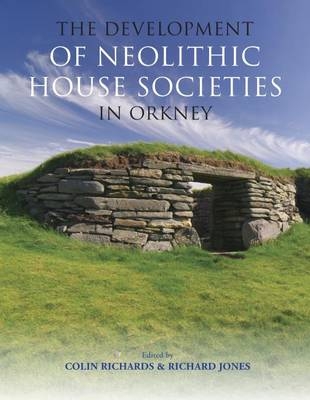
The Development of Neolithic House Societies in Orkney
Windgather Press (Verlag)
978-1-909686-89-2 (ISBN)
- Titel ist leider vergriffen;
keine Neuauflage - Artikel merken
Considering that Orkney is a group of relatively small islands lying off the northeast coast of the Scottish mainland, its wealth of Neolithic archaeology is truly extraordinary. An assortment of houses, chambered cairns, stone circles, standing stones and passage graves provides an unusually comprehensive range of archaeological and architectural contexts. Yet, in the early 1990s, there was a noticeable imbalance between 4th and 3rd millennium cal BC evidence, with house structures, and ‘villages’ being well represented in the latter but minimally in the former. As elsewhere in the British Isles, the archaeological visibility of the 4th millennium cal BC in Orkney tends to be dominated by the monumental presence of chambered cairns or tombs.
In the 1970s Claude Lévi-Strauss conceived of a form of social organisation based upon the‘house’ – sociétés à maisons – in order to provide a classification for social groups that appeared not to conform to established anthropological kinship structures. In this approach, the anchor point is the ‘house’, understood as a conceptual resource that is a consequence of a strategy of constructing and legitimising identities under ever shifting social conditions.
Drawing on the results of an extensive programme of fieldwork in the Bay of Firth, Mainland Orkney, the text explores the idea that the physical appearance of the house is a potent resource for materialising the dichotomous alliance and descent principles apparent in the archaeological evidence for the early and later Neolithic of Orkney. It argues that some of the insights made by Lévi-Strauss in his basic formulation of sociétésà maisons are extremely relevant to interpreting the archaeological evidence and providing the parameters for a ‘social’ narrative of the material changes occurring in Orkney between the 4th and 2nd millennia cal BC.
The major excavations undertaken during the Cuween-Wideford Landscape Project provided an unprecedented depth and variety of evidence for Neolithic occupation, bridging the gap between domestic and ceremonial architecture and form, exploring the transition from wood to stone and relationships between the living and the dead and the role of material culture. The results are described and discussed in detail here, enabling tracing of the development and fragmentation of sociétés à maisons over a 1500 year period of Northern Isles prehistory.
Colin Richards is Professor of World Prehistory in the Deaprtment of Archaeology at the University of Manchester where he mainly specialises in Neolithic archaeology, architecture and monumentality and ethnoarchaeology, with specific interests in Orkney and Easter Island. Richard Jones is honorary lecturer in the Department of Archaeology, University of Glasgow. In addition to his work in Orkney his main research interests in archaeological geophysics , pottery technology and function, and non-destructive techniques in the analysis of archaeological materials.
Contents
Acknowledgements
List of figures
List of tables
Chapter 1 Images of Neolithic Orkney
Colin Richards & Richard Jones
Chapter 2 Houses of the dead: the transition from wood to stone architecture at Wideford Hill
Colin Richards & Andrew Meirion Jones
Chapter 3 Place in the Past: an early Neolithic house at the Knowes of Trotty barrow cemetery, Harray, Mainland, Orkney
Jane Downes, Paul Sharman, Adrian Challands, Patricia D. Voke, Erika Guttmann-Bond, Jo McKenzie & Roy Towers
Chapter 4 Local histories of passage grave building communities: Brae of Smerquoy
Christopher Gee, Colin Richards & Mairi Robertson
Chapter 5 Good neighbours: Stonehall Knoll, Stonehall Meadow and Stonehall Farm
Colin Richards, Kenny Brophy, Martin Carruthers, Andrew Meirion Jones, Richard Jones & Siân Jones
Chapter 6 At Stonehall Farm, late Neolithic life is rubbish
Colin Richards, Richard Jones, Adrian Challands, Andrew Meirion Jones, Siân Jones & Tom Muir
Chapter 7 The settlement of Crossiecrown: the Grey and Red Houses
Nick Card, Jane Downes, Richard Jones, Colin Richards & Antonia Thomas
Chapter 8 Reorientating the dead of Crossiecrown: Quanterness & Ramberry Head
Rebecca Crozier, Colin Richards, Judith Robertson & Adrian Challands
Chapter 9 Materializing Neolithic house societies in Orkney, introducing Varme Dale & Muckquoy
Colin Richards, Jane Downes, Christopher Gee & Stephen Carter
Chapter 10 Beside the ocean of time: a chronology of Neolithic burial monuments and houses in Orkney
Seren Griffiths
Chapter 11 Prehistoric pottery from sites within the Bay of Firth: Stonehall, Crossiecrown, Wideford Hill, Brae of Smerquoy, Muckquoy, Ramberry and Knowes of Trotty
Andrew Meirion Jones, Richard Jones, Gemma Tully, Lara Maritan, Anna Mukherjee, Richard Evershed, Ann MacSween, Colin Richards & Roy Towers
Chapter 12 Flaked lithic artefacts from Neolithic sites around the Bay of Firth: Wideford Hill, Knowes of Trotty, Brae of Smerquoy, Stonehall, Crossiecrown and Ramberry
Hugo Anderson-Whymark, Richard Chatterton, Mark Edmonds & Caroline Wickham-Jones
Chapter 13 The coarse stone from Neolithic sites around the Bay of Firth: Stonehall, Wideford Hill, Crossiecrown, Knowes of Trotty and Brae of Smerquoy
Ann Clarke
Chapter 13.1 The pumice from Crossiecrown and Stonehall
Ann Clarke
Chapter 13.2 The black stone bead from Structure 1, Stonehall Farm
Alison Sheridan
Chapter 13.3 The haematite and iron-rich materials
Effie Photos-Jones, Arlene Isbister & Richard Jones
Chapter 14 The animal remains from Stonehall and Crossiecrown
Catherine Smith & Julie A. Roberts
Chapter 14.1 The human remains from Ramberry Head
David Lawrence
Chapter 15 Bay of Firth environments from the 2nd to 4th millennium BC: the evidence from Stonehall, Wideford Hill, Crossiecrown, Knowes of Trotty, Varme Dale & Brae of Smerquoy
Jennifer Miller, Susan Ramsay, Diane Alldrit & Joanna Bending
Chapter 15.1 Palaeoenvironmental investigation of a peat core from Stonehall Susan Ramsay, Stephanie Leigh-Johnson & Rupert Housley
Chapter 16 The micromorphological analysis of soils and site contexts at Stonehall and Crossiecrown
Charles A. I. French
Bibliography
Index
| Erscheint lt. Verlag | 29.2.2016 |
|---|---|
| Co-Autor | Stuart Jeffrey |
| Zusatzinfo | full colour |
| Verlagsort | Macclesfield |
| Sprache | englisch |
| Maße | 215 x 279 mm |
| Themenwelt | Geisteswissenschaften ► Archäologie |
| Geschichte ► Allgemeine Geschichte ► Vor- und Frühgeschichte | |
| ISBN-10 | 1-909686-89-1 / 1909686891 |
| ISBN-13 | 978-1-909686-89-2 / 9781909686892 |
| Zustand | Neuware |
| Informationen gemäß Produktsicherheitsverordnung (GPSR) | |
| Haben Sie eine Frage zum Produkt? |
aus dem Bereich