


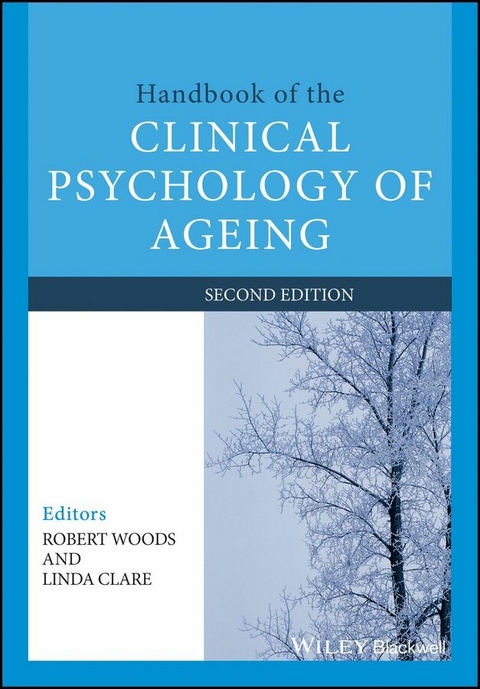
Handbook of the Clinical Psychology of Ageing (eBook)
John Wiley & Sons (Verlag)
9781119056997 (ISBN)
Bob Woods has been practising as a clinical psychologist with older people for over 30 years. His interest was activated prior to clinical training by his experience working initially as a clinical psychologist in Newcastle-upon-Tyne, where the is a strong tradition of old age research. Subsequently he combined extensive clinical work with older people with academic appointment at the Institute of Psychiatry. London and University College, London. In both settings he was heavily involved in training clinical psychologist in work with older people. in 1996, he was appointed to the first Chair in Clinical Psychology with Older People in the UK, At the University of Wales, Bangor, where he is also-Co-Director of the Dementia services Development Centre Wales, Academic Directors of the North Wales Clinical Psychology Programme and Director of the Wales Dementias Neurodegenerative Diseases Research Network (NEURODEM Cymru). His publications have included over 120 books, book chapters and journal articles, and his research has included studies on both depression and dementia,on assessment and therapeutic approaches, and on family caregivers. he received the Alzheimer's Society therapeutic approaches, and on family caregivers. He received the Alzhemier's Society therapeutic approaches, and on family caregivers. He received the Alzheimer's Society twenty-fifth Anniversary Award 'for contributions to the Alzheimer's Society and to the twenty-fifth Anniversary Award 'for contributions to the Alzheimer's Society and to the cause of people with dementia and their careers in 2004, and the British Psychological Society Division of Clinical Psychology M B Shapiro Award, for a career contribution to the development of clinical psychology in 2006. He continues o work clinically, in the Bangor memory Clinic.
Linda Clare is a chartered clinical psychologist and clinical neuropsychologist. She holds the post of Reader in Psychology at the School of Psychology, University of Wales Bangor, interests focus primarily on the theoretical and clinical issues surrounding awareness and self-concept, the impact of progressive cognitive impairment on self and relationship and the potential of neuropsychological rehabilitation for people with early-stage dementia. Her career and recent research focuses on the application of cognitive rehabilitation for people with early stage dementia, on the implications and impact of differing feels of people with early sage dementia, on the implications and impact of differing levels of awareness in people with early-stage dementia, and on issue sin family caregiving. She has also published a substantial set of qualitative studies analyzing the subjective experience of dementia and the way in which both people with dementia and their family members attempt to adjust and cope at different stages of he disorder. As well as publishing over 70 journal articles, Dr Clare has coauthored a book for patients and families on coping with memory problems and has authored and coedited texts on cognitive rehabilitation in dementia and on disturbances of awareness. She currently serves as Editor for the Cochrane Dementia and Cognitive Impairment Group, is on the Editorial board of the journal Neuropsychological rehabilitation, and contributes to a number of research and professional networks. In 2003, she received the May Davidson Award from the British Psychological Society for her contribution to the development of clinical psychology.
The first authoritative reference on clinical psychology and aging, the Handbook of the Clinical Psychology of Ageing was universally regarded as a landmark publication when it was first published in 1996. Fully revised and updated, the Second Edition retains the breadth of coverage of the original, providing a complete and balanced picture of all areas of clinical research and practice with older people. Contributions from the UK, North America, Scandinavia and Australia provide a broad overview of the psychology of aging, psychological problems (including depression, anxiety, psychosis, and dementia), the current social service context, and assessment and intervention techniques.
Bob Woods has been practising as a clinical psychologist with older people for over 30 years. His interest was activated prior to clinical training by his experience working initially as a clinical psychologist in Newcastle-upon-Tyne, where the is a strong tradition of old age research. Subsequently he combined extensive clinical work with older people with academic appointment at the Institute of Psychiatry. London and University College, London. In both settings he was heavily involved in training clinical psychologist in work with older people. in 1996, he was appointed to the first Chair in Clinical Psychology with Older People in the UK, At the University of Wales, Bangor, where he is also-Co-Director of the Dementia services Development Centre Wales, Academic Directors of the North Wales Clinical Psychology Programme and Director of the Wales Dementias Neurodegenerative Diseases Research Network (NEURODEM Cymru). His publications have included over 120 books, book chapters and journal articles, and his research has included studies on both depression and dementia,on assessment and therapeutic approaches, and on family caregivers. he received the Alzheimer's Society therapeutic approaches, and on family caregivers. He received the Alzhemier's Society therapeutic approaches, and on family caregivers. He received the Alzheimer's Society twenty-fifth Anniversary Award "for contributions to the Alzheimer's Society and to the twenty-fifth Anniversary Award 'for contributions to the Alzheimer's Society and to the cause of people with dementia and their careers in 2004, and the British Psychological Society Division of Clinical Psychology M B Shapiro Award, for a career contribution to the development of clinical psychology in 2006. He continues o work clinically, in the Bangor memory Clinic. Linda Clare is a chartered clinical psychologist and clinical neuropsychologist. She holds the post of Reader in Psychology at the School of Psychology, University of Wales Bangor, interests focus primarily on the theoretical and clinical issues surrounding awareness and self-concept, the impact of progressive cognitive impairment on self and relationship and the potential of neuropsychological rehabilitation for people with early-stage dementia. Her career and recent research focuses on the application of cognitive rehabilitation for people with early stage dementia, on the implications and impact of differing feels of people with early sage dementia, on the implications and impact of differing levels of awareness in people with early-stage dementia, and on issue sin family caregiving. She has also published a substantial set of qualitative studies analyzing the subjective experience of dementia and the way in which both people with dementia and their family members attempt to adjust and cope at different stages of he disorder. As well as publishing over 70 journal articles, Dr Clare has coauthored a book for patients and families on coping with memory problems and has authored and coedited texts on cognitive rehabilitation in dementia and on disturbances of awareness. She currently serves as Editor for the Cochrane Dementia and Cognitive Impairment Group, is on the Editorial board of the journal Neuropsychological rehabilitation, and contributes to a number of research and professional networks. In 2003, she received the May Davidson Award from the British Psychological Society for her contribution to the development of clinical psychology.
About the Editors viii
List of Contributors X
Preface XV
1 Introduction
Bob Woods 1
Part One: Ageing
2 Ageing and adaptation 17
Peter G. Coleman, Ann O'Hanlon
3 Memory and cognition in ageing 33
Boo Johansson
4 Ageing and physical health 57
Valerie Morrison
5 Death, dying and bereavement 75
Jan R. Oyebode
Part Two: Psychological Problems
6 Manifestations of depression and anxiety in older adults 97
Inger Hilde Nordhus
7 Suicide and attempted suicide in later life 111
Bob Woods
8 Psychological trauma in late life: conceptualization, assessment and treatment 121
Steve Davies
9 Late onset psychosis 133
Linda Clare, Sharon Giblin
10 Dementia as a biopsychosocial condition: implications for practice and research 145
Muma Downs, Linda Clare, Elizabeth Anderson
11 The Neuropsychology of dementia: Alzheimer's disease and other neurodegenerative disorders 161
Robin G. Morris
12 Parkinson's disease 185
Peter Hobson
13 Stroke 201
Janet Cockbum
14 Sleep and insomnia in later life 219
Kevin Morgan
Part Three: Service Context
15 Values and diversity in working with older people 237
Kate Allan
16 Family caregiving: research and clinical intervention 255
Steven H. Zarit, Anne B. Edwards
17 Residential care 289
Bob Woods
18 Elder abuse and neglect 311
Alice Campbell Reay, Kevin D. Browne
19 Primary care psychology and older people 323
Gita E. Bhutani
20 Ageing, dementia and people with intellectual disability 34
Chris Oliver, Dawn Adams, Sunny Kalsy
21 Palliative care for people with dementia: principles, practice and implications 351
Katherine Froggatt, Murna Downs, Neil Small
Part Four: Assessment
22 Neuropsychological assessment of the older person 363
Linda Clare
23 Assessing function, behaviour and need 385
Adrienne Little, Breid Doherty
24 Assessing mood, wellbeing and quality of life 415
Bob Woods
25 Capacity and consent: empowering and protecting vulnerable older people 429
Charles Twining
Part Five: Intervention
26 The socio-cultural context in understanding older adults: contextual adult lifespan theory for adapting psychotherapy 439
Bob G. Knight, Cecilia Poon
27 Cognitive behaviour therapy with older people 457
Ken Laidlaw
28 Psychoanalysis and old age 473
Rachael Davenhill
29 Systemic interventions and older people 489
Alison Roper-Hall
30 Neuropsychological rehabilitation in later life: special considerations, contributions and future directions 505
Margaret Crossley
31 Psychological interventions with people with dementia 523
Bob Woods, Linda Clare
32 Interventions for family caregivers of people with dementia 549
Henry Brodaty, Karen Berman
33 Challenging behaviour in dementia: a psychosocial approach to intervention 571
Mike Bird, Esme Moniz-Cook
34 Interventions at the care team level 595
Dawn Brooker
Index
"This extremely comprehensive Handbook is an excellent reference guide to work with older people. It communicates motivation and inspiration in working with a client group that is still inevitably a "silent minority." (Ageing & Society, October 2008)
1
Introduction
Bob Woods
University of Wales Bangor, Bangor, UK
This volume marks the continuing growth and development of clinical psychology with older people. Since the first edition of this handbook was published (Woods, 1996) research activity has continued to increase in relation to all aspects of ageing. Both ‘normal’ and ‘abnormal’ aspects have been extensively studied; the area of overlap between the two has become more evident, although still not well understood. Opportunities to develop clinical psychological services for older people have been apparent in the UK and elsewhere and no longer can the contribution of clinical psychology to services for older people be seen as simply one of ‘promising potential’. There is now ample evidence of psychological practice with older people in a wide range of contexts working with most of the common problems experienced by older people and their supporters. Within the broader family of clinical psychology, work with older adults has, perhaps belatedly, achieved recognition and is less likely to be seen as a rather esoteric, minority interest.
This volume stands as witness to a remarkable degree of progress in the field. Although there remain large gaps in the evidence base for interventions with older people, there are now sufficient indications of effectiveness to underpin a number of evidence-based reviews (e.g. Gatz et al., 1998; Livingston et al., 2005; Woods & Roth, 2005) and to inform evidence-based guidelines, such as the NICE-SCIE guideline on supporting people with dementia and their carers (NICE-SCIE, 2006). The latter document includes recommendations on psychological therapies for depression and anxiety in dementia, and for psychological distress experienced by family caregivers, a psychological approach to behaviour that challenges, and psychological interventions, such as cognitive stimulation, to enhance cognition in people with mild to moderate dementia. In addition, it is recommended that a neuropsychological assessment be carried out in all cases of suspected dementia.
This volume aims to provide an up-to-date review and synthesis of theory and research evidence relevant to clinical practice. Although there are a number of chapters that specifically address issues relating to dementia, the range of psychological problems experienced by older people is addressed. A brief first section covers the key aspects of the psychology of ageing, as well as providing a health psychology perspective on the physical health problems experienced by older people. This section provides the necessary underpinning for a consideration of psychological problems in later life. Detailed discussion of important aspects of the service context for clinical psychology in later life includes primary care, residential care and the situation of people with intellectual disabilities. Two sections address the key aspects of clinical practice – assessment and intervention. A wide range of intervention approaches are discussed, for the range of psychological problems, and interventions with family care-givers are addressed in Chapter 16, based on a well-developed model of understanding and assessing the care-giving situation and also in Chapter 32, based on an analysis of the extensive evidence-base.
However, for all that has been achieved, it is important to acknowledge some of the challenges that this now-mature specialism will be likely to face in its next phase of development. These challenges arise from several interacting factors. Firstly, there is the nature of the ageing population, which will define the target group for psychological services for older people. Second, there are challenges arising from the position of older people in society, and the diverse experiences of later life that results from a society that has embraced the active older person, but where disability and dependency lead to a risk of social exclusion. Third, there are developments and pressures specifically relating to the profession of clinical psychology, including training and issues of recruitment and service development. Finally, there are personal challenges that arise in working with older people, which are by no means new, but must be encountered by each new cohort of clinical psychologists entering this field.
WHO ARE OLDER PEOPLE?
Across the world, there are an unprecedented number of older people. Taking the age of 65 as an arbitrary dividing line, in 1950 there were, according to United Nations statistics (United Nations, 2006), just under 131 million older people in the world, representing 5.2% of the total population; by 2005, there were estimated to be 477 million (7.3% of the total population), and by 2025 older people are projected to form 10.5% of the global population, with 839 million older people – a six-fold increase in 75 years.
There are differences in the overall level and rate of change between regions of the world and individual countries. In general, northern European countries were at the vanguard of population ageing, with many parts of Africa showing the smallest proportions of older people. Population ageing is now very rapid in parts of Asia. Table 1.1 shows the changes in the population of people aged 65 and over in five selected countries from 1985–2025. The UK and Sweden represent the northern European countries, which have shown relatively little change over the last 20 years, already constituting over 15% of the population in 1985. The US has also shown relatively little change in this proportion, but has yet to reach the level seen in the UK and Sweden 20 years ago. Australia has had a slightly more rapid growth, but it is in Japan where the most dramatic changes have occurred, with the proportion of older people having nearly doubled in 20 years, almost reaching 20% by 2005. This trend looks set to continue in Japan, with more modest, but clear and important, growth in the population aged 65 and over in the other selected countries too. Table 1.2 indicates the changes over the similar time period in the population aged 80 and over. In the UK and the USA, the numbers of people in this age group are projected to have doubled over the period 1985–2025. Again, Japan is showing the most dramatic rate of change, with 10% of the population projected to be aged 80 and over by the year 2025.
Table 1.1 Population (thousands) and percentage of total population, aged 65 and over in selected countries
Source: Population Division of the Department of Economic and Social Affairs of the United Nations Secretariat, World Population Prospects: The 2006 Revision and World Urbanization Prospects: The 2005 Revision, http://esa.un.org/unpp.
| UK | US | Sweden | Japan | Australia |
| 1985 | 8 578 | 28 423 | 1 491 | 12 450 | 1 588 |
| 15.2 | 11.7 | 17.9 | 10.3 | 10.1 |
| 1995 | 9 169 | 33 399 | 1 542 | 18 264 | 2 151 |
| 15.8 | 12.4 | 17.5 | 14.6 | 11.9 |
| 2005 | 9 684 | 36 751 | 1 557 | 25 255 | 2 662 |
| 16.1 | 12.3 | 17.2 | 19.7 | 13.1 |
| 2015 | 11 358 | 46 355 | 1 909 | 33 120 | 3 600 |
| 18.1 | 14.1 | 20.2 | 26.2 | 16.1 |
| 2025 | 12 986 | 63 203 | 2 155 | 35 835 | 4 788 |
| 19.9 | 17.8 | 21.9 | 29.5 | 19.6 |
Table 1.2 Population (thousands) and percentage of total population, aged 80 and over in selected countries
Source: Population Division of the Department of Economic and Social Affairs of the United Nations Secretariat, World Population Prospects: The 2006 Revision and World Urbanization Prospects: The 2005 Revision, http://esa.un.org/unpp.
| UK | US | Sweden | Japan | Australia |
| 1985 | 1 802 | 5 916 | 332 | 2 215 | 267 |
| 3.2 | 2.4 | 4.0 | 1.8 | 1.7 |
| 1995 | 2 272 | 7 565 | 411 | 3 881 | 466 |
| 3.9 | 2.8 | 4.7 | 3.1 | 2.6 |
| 2005 | 2 685 | 10 625 | 482 | 6 178 | 712 |
| 4.5 | 3.5 | 5.3 | 4.8 | 3.5 |
| 2015 | 3 049 | 11 958 | 497 | 9 849 | 944 |
| 4.9 | 3.6 | 5.3 | 7.8 | 4.2 |
| 2025 | 3 597 | 14 642 | 638 | 12 929 | 1 254 |
| 5.5 | 4.1 | 6.5 | 10.6 | 5.1 |
Typically, at present, life expectancy at birth is greater for females than males. For example, in the UK, in 2005 it was 80.7 years for women and 76.1 years for men; in Japan, it was 85.2 for women...
| Erscheint lt. Verlag | 13.4.2015 |
|---|---|
| Sprache | englisch |
| Themenwelt | Geisteswissenschaften ► Psychologie ► Entwicklungspsychologie |
| Geisteswissenschaften ► Psychologie ► Klinische Psychologie | |
| Schlagworte | Clinical psychology • depression, anxiety, psychosis, dementia, older adulthood, geriatric, older people, trauma, substance abuse, elder abuse, elder neglect, geriatricians • Klinische Psychologie • Psychologie • Psychology |
| ISBN-13 | 9781119056997 / 9781119056997 |
| Informationen gemäß Produktsicherheitsverordnung (GPSR) | |
| Haben Sie eine Frage zum Produkt? |
 EPUB (Adobe DRM)
Kopierschutz: Adobe-DRM
Adobe-DRM ist ein Kopierschutz, der das eBook vor Mißbrauch schützen soll. Dabei wird das eBook bereits beim Download auf Ihre persönliche Adobe-ID autorisiert. Lesen können Sie das eBook dann nur auf den Geräten, welche ebenfalls auf Ihre Adobe-ID registriert sind.
Details zum Adobe-DRM
Dateiformat: EPUB (Electronic Publication)
EPUB ist ein offener Standard für eBooks und eignet sich besonders zur Darstellung von Belletristik und Sachbüchern. Der Fließtext wird dynamisch an die Display- und Schriftgröße angepasst. Auch für mobile Lesegeräte ist EPUB daher gut geeignet.
Systemvoraussetzungen:
PC/Mac: Mit einem PC oder Mac können Sie dieses eBook lesen. Sie benötigen eine
eReader: Dieses eBook kann mit (fast) allen eBook-Readern gelesen werden. Mit dem amazon-Kindle ist es aber nicht kompatibel.
Smartphone/Tablet: Egal ob Apple oder Android, dieses eBook können Sie lesen. Sie benötigen eine
Geräteliste und zusätzliche Hinweise
Buying eBooks from abroad
For tax law reasons we can sell eBooks just within Germany and Switzerland. Regrettably we cannot fulfill eBook-orders from other countries.
aus dem Bereich


