


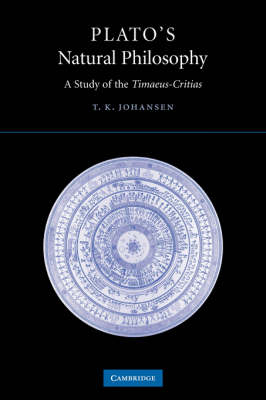
Plato's Natural Philosophy
A Study of the Timaeus-Critias
Seiten
2004
Cambridge University Press (Verlag)
978-0-521-79067-3 (ISBN)
Cambridge University Press (Verlag)
978-0-521-79067-3 (ISBN)
This book connects the accounts in Plato's dialogue the Timaeus-Critias, that of Atlantis' defeat by ancient Athens and that of the divine creation of the cosmos, through the unifying theme of teleology and shows the dialogue to be an important development in the Aristotelian tradition of natural philosophy.
Plato's dialogue the Timaeus-Critias presents two connected accounts, that of the story of Atlantis and its defeat by ancient Athens and that of the creation of the cosmos by a divine craftsman. This book offers a unified reading of the dialogue. It tackles a wide range of interpretative and philosophical issues. Topics discussed include the function of the famous Atlantis story, the notion of cosmology as 'myth' and as 'likely', and the role of God in Platonic cosmology. Other areas commented upon are Plato's concepts of 'necessity' and 'teleology', the nature of the 'receptacle', the relationship between the soul and the body, the use of perception in cosmology, and the work's peculiar monologue form. The unifying theme is teleology: Plato's attempt to show the cosmos to be organised for the good. A central lesson which emerges is that the Timaeus is closer to Aristotle's physics than previously thought.
Plato's dialogue the Timaeus-Critias presents two connected accounts, that of the story of Atlantis and its defeat by ancient Athens and that of the creation of the cosmos by a divine craftsman. This book offers a unified reading of the dialogue. It tackles a wide range of interpretative and philosophical issues. Topics discussed include the function of the famous Atlantis story, the notion of cosmology as 'myth' and as 'likely', and the role of God in Platonic cosmology. Other areas commented upon are Plato's concepts of 'necessity' and 'teleology', the nature of the 'receptacle', the relationship between the soul and the body, the use of perception in cosmology, and the work's peculiar monologue form. The unifying theme is teleology: Plato's attempt to show the cosmos to be organised for the good. A central lesson which emerges is that the Timaeus is closer to Aristotle's physics than previously thought.
Dr Thomas Kjeller Johansen is Reader in Philosophy in the University of Edinburgh. He is the author of Aristotle on the Sense-Organs (0521 583381).
Acknowledgements; Introduction: Plato's tales of teleology; 1. What is the Timaeus-Critias about?; 2. The status of the Atlantis story; 3. The status of Timaeus' account; 4. Teleology and craftsmanship; 5. Necessity and teleology; 6. Space and motion; 7. Body, soul and tripartition; 8. Perception and cosmology; 9. Dialogue and dialectic; Epilogue; Bibliography; General index; Index locorum.
| Erscheint lt. Verlag | 1.7.2004 |
|---|---|
| Verlagsort | Cambridge |
| Sprache | englisch |
| Maße | 152 x 229 mm |
| Gewicht | 510 g |
| Themenwelt | Geisteswissenschaften ► Philosophie ► Philosophie Altertum / Antike |
| ISBN-10 | 0-521-79067-0 / 0521790670 |
| ISBN-13 | 978-0-521-79067-3 / 9780521790673 |
| Zustand | Neuware |
| Informationen gemäß Produktsicherheitsverordnung (GPSR) | |
| Haben Sie eine Frage zum Produkt? |
Mehr entdecken
aus dem Bereich
aus dem Bereich
Anleitung zu einer Lektüre Mark Aurels
Buch | Hardcover (2025)
FinanzBuch Verlag
CHF 27,95
Die Philosophie der Antike als Lebensweise in der modernen Welt
Buch | Hardcover (2025)
FinanzBuch Verlag
CHF 25,20


