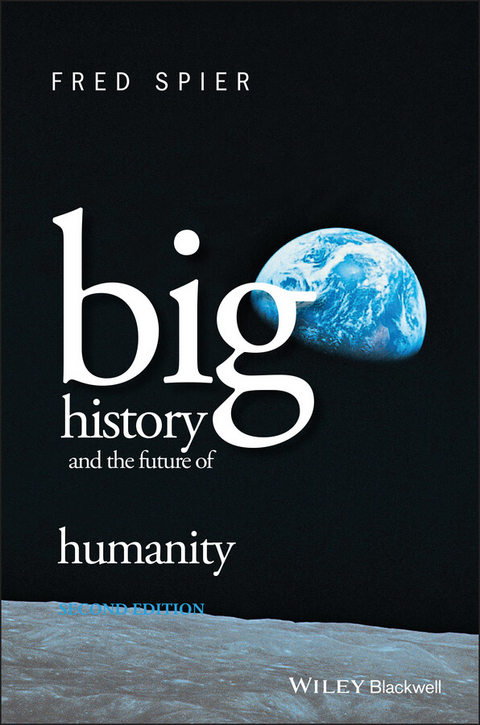
Big History and the Future of Humanity (eBook)
John Wiley & Sons (Verlag)
978-1-118-88171-2 (ISBN)
'This remains the best single attempt to theorize big history as a discipline that can link core concepts and paradigms across all historical disciplines, from cosmology to geology, from biology to human history. With additional and updated material, the Second Edition also offers a fine introduction to the history of big history and a superb introductory survey to the big history story. Essential reading for anyone interested in a rapidly evolving new field of scholarship that links the sciences and the humanities into a modern, science-based origin story.'
David Christian, Macquarie University
'Notable for its theoretic approach, this new Second Edition is both an indispensable contribution to the emerging big history narrative and a powerful university textbook. Spier defines words carefully and recognizes the limits of current knowledge, aspects of his own clear thinking.'
Cynthia Brown, Emerita, Dominican University of California
Reflecting the latest theories in the sciences and humanities, this new edition of Big History and the Future of Humanity presents an accessible and original overview of the entire sweep of history from the origins of the universe and life on Earth up to the present day. Placing the relatively brief period of human history within a much broader framework - one that considers everything from vast galaxy clusters to the tiniest sub-atomic particles - big history is an innovative theoretical approach that opens up entirely new multidisciplinary research agendas. Noted historian Fred Spier reveals how a thorough examination of patterns of complexity can offer richer insights into what the future may have in store for humanity.
The second edition includes new learning features, such as highlighted scientific concepts, an illustrative timeline and comprehensive glossary. By exploring the cumulative history from the Big Bang to the modern day, Big History and the Future of Humanity, Second Edition, sheds important historical light on where we have been - and offers a tantalizing glimpse of what lies ahead.
Fred Spier is Senior Lecturer in Big History at the University of Amsterdam. He also teaches Big History at the Eindhoven University of Technology and Amsterdam University College. He is the author of The Structure of Big History: From the Big Bang until Today (1996) and a founding member and President of the International Big History Association.
Fred Spier is Senior Lecturer in Big History at the University of Amsterdam. He also teaches Big History at the Eindhoven University of Technology and Amsterdam University College. He is the author of The Structure of Big History: From the Big Bang until Today (1996) and a founding member and President of the International Big History Association.
List of Figures viii
List of Text Boxes x
Preface and Acknowledgments xi
A Short Time Line of Big History xx
Chapter One Introduction to Big History 1
Introduction 1
Studying the Past 2
A Very Short History of Academic History 12
A Short History of Big History 18
A Historical Theory of Everything? 29
Chapter Two General Approach 42
Introduction 42
Matter and Energy 45
Complexity 48
Energy Flows and the Emergence of Complexity 54
The Goldilocks Principle 63
Chapter Three Cosmic Evolution: The Emergence of Simple Forms of Complexity 74
Introduction 74
The Big Bang: No Complexity 75
Recent Issues Concerning the Big Bang Scenario 77
The Radiation Era: The Emergence of Complexity at the Smallest Scales 80
The Matter Era: The Emergence of Complexity at Atomic and Molecular Scales 86
Galaxy Formation: The Emergence of Complexity at Larger Scales 89
The Emergence of Stars 95
Stars as Nuclear Forges 100
Chapter Four Our Cosmic Neighborhood: The Emergence of Greater Complexity 107
Introduction 107
The Galactic Habitable Zone 110
The Emergence of Our Cosmic Neighborhood 111
The Solar System Habitable Zone 116
Major Characteristics of Earth 118
Early Inner Planetary History 122
Early Earth History 125
Life Is Very Special 126
The Emergence of Life 130
Chapter Five Life on Earth: The Widening Range of Complexity 140
Life, Energy and Complexity 140
Planetary Energy Flows and Life 147
The Gaia Hypothesis 149
The Emergence of Energy Harvesting from Outside 153
The Emergence of the Biological Food Web 156
The Emergence of Multicellular Organisms 160
The Emergence of Brains and Consciousness 162
The Increase and Expansion of Biological Complexity 166
Conquest of the Land 168
Further Increasing Complexity 170
Chapter Six Early Human History: The Emergence of the Greatest Known Complexity 179
Introduction 179
What Makes Humans Different 180
Energy and Complexity 183
The Emergence of Early Humans 185
Improving Social Coordination 188
Tool Making and Brain Growth 189
Brains and Intestines 193
Fire Control 194
Migration 197
The Rise of Modern Humans 200
Early Religion 205
Chapter Seven Recent Human History: The Development of the Greatest Known Complexity 214
Introduction 214
The Agrarian Revolution 220
The Developing Agrarian Regime 229
Social Effects of the Agrarian Revolution 232
The Emergence of Agrarian Religions 234
Increasing Agricultural Complexity and Declining Untamed Complexity 235
Early State Formation 240
The Emergence of Big States 245
The Emergence of Moral Religions 247
Energy and Complexity in State Societies 251
The First Wave of Globalization 256
Industrialization: The Second Wave of Globalization 264
Informatization: The Third Wave of Globalization 271
Energy, Complexity and Goldilocks Circumstances 276
Chapter Eight Facing the Future 295
Introduction 295
A Very Short Overview of the Long Future of the Universe 299
The Future of Earth and Life 300
The Future of Humanity 301
The Availability of Matter and Energy 304
Exhaustion of Critical Resources and Growing Entropy 309
Will Humans Migrate to Other Planets? 311
Final Words 313
Index 318
PREFACE AND ACKNOWLEDGMENTS
The biggest philosophy, foundation-shaking impression was seeing the smallness of the Earth. … Even the pictures don’t do it justice, because they always have this frame around them. But when you … put your eyeball to the window of the spacecraft, you can see essentially half of the universe. … That’s a lot more black and a lot more universe than ever comes through a framed picture. … It’s not how small the Earth was, it’s just how big everything else was.
(Apollo 8 astronaut William Anders in Chaikin & Kohl (2009), p. 158)
This book is about big history, the approach to history in which the human past is placed within the framework of cosmic history, from the beginning of the universe up until life on Earth today. This book offers a fresh theoretical approach to big history that, I hope, will provide a better understanding not only of the past but also of the major challenges humanity will be facing in the near future.
My search for a theory underlying big history has been motivated by a deep concern about what humans have been doing to our living conditions on planet Earth. My environmental preoccupation, in its turn, came as a direct result of the Apollo moon flights during the late 1960s and early 1970s ce. The mission that left the most enduring impression took place in December of 1968 ce, when Apollo 8 went to the moon for the first time and orbited our celestial companion 10 times before returning to Earth. In the Netherlands, I watched their exciting black-and-white live transmissions from space, while snapping pictures with my photo camera mounted on a tripod in front of our television set. This was before the days of home video recorders or any other devices that could record television pictures. I felt that I was witnessing events of great importance, while I was not certain whether these images would be preserved or be available to me. I took pictures of the launch; of the first live broadcast from space, which included the first crude images of Earth; and of the moon’s surface as seen from lunar orbit. On our family television set, Earth from space looked like a white blob, the result of overexposure by the Apollo television camera. I was very curious to know what the astronauts were really seeing, what ‘the good Earth’ looked like from space, as Apollo 8 commander Frank Borman called our planet during the famous Christmas Eve broadcast from lunar orbit.
I did not have to wait long. Soon my family received the 10 January 1969 ce issue of Time Magazine, which showed a selection of pictures taken by the astronauts. The opening picture of its ‘lunar album’ was the famous Earthrise photo, depicted on the cover of this book, with the caption: ‘The Awesome Views from Apollo 8.’ While looking at this picture, I experienced a shock that I had never felt before and never have experienced since. Within a second, it changed my perspective of Earth beyond recognition. I tore the picture out carefully, stuck it on the wall of my room and looked at it for years. I still have this picture and treasure it greatly.
None of my education had prepared me for this new look at Earth. At school, I had received a classical Dutch – perhaps West European – education, which included Latin and ancient Greek; modern languages such as English, French and German; mathematics, physics, chemistry, geography and history. Yet these portions of discrete knowledge were never related to one another or presented from one single perspective. This had left me totally unprepared for the extraordinary sight of our blue-and-white planet surrounded by dark space, rising above the forbidding gray lunar landscape. These pictures showed for the first time how different Earth was from its cosmic surroundings.1 It also made people around the globe wonder what we were doing to our home in space. This led to an unprecedented upsurge of environmental awareness, including the establishment of the first Earth Day in 1970 ce.
The most influential environmental publication at the time was a study commissioned in 1970 ce by an independent group of intellectuals who called themselves the Club of Rome, because they had started their meetings in this ancient city. Executed at the Massachusetts Institute of Technology under the leadership of Dennis Meadows and financed by the Volkswagen Foundation, the final report was called The Limits to Growth: A Report for the Club of Rome Project on the Predicament of Mankind. It was published in many languages, including Dutch. Great attention was paid to five variables deemed important: population growth, food production, industrial production, the limited supplies of natural resources and the inevitable pollution. The resulting conclusion was that all of these factors in whatever combination would act as a brake on human well-being in the near future. Especially in the Netherlands, this study received a great deal of attention and sold very well. According to Frits Böttcher, a Dutch member of the Club of Rome, this would have been the case because the Netherlands had the highest income per hectare in the world and, as a result, was already experiencing many of the highlighted problems on a daily basis.2
While this was going on, none of the people I was surrounded by, including my teachers at secondary school and later at university, ever mentioned the profound change in perspective the pictures of Earth from space had produced, but preferred to stick to their established educational programs. Given this situation, I kept most of my thoughts and feelings to myself. Yet I began to feel what I would now describe as a most distressing disconnect. Not only was I increasingly worried about environmental problems, but I also wanted to know how humanity had gotten itself into this situation. This curiosity about human history was fueled by a paragraph in the Dutch introduction to The Limits to Growth, which stated that we would only be able to effectively change our current situation for the better if we understood how the current situation differed from those earlier periods of history that had shaped humans in a biological and cultural sense.3 At that time, academic environmental history did not yet exist, nor was I aware of any world history accounts that could help me in this respect. As a result, I began a long intellectual search for a better understanding of human history, which reached its culmination when I became familiar with big history.
For me, big history has become a wonderful way of explaining how both my own person and everything around me have come into being. In big history, any question can be addressed concerning how and why certain aspects of the present have become the way they are. Unlike any other academic discipline, big history integrates all the studies of the past into a novel and coherent perspective. In doing so, big history has provided me with a new and most satisfying connect. And judging by the large numbers of students who take big history courses every year on a voluntary basis, it may provide a similar connect for them also. Most of my students were born well after the Apollo space program had ended. For them, the moon flights are part of deep history. Since the end of the 1960s ce, however, many university courses, especially in the humanities, have not changed a great deal. As a result, many students may still be experiencing similar disconnects.
Inspired by the Earthrise photo, over the past 30 years I have striven to attain a detached overview of history with the aid of a theoretical point of view. While such an approach is extremely common within the natural sciences – natural scientists would not know how to do science in any other way – even today most historians and social scientists tend to focus on details at the expense of losing the overview. My approach to history has led to an account of human affairs on this planet that is, therefore, rather different from the more established historical narratives.
The theoretical approach to big history, which will be explained in Chapter 2, is based on the knowledge gained during my rather diverse academic career. I first completed a study of biochemistry, specializing in what was then called the ‘genetic engineering’ of plants. The promise of this type of research was that this would help boost world food production.4 Yet I kept a nagging fear that this might not be sufficient to solve the problems mentioned in The Limits to Growth report. After finishing my study of biochemistry, I therefore decided not to pursue a career in this field, even though I was offered several PhD positions. Instead, I started to drift, in an attempt to find a solution to the question of how humans had gotten themselves into their current predicament.
For about one year, I worked on a Dutch ecological enterprise called Gaiapolis. This taught me a great deal both about the Dutch ecological movement and about life in general. I also began to travel overland through Europe, the Middle East and Africa, which helped me to become a little more familiar with life in poorer areas of the world. During a train ride in the Central Sudan in 1979 ce, I met German cultural anthropologist Joachim Theis, whose balanced analyses of local Sudanese situations put me on the track of studying cultural anthropology. A good friend of mine in Leiden, the Netherlands, Leony van der Splinter, gave me a copy of US cultural anthropologist Marvin...
| Erscheint lt. Verlag | 4.3.2015 |
|---|---|
| Sprache | englisch |
| Themenwelt | Geisteswissenschaften ► Geschichte ► Allgemeines / Lexika |
| Geisteswissenschaften ► Geschichte ► Allgemeine Geschichte | |
| Schlagworte | Cosmology • Geschichte • History • Kosmologie • Physics • Physik • Weltgeschichte • World History |
| ISBN-10 | 1-118-88171-0 / 1118881710 |
| ISBN-13 | 978-1-118-88171-2 / 9781118881712 |
| Informationen gemäß Produktsicherheitsverordnung (GPSR) | |
| Haben Sie eine Frage zum Produkt? |
 EPUB (Adobe DRM)
Kopierschutz: Adobe-DRM
Adobe-DRM ist ein Kopierschutz, der das eBook vor Mißbrauch schützen soll. Dabei wird das eBook bereits beim Download auf Ihre persönliche Adobe-ID autorisiert. Lesen können Sie das eBook dann nur auf den Geräten, welche ebenfalls auf Ihre Adobe-ID registriert sind.
Details zum Adobe-DRM
Dateiformat: EPUB (Electronic Publication)
EPUB ist ein offener Standard für eBooks und eignet sich besonders zur Darstellung von Belletristik und Sachbüchern. Der Fließtext wird dynamisch an die Display- und Schriftgröße angepasst. Auch für mobile Lesegeräte ist EPUB daher gut geeignet.
Systemvoraussetzungen:
PC/Mac: Mit einem PC oder Mac können Sie dieses eBook lesen. Sie benötigen eine
eReader: Dieses eBook kann mit (fast) allen eBook-Readern gelesen werden. Mit dem amazon-Kindle ist es aber nicht kompatibel.
Smartphone/Tablet: Egal ob Apple oder Android, dieses eBook können Sie lesen. Sie benötigen eine
Geräteliste und zusätzliche Hinweise
Buying eBooks from abroad
For tax law reasons we can sell eBooks just within Germany and Switzerland. Regrettably we cannot fulfill eBook-orders from other countries.
aus dem Bereich